


 6 Min Read
Have you ever looked in the mirror and noticed a new, reddish bump on your face or shoulder? Your first thought was likely, "Oh, just another pimple," followed by the urge to reach for a spot treatment or simply wait for it to disappear. But what if that tiny mark isn't just a blemish? What if your skin is trying to tell you something more serious? Taking a moment to really look at your skin today could be the most important thing you do for your long-term health. Do you know how to tell if a spot is a passing visitor or a permanent danger? Let’s find out.
Synopsis
What are Pimples and Skin Cancer?
To understand the difference, we must first define what is happening beneath the surface of your skin.
What is a Pimple?
A pimple, medically known as acne, is a small inflammation of the skin. It occurs when your pores (tiny openings in the skin) become blocked. Each pore is connected to a sebaceous gland that produces oil (sebum). When oil, dead skin cells, and bacteria get trapped inside, the area becomes inflamed, resulting in a raised red bump, often filled with white fluid or pus.
What is Skin Cancer?
Skin cancer is the abnormal and uncontrolled growth of skin cells. It usually develops on skin that has been damaged by the sun's ultraviolet (UV) radiation. The most common early-stage types are Basal Cell Carcinoma (BCC) and Squamous Cell Carcinoma (SCC). Unlike a pimple, which is a temporary infection, skin cancer is a structural change in the DNA of your skin cells that will continue to grow unless medically treated.
What Causes These Skin Changes?
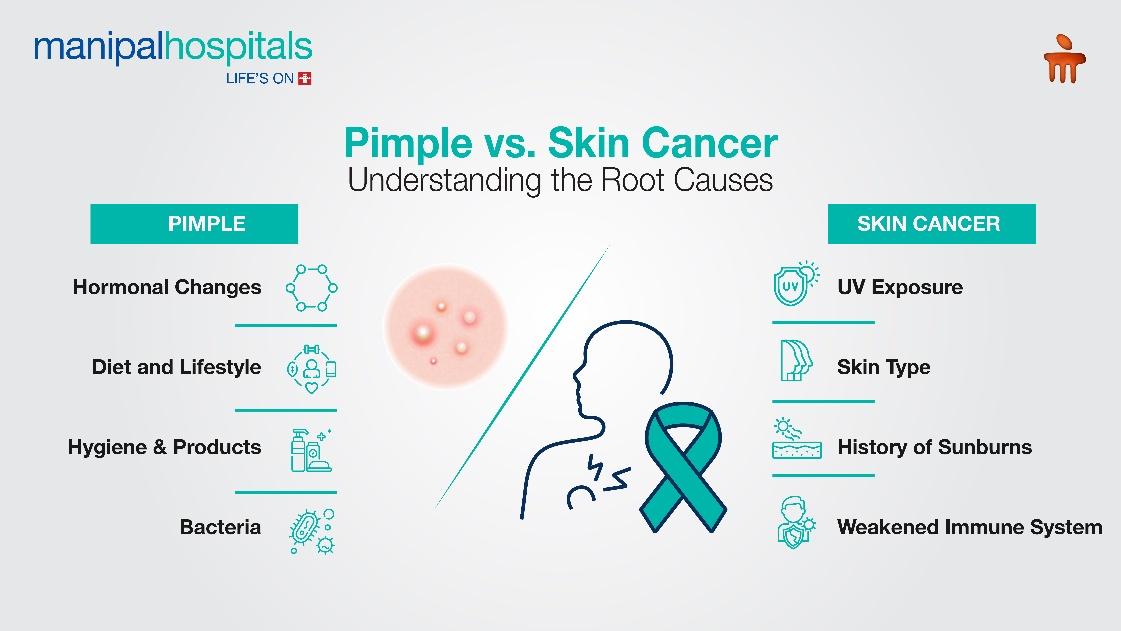
Causes of Pimples
-
Hormonal Changes: Fluctuations during puberty, pregnancy, or menstrual cycles can increase oil production.
-
Diet and Lifestyle: High-sugar diets or high stress levels can sometimes trigger breakouts.
-
Hygiene & Products: Using heavy oils or failing to wash away sweat can clog pores.
-
Bacteria: Propionibacterium acnes is a specific type of bacteria that thrives in clogged pores.
Causes of Skin Cancer
-
UV Exposure: The primary cause is long-term exposure to sunlight or tanning beds.
-
Skin Type: People with fair skin, light eyes, and freckles are at higher risk, though everyone is susceptible.
-
History of Sunburns: Even a few blistering sunburns in childhood can increase your risk later in life.
-
Weakened Immune System: A lowered immune response can make it harder for your body to repair damaged skin cells.
Identifying the Symptoms
Symptoms of a Pimple
-
Rapid Appearance: A pimple usually "pops up" overnight or over two days.
-
The "Head": Most pimples develop a white centre (pus) or a black centre (oxidised oil).
-
Pain or Tenderness: They often feel sore or "tight" when you touch them or move your facial muscles.
-
Short Lifecycle: A pimple will naturally come to a head, drain, and heal within 7 to 10 days.
Symptoms of Early-Stage Skin Cancer
-
Slow Growth: Cancerous spots grow very slowly over weeks, months, or even years.
-
Pearly or Waxy Texture: Basal cell carcinoma often looks like a shiny, flesh-coloured, or pinkish bump.
-
Scariness: Squamous cell carcinoma often feels like a rough, scaly patch that never gets smooth, even with lotion.
-
Bleeding and Scabbing: If a "pimple" bleeds easily when you wash your face or keeps scabbing over without healing, it is a major warning sign.
-
Transparent Borders: You might see tiny blood vessels (like thin red lines) inside the bump.
When to See a Doctor
Consult a dermatologist if you notice:
-
The Three-Week Rule: If a spot hasn't gone away or shown significant healing within three weeks, it is likely not a pimple.
-
A "Ghost" Sore: A sore that heals but then keeps coming back in the exact same spot.
-
Changing Moles: Any existing mole that changes colour, gets bigger, or develops irregular edges.
-
New Growths: Any new growth on the ears, nose, lips, or back of the hands, especially if you spend a lot of time outdoors.
If you're unsure whether a skin change is concerning, take our health checkup to assess your symptoms and find out whether it's time to see a dermatologist.
Treatment Options
Treatment for Pimples
-
Topical Creams: Over-the-counter creams containing Benzoyl Peroxide or Salicylic Acid help kill bacteria and clear pores.
-
Antibiotics: For severe acne, doctors may prescribe oral or topical antibiotics.
-
Lifestyle Changes: Regular cleansing, staying hydrated, and avoiding "popping" pimples to prevent scarring.
Treatment for Early-Stage Skin Cancer
-
Excision: The doctor numbs the area and surgically removes the cancerous growth and a small margin of healthy skin.
-
Cryotherapy: Using liquid nitrogen to "freeze off" the abnormal cells (common for very early, thin cancers).
-
Mohs Surgery: A specialised procedure where layers of skin are removed and examined under a microscope one by one until no cancer remains.
-
Topical Chemotherapy: For very early surface-level cancers, medicated creams can be used to kill the abnormal cells.
Conclusion
Your skin is a map of your health, and learning to read it is a vital skill. While most bumps are just your body's way of dealing with a clogged pore, the persistence of a "pimple" should never be ignored. By staying observant and practising sun safety, you can protect yourself from the long-term risks of skin cancer. Remember, a quick visit to a specialist can provide the peace of mind you deserve.
At Manipal Hospitals, our experts in the Department of Oncology provide specialised evaluation and treatment for skin cancers, including Basal Cell and Squamous Cell Carcinoma. With an emphasis on early detection and advanced diagnostic screening, we deliver personalised care plans to accurately distinguish malignancies from common skin conditions. Our team ensures timely intervention and comprehensive management, helping patients achieve successful outcomes and a better quality of life.
FAQ's
You can try it for a few days, but if the spot doesn't react or becomes more irritated, stop immediately. Pimple creams will not cure skin cancer, and delaying professional help is not recommended.
No. It can also appear as a flat, red, scaly patch, a firm red nodule, or even a scar-like lesion in an area where you haven't had an injury.
Sometimes. While many skin cancers are painless, some patients report a persistent "itchy" or "tingling" sensation in the affected area.
Yes. While melanin provides some protection, people with darker skin tones can still develop skin cancer. It is often found in less-exposed areas like the soles of the feet or under the fingernails.
A biopsy involves taking a tiny sample of the skin. While a small mark may remain, it is much smaller and less noticeable than the scar that would result from removing a cancer that has been allowed to grow large.
Share this article on:






