6 Min Read
Hearing plays a crucial role in a child's speech, language, cognitive, and social development. When hearing difficulties go unnoticed, they can significantly impact communication skills, academic performance, and overall quality of life. Hearing loss in children can occur at birth or develop later due to various medical conditions, infections, injuries, or genetic factors. Early identification and timely intervention are essential to ensure children receive the support and treatment they need to thrive.
Synopsis
Understanding Hearing Loss In Children
Hearing loss in children refers to a partial or complete inability to hear sounds in one or both ears. The severity can range from mild hearing impairment to complete loss of hearing. Depending on the cause and extent of damage, hearing loss may be temporary or permanent and is of three types:
-
Conductive hearing loss: Caused by problems in the outer or middle ear that prevent sound from reaching the inner ear.
-
Sensorineural hearing loss: Results from damage to the inner ear or auditory nerve and is often permanent.
-
Mixed hearing loss: A combination of conductive and sensorineural hearing loss.
Some children may also experience sudden hearing loss in one ear, which requires immediate medical evaluation to prevent long-term complications.
Early Signs Of Hearing Impairment In Children
Recognising the early signs of hearing impairment is critical for timely diagnosis and treatment. Symptoms may vary depending on the child's age.
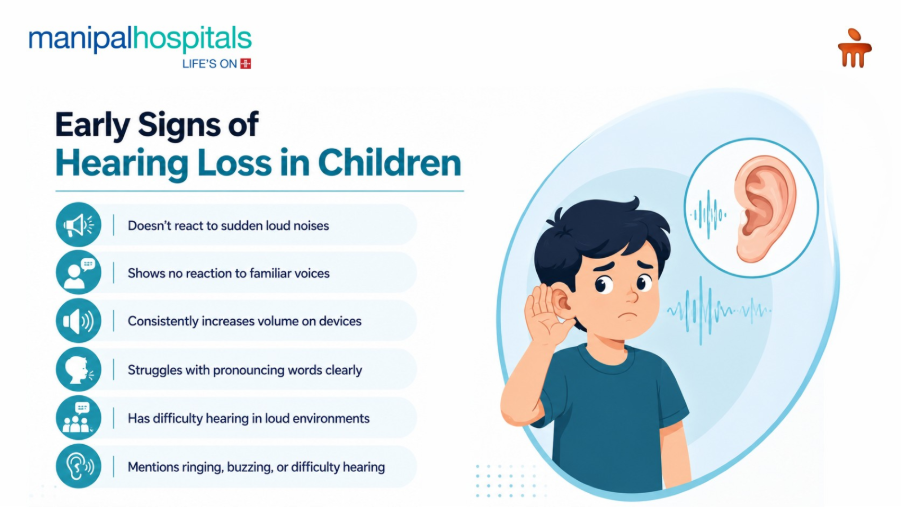
Signs in infants
-
Does not startle at loud noises
-
Does not turn toward sounds by six months of age
-
Does not respond to their name by one year
-
Delayed babbling or speech development
-
Limited reaction to familiar voices
Signs in toddlers and preschoolers
-
Delayed speech and language development
-
Difficulty understanding simple instructions
-
Turning up the volume of television or devices excessively
-
Poor pronunciation of words
Signs in school-age children
-
Difficulty following classroom discussions
-
Poor academic performance
-
Trouble hearing in noisy environments
-
Social withdrawal or frustration during conversations
-
Complaints of ringing in the ears or hearing difficulties
Causes Of Hearing Loss In Children
Several factors can contribute to hearing loss in children. Some common causes include:
Genetic factors
Inherited conditions are among the leading causes of permanent hearing impairment in children. Hearing loss may be present at birth or develop gradually over time.
Infections
Certain infections during pregnancy, such as rubella, cytomegalovirus (CMV), and toxoplasmosis, can affect the development of a baby`s auditory system and lead to hearing loss. In childhood, infections such as meningitis, measles, and mumps can damage the inner ear or auditory nerve, resulting in temporary or permanent hearing impairment.
Ear infections
Middle ear (otitis media) infections are common in children and can cause fluid build-up behind the eardrum, making it difficult for sound to travel effectively through the ear. While most cases resolve with appropriate treatment, recurrent or untreated infections may damage the eardrum, middle-ear structures, or hearing mechanisms over time.
Premature birth and birth complications
Babies born prematurely or those who experience complications during the birth are at a higher risk of hearing loss. Factors such as low birth weight, oxygen deprivation, severe jaundice, infections, or the need for intensive neonatal care can affect the development and functioning of the auditory system.
Exposure to loud noise
Repeated exposure to loud sounds can cause hearing damage treatment concerns later in life. Protecting children from excessive noise is important for maintaining healthy hearing.
Treatment Options For Hearing Loss In Children
The treatment approach depends on the cause and severity of hearing loss. An ENT department provides specialized evaluation, diagnosis, and treatment for hearing loss in children
Medical treatment
For hearing loss caused by infection, fluid buildup, or inflammation, treatment may involve antibiotics, anti-inflammatory medications, or procedures to address the underlying condition. In some children with recurrent middle ear infections or persistent fluid buildup, a minor surgical procedure called grommet (ear tube) insertion may be recommended to improve drainage and restore hearing.
Hearing aids
Children with mild to severe hearing impairment may benefit from hearing aids that amplify sounds and make speech easier to hear and understand. By improving access to sounds during critical developmental years, hearing aids can support speech and language development, enhance communication skills, improve classroom learning, and encourage social interaction.
Speech and language therapy
Early speech therapy helps children develop communication skills and supports language development.
Hearing damage treatment
When hearing damage is identified early, healthcare providers may recommend therapies, assistive devices, or medical interventions to maximise hearing potential and minimise developmental delays.
Management of sudden hearing loss in one ear
Sudden hearing loss in one ear is considered a medical emergency. Prompt evaluation and treatment can improve the chances of recovery. Depending on the cause, treatment may include medications, monitoring, or specialised hearing rehabilitation.
Cochlear Implants: A Life-changing Solution
For children with profound hearing deafness or severe sensorineural hearing loss who receive limited benefit from hearing aids, cochlear implants may offer highly effective solution.
What Is A Cochlear Implant?
A cochlear implant is an advanced electronic device that bypasses damaged portions of the inner ear and directly stimulates the auditory nerve. Unlike hearing aids, which amplify sounds, cochlear implants convert sound into electrical signals that the brain interprets signals that the brain interprets a hearing.
The Cochlear Implant Procedure
The procedure involves surgically placing the implant under the skin behind the ear. After healing, the external processor is fitted and programmed according to the child's hearing needs.
The process typically includes:
-
Hearing assessment and candidacy evaluation
-
Surgical implantation
-
Activation of the device
-
Ongoing auditory and speech rehabilitation
When should you see a doctor?
Parents should seek prompt medical attention if their child:
-
Does not respond consistently to sounds or voices
-
Shows delayed speech or language development
-
Frequently asks others to repeat themselves
-
Turns up the volume of electronic devices excessively
-
Experience sudden hearing loss in one ear
-
Complains of ringing in the ears or ear pain
-
Displays difficulties at school that may be linked to hearing problems
Conclusion
Hearing loss in children can have a lasting effect on speech, learning, and social development. However, recognising the signs early and seeking appropriate medical care can make a significant difference. From hearing aids to cochlear implants, modern treatment options offer hope and improved quality of life for children with hearing impairment. Whether you suspect a hearing issue or simply want to monitor your child’s hearing, our ENT experts at Manipal Hospitals are here to help. They will offer precise solutions and expert guidance to protect your child’s ear health.
FAQ's
The outcome depends on the cause. Some forms of hearing loss can be treated medically, while others may require hearing aids or cochlear implants.
Hearing loss can often be detected shortly after birth through newborn hearing screening tests.
Possible causes include infections, trauma, inflammation, or inner ear disorders. Immediate medical evaluation is recommended.
Whether your child has severe to profound hearing loss and whether hearing aids provide sufficient benefit.
Yes. Cochlear implantation is a well-established procedure and has helped many children develop better hearing and communication skills when combined with rehabilitation support.
Share this article on: