9 Min Read
Breast cancer treatment has evolved significantly over the last two decades, giving women more personalised and effective surgical options than ever before. One of the most important decisions many patients face is whether to undergo breast conserving surgery or a mastectomy. While both procedures aim to remove cancer and improve long-term survival, the right choice depends on several medical, emotional, cosmetic, and lifestyle factors.
Understanding the difference between breast conserving surgery vs mastectomy can help patients feel more informed, confident, and prepared during their treatment journey. Modern advancements in breast cancer surgery now focus not only on cancer removal but also on preserving quality of life, body image, and emotional wellbeing.
If you or a loved one has recently been diagnosed with breast cancer, this guide explains everything you need to know about breast conserving surgery, mastectomy, recovery, benefits, risks, eligibility, and long-term outcomes.
Synopsis
- What Is Breast Conserving Surgery?
- What Is a Mastectomy?
- Breast Conserving Surgery vs Mastectomy: Understanding the Difference
- Lumpectomy vs Mastectomy: Which Offers Better Survival?
- Who Is Eligible for Breast Conserving Surgery?
- Advantages of Breast Conserving Surgery
- Potential Risks of Breast Conserving Surgery
- Recovery After Breast Conserving Surgery
- What Happens During Breast Conserving Surgery?
- Breast Conserving Surgery and Radiation Therapy
- Advanced Breast Cancer Surgery in Delhi
- Questions to Ask Before Choosing Breast Conserving Surgery vs Mastectomy
- Lifestyle Changes After Breast Cancer Surgery
- Why Early Detection Matters
- Final Thoughts
What Is Breast Conserving Surgery?
Breast conserving surgery is a procedure designed to remove the cancerous tumour while preserving as much healthy breast tissue as possible. It is commonly referred to as a lumpectomy, partial mastectomy, or wide local excision.
Unlike complete breast removal, breast conserving surgery focuses on targeted tumour removal along with a margin of surrounding healthy tissue to reduce the risk of recurrence.
Today, breast conserving surgery is considered one of the most preferred treatment approaches for eligible patients with early-stage breast cancer because it combines excellent cancer control with improved cosmetic outcomes.
Key Goals of Breast Conserving Surgery
-
Remove the tumour completely
-
Preserve the natural appearance of the breast
-
Maintain breast sensation and body confidence where possible
-
Reduce emotional distress associated with full breast removal
-
Deliver survival outcomes comparable to mastectomy in selected patients
Our oncologists in Delhi carefully assess tumour size, tumour location, breast size, lymph node involvement, genetic risk, and overall health before recommending breast conserving surgery.
What Is a Mastectomy?
A mastectomy is a breast cancer surgery procedure that involves removing the entire breast tissue. Depending on the stage and type of cancer, surrounding lymph nodes, skin, or chest muscles may also be removed.
A mastectomy may be recommended when:
-
The tumour is large relative to breast size
-
There are multiple tumours in different areas of the breast
-
Radiation therapy is not suitable
-
There is a high genetic risk of recurrence
-
Previous breast conserving surgery did not achieve clear margins
-
The patient prefers complete breast removal for peace of mind
Modern breast cancer surgery techniques also allow reconstructive procedures either immediately or later to restore breast shape and symmetry.
Breast Conserving Surgery vs Mastectomy: Understanding the Difference
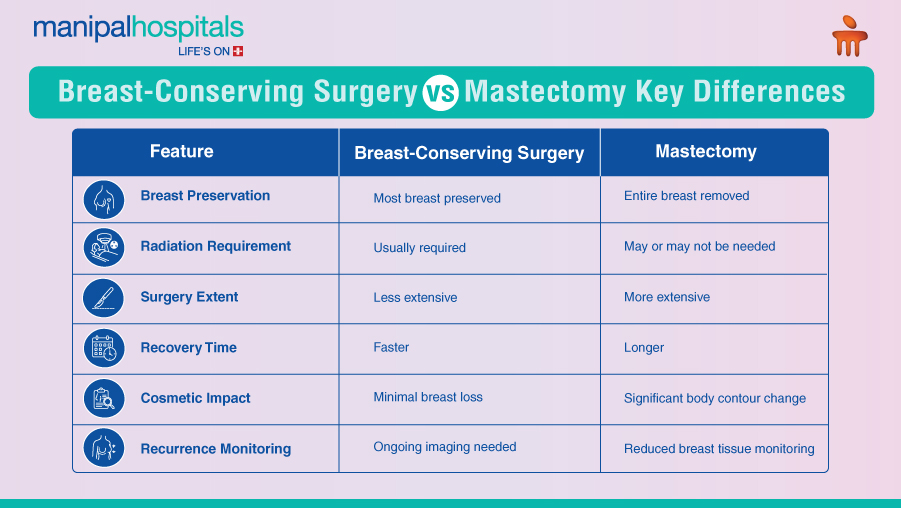
The debate around breast conserving surgery vs mastectomy is common among newly diagnosed patients. Both procedures can be highly effective, but the choice should always be individualised.
Breast Conserving Surgery
-
Removes only the tumour and surrounding tissue
-
Preserves most of the breast
-
Usually followed by radiation therapy
-
Shorter surgical recovery
-
Better cosmetic preservation
-
May offer improved psychological comfort for some patients
Mastectomy
-
Removes the entire breast
-
May or may not require radiation afterwards
-
Can reduce recurrence risk in some high-risk patients
-
Longer recovery in extensive surgeries
-
Often chosen in advanced or multifocal cancers
Research shows that for many early-stage cancers, breast conserving surgery combined with radiation therapy can provide survival outcomes similar to mastectomy.
Lumpectomy vs Mastectomy: Which Offers Better Survival?
One of the most searched topics online is lumpectomy vs mastectomy survival rates. Several global studies have shown that breast conserving surgery followed by radiation can be just as effective as mastectomy for appropriately selected patients.
However, survival depends on multiple factors, including:
-
Cancer stage
-
Tumour biology
-
Hormone receptor status
-
HER2 status
-
Lymph node involvement
-
Timely diagnosis
-
Overall treatment plan
This is why treatment should always be guided by a multidisciplinary cancer team.
Our oncologists in Delhi use advanced imaging, pathology review, tumour board discussions, and precision-based treatment planning to determine the most suitable breast cancer surgery option.
Who Is Eligible for Breast Conserving Surgery?
Not every patient is an ideal candidate for breast conserving surgery. Proper evaluation is essential.
You May Be Suitable for Breast Conserving Surgery If:
-
The cancer is detected early
-
The tumour is small relative to breast size
-
There is only one tumour area
-
Clear surgical margins are achievable
-
Radiation therapy is medically suitable
-
There are no widespread calcium deposits across the breast
You May Need a Mastectomy If:
-
The tumour is very large
-
Multiple tumours are present
-
Cancer recurs after previous treatment
-
Radiation cannot be administered safely
-
There is a strong hereditary breast cancer risk
Choosing between breast conserving surgery vs mastectomy should involve detailed discussions with specialists, family members, and support systems.
Advantages of Breast Conserving Surgery
Breast conserving surgery has become increasingly popular because it offers several emotional, cosmetic, and physical advantages.
1. Preserves Natural Breast Appearance
One of the biggest advantages of breast conserving surgery is that most of the breast remains intact, helping patients maintain their body image and confidence.
2. Less Extensive Surgery
Compared with mastectomy, breast conserving surgery is generally less invasive and involves shorter hospital stays.
3. Faster Physical Recovery
Many patients return to normal daily activities sooner after breast conserving surgery.
4. Improved Psychological Wellbeing
Preserving the breast can help reduce anxiety, depression, and emotional trauma associated with cancer treatment.
5. Comparable Survival in Early Breast Cancer
For eligible patients, breast conserving surgery offers survival rates comparable to mastectomy when combined with radiation therapy.
Our cancer doctor in Delhi explains the long-term outcomes, cosmetic expectations, and recurrence risks in detail before finalising a surgical plan.
Potential Risks of Breast Conserving Surgery
Although breast conserving surgery is highly effective, it may still involve certain risks.
Possible Complications Include:
-
Bleeding
-
Infection
-
Pain or tenderness
-
Breast shape asymmetry
-
Fluid accumulation
-
Need for repeat surgery if margins are unclear
-
Radiation-related side effects
Understanding these possibilities beforehand helps patients make informed decisions.
Recovery After Breast Conserving Surgery
Recovery after breast conserving surgery is usually smoother than recovery after extensive breast removal.
Typical Recovery Timeline
First Few Days
-
Mild pain and swelling
-
Fatigue after anaesthesia
-
Temporary arm stiffness
First Few Weeks
-
Gradual return to regular movement
-
Wound healing improves
-
Light physical activities resume
Long-Term Recovery
-
Radiation therapy may continue for several weeks
-
Regular follow-ups remain essential
-
Lifestyle modifications support recovery
Patients are usually encouraged to perform arm exercises, maintain healthy nutrition, and attend scheduled follow-up appointments.
Our oncologists in Delhi also emphasise rehabilitation, emotional support, survivorship counselling, and long-term monitoring after breast cancer surgery.
What Happens During Breast Conserving Surgery?
Understanding the procedure can reduce fear and anxiety before surgery.
Before Surgery
Patients undergo:
-
Imaging tests
-
Blood investigations
-
Anaesthesia evaluation
-
Surgical planning
-
Tumour localisation, if necessary
During Surgery
The surgeon:
-
Removes the tumour
-
Removes a surrounding safety margin
-
May remove sentinel lymph nodes for testing
-
Preserves as much healthy tissue as possible
After Surgery
-
The tissue is examined under a microscope to confirm whether all cancer cells have been removed.
-
If margins are not clear, an additional surgery may occasionally be required.
Breast Conserving Surgery and Radiation Therapy
Radiation therapy is commonly recommended after breast conserving surgery because it helps destroy microscopic cancer cells that may remain in the breast.
Radiation significantly reduces recurrence risk and improves long-term treatment success.
Common Radiation Side Effects
-
Mild skin redness
-
Temporary breast swelling
-
Skin sensitivity
Most side effects improve gradually after treatment completion.
Emotional Factors in Choosing Breast Cancer Surgery
The emotional impact of breast cancer surgery can be profound.
Many women choosing between lumpectomy vs mastectomy worry about:
-
Cancer recurrence
-
Body image changes
-
Femininity and confidence
-
Relationship concerns
-
Future screenings
-
Long-term quality of life
Psychological counselling and support groups can play an important role in emotional recovery.
Open communication with family and specialists often helps patients feel more empowered during decision-making.
Advanced Breast Cancer Surgery in Delhi
Modern breast cancer surgery in Delhi now includes highly advanced surgical techniques focused on precision, safety, aesthetics, and faster recovery.
Key advancements include:
-
Oncoplastic breast conserving surgery
-
Sentinel lymph node biopsy
-
Scar-minimising surgical approaches
-
Breast reconstruction options
-
Image-guided tumour localisation
-
Personalised cancer treatment planning
These innovations have improved both survival outcomes and cosmetic satisfaction for patients.
Our oncologists in Delhi use evidence-based protocols and multidisciplinary expertise to create individualised breast cancer treatment pathways.
Questions to Ask Before Choosing Breast Conserving Surgery vs Mastectomy
Before deciding on breast cancer surgery, patients should discuss:
-
Am I eligible for breast conserving surgery?
-
What are my recurrence risks?
-
Will I need radiation therapy?
-
What cosmetic outcome can I expect?
-
Will reconstruction be necessary?
-
How long is recovery likely to take?
-
What follow-up care is required?
Having clarity on these questions can make treatment decisions less overwhelming.
Lifestyle Changes After Breast Cancer Surgery
Long-term recovery after breast cancer surgery involves more than wound healing.
Healthy lifestyle measures can improve overall wellbeing and reduce future health risks.
Recommended Lifestyle Habits
-
Maintain a healthy body weight
-
Stay physically active
-
Limit alcohol intake
-
Stop smoking
-
Follow a balanced diet
-
Attend regular cancer screenings
-
Manage stress effectively
Survivorship care is an important part of modern cancer management.
Why Early Detection Matters
Early diagnosis remains one of the strongest factors influencing successful breast cancer treatment outcomes.
Women should never ignore symptoms such as:
-
Nipple discharge
-
Skin dimpling
-
Breast swelling
-
Persistent breast pain
-
Changes in breast shape
-
Nipple inversion
Prompt medical evaluation increases the chances of successful breast conserving surgery and less aggressive treatment.
Final Thoughts
Choosing between breast conserving surgery vs mastectomy is a deeply personal decision that should balance medical safety, emotional wellbeing, cosmetic expectations, and long-term quality of life.
For many women with early-stage disease, breast conserving surgery offers an excellent combination of cancer control, breast preservation, and faster recovery. However, mastectomy may still be the best option in certain complex or high-risk situations.
The most important step is seeking expert guidance early and discussing every available treatment option in detail.
With modern advancements in breast cancer surgery in Delhi, patients today have access to highly personalised treatment strategies designed to improve survival while preserving dignity, confidence, and quality of life.
FAQ's
Both procedures are considered safe and effective. For many early-stage breast cancers, breast conserving surgery combined with radiation offers survival outcomes comparable to mastectomy.
The goal of breast conserving surgery is complete tumour removal with clear margins. Additional treatment, such as radiation therapy, helps reduce recurrence risk further.
Most patients recover within a few weeks, although complete healing and radiation therapy may take longer.
There is a possibility of recurrence after any breast cancer surgery. Regular follow-up care and recommended treatments help minimise this risk.
There is no universal answer. The best option depends on cancer stage, tumour size, genetics, personal preferences, and overall medical condition.
Share this article on: