


 5 Min Read
Golfer’s elbow also medically known as Medial Epicondylitis may sound like a condition that only affects athletes, but it can happen to anyone who repeatedly uses their wrist, forearm, or grip strength. Simple daily activities like lifting, typing, or manual work can gradually strain the tendons inside the elbow, leading to pain and stiffness. The good news is that with the right care and treatment, most people recover fully without long-term issues.
Synopsis
What is Golfer’s Elbow?
Medial epicondylitis is a condition where the tendons on the inner side of the elbow become irritated and inflamed due to repeated use of the forearm muscles.
This condition happens when the arm and wrist are used too much in repeated movements. The muscles in the forearm are connected to the elbow by strong bands called tendons, which help us grip, lift, and move the wrist. When these same movements are done again and again, the tendons get extra pressure and small strain builds up over time. This leads to irritation and makes the arm feel weak and uncomfortable during simple activities like holding or lifting objects.
Causes of Golfer’s Elbow
Golfer’s elbow develops mainly due to repeated stress on the forearm muscles and tendons. Over time, this strain leads to tiny tears and inflammation near the inner side of the elbow.
-
Repetitive wrist and finger movements:
Doing the same hand or wrist actions again and again (like typing or gripping) can overload the tendons.
-
Improper lifting techniques:
Lifting weights or objects incorrectly puts extra pressure on the elbow muscles.
-
Sports activities (golf, tennis, throwing sports):
Frequent swinging or throwing motions can strain the inner elbow tendons.
-
Manual labour or heavy tool use:
Jobs that involve continuous gripping, hammering, or tool handling increase the risk.
-
Weak forearm muscles:
If the muscles are not strong enough, tendons get overworked more easily, leading to injury.
Symptoms of Golfer’s Elbow
Golfer’s elbow develops gradually, and the symptoms mainly affect the inner side of the elbow and forearm. These signs often become worse with repeated hand or wrist use.
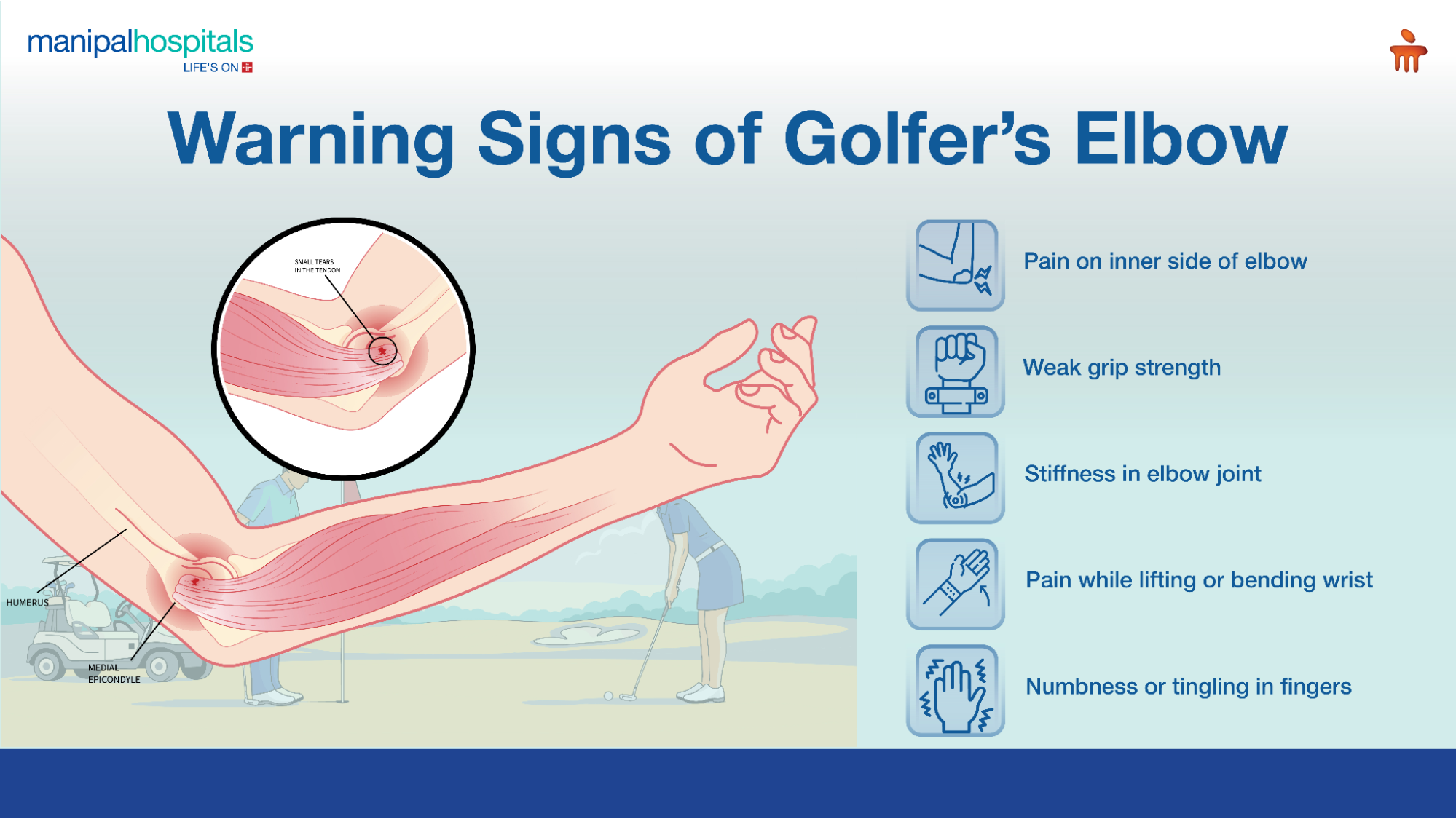
-
Pain on the inner side of the elbow:
A common early sign, where you feel soreness or sharp pain on the inside part of the elbow.
-
Weak grip strength:
You may find it difficult to hold objects firmly, as the forearm muscles become strained.
-
Stiffness in the elbow joint:
The elbow may feel tight or less flexible, especially after rest or inactivity.
-
Pain while lifting or bending the wrist:
Simple activities like lifting a bag or bending the wrist can trigger discomfort.
-
Numbness or tingling in fingers (in some cases):
Some people may feel a “pins and needles” sensation if nearby nerves are affected.
When to See a Doctor?
Golfer’s elbow often improves with rest and simple care, but in some cases, medical attention is necessary to prevent it from becoming a long-term problem.
-
Pain lasts more than a few weeks:
If the pain does not reduce even after rest and home care, it may indicate ongoing tendon inflammation that needs treatment.
-
Symptoms worsen despite rest:
If discomfort increases instead of improving, it suggests the condition is progressing and should not be ignored.
-
Weak grip affects daily activities:
Difficulty holding objects, lifting items, or performing routine tasks is a sign that the muscles and tendons are significantly affected.
Medical Treatments for Golfer’s Elbow
When golfer’s elbow pain does not improve with rest or home care, doctors may recommend medical treatments to reduce inflammation, restore strength, and support healing.
-
Pain relief medications: Anti-inflammatory medicines help reduce pain, swelling, and discomfort in the affected elbow.
-
Physiotherapy: A structured exercise program helps strengthen the forearm muscles, improve flexibility, and restore normal movement of the elbow.
-
Steroid injections: In moderate to severe cases, injections are used to quickly reduce inflammation and provide short-term pain relief.
-
Advanced therapies: Treatments like shockwave therapy may be used to stimulate healing in damaged tendons and improve recovery.
-
Surgery (rare cases): Surgery is considered only when all other treatments fail and the pain becomes long-lasting or severely affects daily life.
Home Remedies for Golfer’s Elbow
These are the first steps for mild to moderate symptoms and help in early recovery:
-
Rest: Avoid activities that cause pain to give the tendons time to heal.
-
Ice therapy: Apply an ice pack for 15–20 minutes a few times a day to reduce swelling and pain.
-
Activity modification: Reduce repetitive wrist or gripping movements that trigger discomfort.
-
Stretching exercises: Gentle forearm stretches help improve flexibility and reduce stiffness.
-
Use of support strap: A forearm brace can reduce strain on the affected tendon during daily activities.
Conclusion
Golfer’s elbow is not a permanent problem, and in most cases, it heals well with timely care. When the condition is identified early and managed with rest, physiotherapy, and appropriate medical treatment if needed, the pain reduces and normal arm strength gradually returns. The most important step is to pay attention to early symptoms and avoid ignoring ongoing discomfort. Early action helps prevent the condition from becoming chronic and ensures a faster, smoother recovery.
At Manipal Hospitals, our experienced specialists at the Department of Orthopaedics provide comprehensive evaluation, accurate diagnosis, and effective treatment for golfer’s elbow to relieve pain, restore forearm strength, and improve overall arm function for long-term recovery and mobility
FAQ's
Golfer’s elbow symptoms include pain on the inner side of the elbow, weak grip strength, stiffness, pain while lifting or bending the wrist, and sometimes tingling or numbness in the fingers.
Golfers elbow causes mainly include repetitive wrist movements, overuse of forearm muscles, improper lifting techniques, sports like golf or tennis, manual labour, and weak forearm muscles.
Golfers elbow healing time usually ranges from a few weeks to a few months, depending on how early treatment begins and how strictly rest and physiotherapy are followed.
Golfers elbow recovery time is typically 6 to 12 weeks for mild cases, but severe or long-standing cases may take several months to fully recover, especially if medical treatment is required.
Share this article on:






