


 8 Min Read
When doctors suspect a serious health condition, imaging tests often play a crucial role in diagnosis. One of the most used imaging tools is a computed tomography (CT) scan.
A CT scan provides detailed cross-sectional images of the body`s organs, tissues, and blood vessels. These images can reveal abnormalities that may indicate the presence of cancer. However, understanding what a CT scan can and cannot do is important for accurate diagnosis and treatment planning. However, can a CT scan detect cancer? A CT scan is extremely important in detecting cancer, but it is not always definitive on its own
Synopsis
How CT scan work for diagnosing cancer?
CT imaging has an essential role in cancer care, as it helps to detect and stage a tumour and assess how a patient responds to treatment. It is usually performed before surgery to determine the exact location and size of the tumour. CT imaging also plays a role in planning radiotherapy for cancer treatment.
A CT scan for cancer diagnosis is carried out by positioning the patient on a table that moves through a scanner, which captures cross-sectional images of different body parts.
This provides detailed cross-sectional images of bones, organs, and tissues. Compared to routine X-rays, CT scans provide clearer images and help diagnose cancers. It may also be done to monitor the effectiveness of treatment during follow-up.
This method helps determine the site and size of the tumour and assess its relationship to adjacent organs and nearby structures.
Can cancer be detected in CT scan results?
Yes, cancer can be detected in a CT scan. It generates detailed images of the internal organs within the body and helps the physician look for the presence of abnormal growths or tumours. Scans detect cancers even before the symptoms start showing, especially in the lungs, liver, and colons.
CT scan detects the possible spread cancer to tissues or lymph nodes around the tumour. A 3D CT scans can also help assess the size, shape, and location of tumours. Early detection of cancer through CT scans may offer patients several better treatment options and outcomes.
Types of CT scan
Some of the common types of CT scans are:
3D CT
A 3D CT scan accurately identifies tumour locations, checks if cancer has spread to other areas, and evaluates treatment effectiveness. Sometimes it offers clearer, more detailed images than an MRI or ultrasound.
3D CT Angiography
Three-dimensional CT angiography (3D-CTA) is commonly used to diagnose tumours, heart conditions, and other medical issues. This technique provides clear images of small blood vessels and helps in detecting vascular injuries for more accurate diagnoses and improved treatment options.
Additionally, 3D-CTA is often used as an initial imaging test to check for blood vessel problems in people with unexplained bleeding around the brain.
Large bore CT scanner/Radiation therapy with simulation
This CT scanner produces detailed images of the body to help doctors plan radiation therapy. It helps them target the treatment area accurately while reducing exposure to healthy tissue.
It locates abnormalities to guide radiation therapy, customises treatment based on the changing breathing patterns of patients, and accommodates different patients' sizes and positions.
Each session typically takes 15-30 minutes, including the time needed for patient positioning and equipment setup.
Multidetector CT Scanner
Multidetector CT (MDCT) is an advanced CT technology that captures detailed images quickly. These images can be combined to create 3D views, allowing doctors to examine the body from different angles.
MDCT scanners perform much faster and capture more extended scan areas or thinner slices as needed.
PET-CT Scan
A Positron Emission Tomography (PET) scan is an imaging test that uses a small amount of radioactive tracer to show how tissues and organs are functioning. It helps doctors identify areas of abnormal activity, such as cancer cells, which often use more energy than normal cells.
PET-CT combines PET and CT imaging in a single scan. The CT scan provides detailed images of the body`s structures, while the PET scan highlights areas of increased metabolic activity. Together they help doctors detect, stage, and monitor cancer more accurately.
Types of cancers commonly detected in CT scans
CT scans are commonly used to diagnose different types of cancer. In rare cases, it may also be used to screen high-risk individuals for cancer. For instance, a CT scan for lung cancer is recommended for people who have been smoking for more than 20 years or have a family history of lung cancer and fall under the high-risk category.
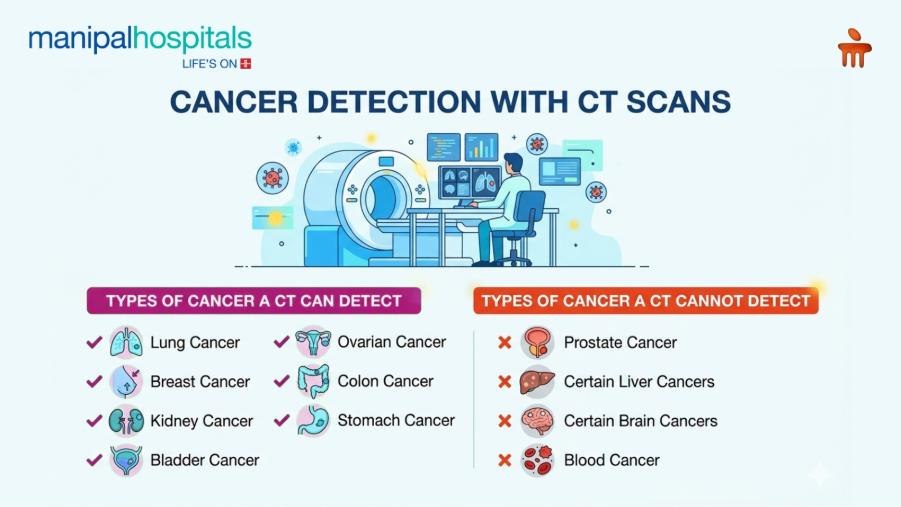
Since a CT scan for cancer provides a clearer view than an X-ray, it is easy to distinguish tumours from other lung tissues. This is critical for accurate and timely diagnosis of lung cancer. Another instance would be that of breast cancer. A CT scan for breast cancer can help determine the extent of the disease's spread to different parts of the body. Other cancer types that can be detected or diagnosed with CT imaging include kidney cancer, bladder cancer, ovarian cancer, colon cancer, stomach cancer, and more.
Few cancers are difficult to detect through CT imaging, and in such cases, other tests, such as MRI, PET scan, or biopsy, will be recommended. Cancers that cannot be diagnosed through CT scan include prostate cancer, uterine cancer, certain liver cancers, certain brain cancers, blood cancer, and bone cancers. For these cancers, CT imaging may be recommended to determine the extent of the disease's spread (metastasis).
Limitations of CT scans in detecting certain cancers
-
Early detection: cancers that are in very early stages cannot be detected by CT scans. Especially in cancers of the ovary, liver, or prostate, small lesions are not easy to identify.
-
Low-contrast lesions: As imaging depends on contrast in tissues, cancers occurring in soft tissues with low contrast appear to be less clear and can lead to a missed diagnosis.
-
Sensitivity of bone marrow: For cancers like multiple myeloma, slight changes in the bone marrow often don't appear on a CT scan. In such cases, other tests are recommended to confirm the diagnosis.
-
Failure to differentiate the types of tumours: A CT scan for cancer can show the presence of a mass but cannot differentiate between a benign or malignant mass. This could lead to unnecessary tests before arriving at a conclusive diagnosis.
-
Radiation exposure risks: CT scans increase radiation exposure; hence, they can only be used occasionally to check patients, especially young patients and those with cancers that need constant monitoring.
-
False positives or false negatives: Because of the overlapping structures in tissues, false positives or negative results may sometimes occur in a CT image for cancer.
The Importance Of CT Scans In Early Cancer Detection
CT scans play an important role in finding cancer early, often before any symptoms appear. They provide detailed images of the inside of the body, helping doctors spot unusual changes or growths that may need further investigation.
Early detection can make a big difference, as many cancers are easier to treat when found at an early stage. CT scans also help doctors understand the size and location of a tumour, allowing them to plan the most appropriate treatment. Although CT scans cannot detect every type of cancer, they are a valuable tool in diagnosing, monitoring and managing many cancers, helping patients receive timely care and improving treatment outcomes.
Conclusion
CT scans aid in cancer diagnosis, staging, treatment planning, and treatment monitoring. It assists in diagnosing various cancers, such as certain abdominal cancers, lung cancer, kidney cancer, ovarian cancer, and pancreatic cancer. However, CT scans have certain disadvantages, such as radiation exposure and the inability to detect cancer at early stages. If a CT scan reveals any abnormal findings, our expert oncologists at Manipal Hospitals can help you with further evaluation and appropriate treatment options.
FAQ's
Although a CT scan assists doctors in detecting the presence and size of abnormal masses in the body, in many cases it may not confirm the presence of cancer.
Although CT scans assist in the diagnosis of cancer and the staging of the disease, they have a certain limitations. The limitations include the inability to detect early-stage cancer and the inability to detect early-stage cancer and the inability to differentiate between different tumour types.
All imagining techniques, such as X-rays, ultrasounds, CT scans, have their own advantages and disadvantages. The choice of imaging techniques depends upon the type and location of the tumour and the availability of the other methods to diagnose cancer.
Both MRI and CT scans have their own advantages and disadvantages. The choice of using any of them depends upon tumours type and location. For instance, an MRI is preferred for diagnosing soft tissue tumour's, while a CT scan is used for bone-related cancers.
Yes. Cancer may be missed on a CT scan, especially cancers in early stages or low-contrast lesions.
Share this article on:






