6 Min Read
At Manipal Hospitals, we understand that facing a heart condition can be daunting. When it comes to aortic valve disease, the thought of traditional open-heart surgery can be particularly intimidating. Fortunately, advancements in medical science offer less invasive, highly effective alternatives. One such groundbreaking innovation is the TAVI procedure, also known as TAVR. This guide aims to demystify Transcatheter Aortic Valve Replacement (TAVR/TAVI), providing you with comprehensive, patient-centric information to help you understand this life-changing treatment option.
Synopsis
- Understanding Aortic Stenosis: The Need for TAVI/TAVR
- What is TAVI/TAVR? A Revolution in Heart Valve Replacement
- Who is a candidate for TAVI/TAVR?
- TAVI vs. Open-Heart Surgery: A Comparative Look
- The TAVI/TAVR Journey at Manipal Hospitals
- Care Essentials: Do's and Don'ts After TAVI/TAVR
- Benefits of Choosing TAVI/TAVR at Manipal Hospitals
Understanding Aortic Stenosis: The Need for TAVI/TAVR
The aortic valve is a crucial gateway from your heart's main pumping chamber (left ventricle) to your body. Over time, this valve can narrow and stiffen – a condition known as aortic stenosis. When severe, aortic stenosis restricts blood flow, forcing your heart to work harder, leading to symptoms like shortness of breath, chest pain, fatigue, and fainting. If left untreated, severe aortic stenosis can be life-threatening.
Historically, the only definitive treatment for severe aortic stenosis was open-heart surgery to replace the damaged valve. While highly effective, this major operation involves opening the chest, stopping the heart, and connecting the patient to a heart-lung machine. For many patients, especially those who are elderly or have other health conditions, this traditional surgery carries significant risks.
What is TAVI/TAVR? A Revolution in Heart Valve Replacement
TAVI (Transcatheter Aortic Valve Implantation) or TAVR (Transcatheter Aortic Valve Replacement) refers to the same revolutionary, minimally invasive heart procedure. It offers a viable alternative for patients with severe aortic stenosis who are considered high-risk or intermediate-risk for conventional open-heart surgery, and increasingly, for lower-risk patients as well. Instead of surgical removal, a new valve is delivered to the heart via a catheter, often inserted through a small incision in the leg artery.
During a TAVI procedure, a specialist cardiac team guides a new, collapsible artificial heart valve, usually made of bovine or porcine tissue, through a catheter. This catheter is typically inserted into an artery in the groin (femoral artery) and advanced up to the heart. Once in position, the new valve is precisely deployed within the diseased native aortic valve. It then expands, pushing aside the old valve leaflets and immediately taking over the function of controlling blood flow. The procedure typically takes 1-2 hours.
The innovation behind TAVI/TAVR has transformed patient outcomes. Clinical studies show that the TAVI procedure boasts an impressive success rate, often exceeding 95%, in effectively replacing the aortic valve and improving heart function.
Who is a candidate for TAVI/TAVR?
Patient selection for TAVR heart surgery is a comprehensive process involving a multidisciplinary team of cardiologists, cardiac surgeons, and imaging specialists. Factors considered include:
-
Severity of aortic stenosis
-
Overall health and other medical conditions
-
Age
-
Risk level for traditional open-heart surgery
-
Anatomical suitability for the transcatheter approach
At Manipal Hospitals, our experts conduct a thorough evaluation to determine if TAVI/TAVR is the safest and most effective treatment option for you.
TAVI vs. Open-Heart Surgery: A Comparative Look
The choice between TAVI vs open heart surgery is a critical one, tailored to individual patient needs and risk profiles. Here’s a brief comparison:
-
Open-Heart Surgery: Involves a large incision in the chest, sternum division, and often requires a heart-lung machine. It’s a highly effective and durable option, particularly for younger, lower-risk patients.
-
TAVI/TAVR: A minimally invasive approach, typically involving a small incision (often in the groin) and a catheter to deliver the new valve. This procedure bypasses the need for open-chest surgery and a heart-lung machine, leading to quicker recovery times.
For patients who are older or have co-existing health conditions, the reduced invasiveness of TAVI/TAVR means significantly lower risks of complications, shorter hospital stays, and a faster return to daily activities. Studies have shown that patients undergoing TAVI often have hospital stays reduced by 50% compared to traditional surgery, with many discharged within 2-3 days.
The TAVI/TAVR Journey at Manipal Hospitals
At Manipal Hospitals, your journey through TAVI/TAVR is supported by cutting-edge technology and a compassionate team of specialists. Our state-of-the-art facilities ensure precise diagnostics, expert procedural execution, and dedicated post-procedure care.
Understanding Transcatheter Aortic Valve Replacement Cost
We understand that the transcatheter aortic valve replacement cost is a significant consideration for many patients and their families. The cost can vary depending on individual patient needs, the specific type of valve used, hospital stay duration, and other factors. At Manipal Hospitals, we are committed to transparency and providing accessible, high-quality care. Our team will provide a detailed breakdown and discuss all financial aspects during your consultation, ensuring you have a clear understanding of the investment in your heart health.
Recovery and Beyond
One of the most appealing aspects of the TAVI procedure is the relatively quick recovery. Patients typically spend only a few days in the hospital, often just 2-3 days, before returning home. Most individuals experience a rapid improvement in symptoms and can resume light activities within a week. Full recovery and return to normal activities are significantly faster than with traditional open-heart surgery, allowing patients to regain their quality of life sooner. Over 80% of TAVI patients report a dramatic improvement in their quality of life within one month post-procedure.
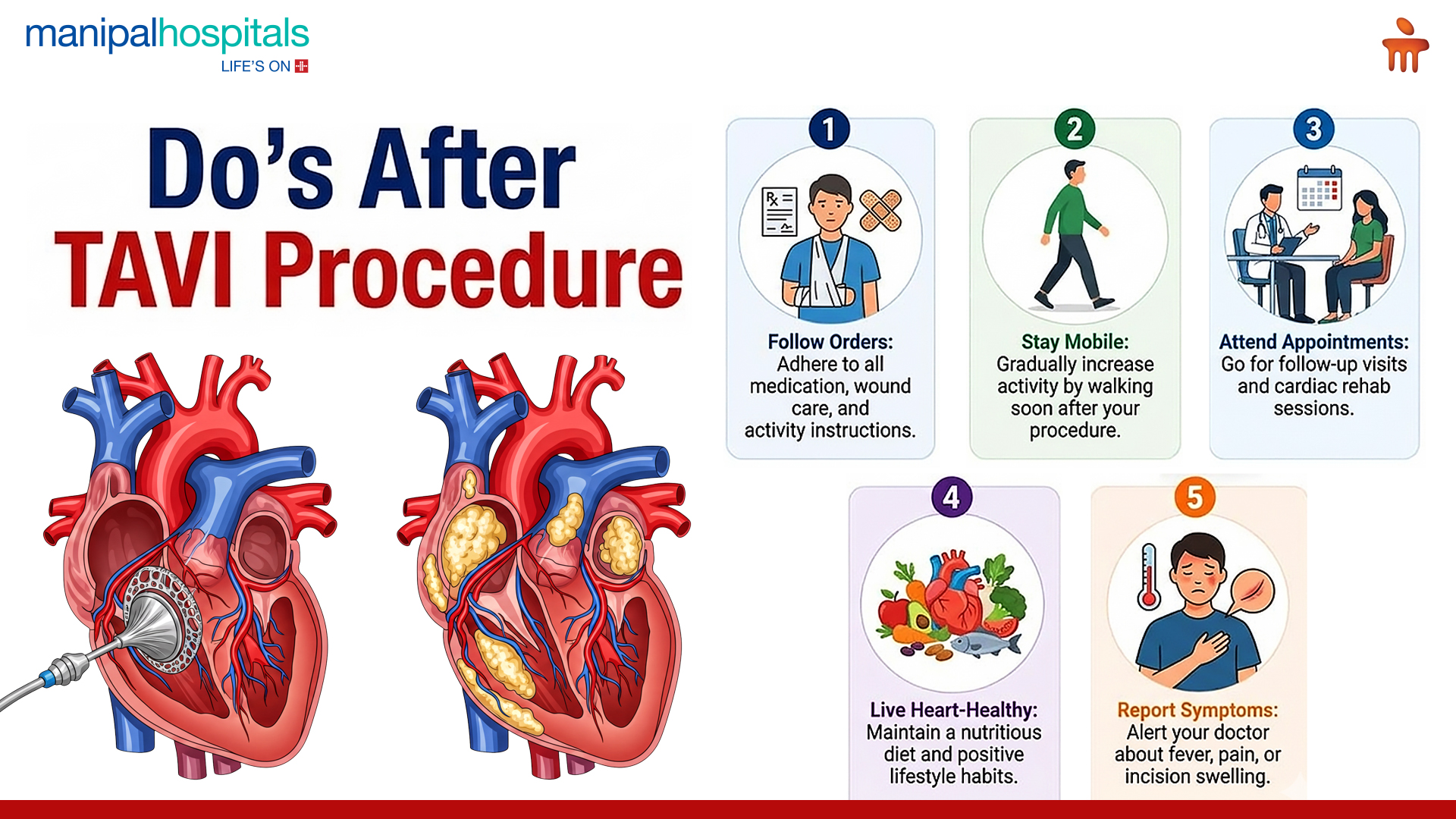
Care Essentials: Do's and Don'ts After TAVI/TAVR
Following your TAVI procedure, adhering to post-operative guidelines is crucial for a smooth recovery and long-term success:
-
Do: Follow your doctor’s instructions regarding medication, wound care, and activity levels diligently.
-
Do: Gradually increase your activity as advised by your healthcare team. Walking is often encouraged soon after the procedure.
-
Do: Attend all follow-up appointments and cardiac rehabilitation sessions.
-
Do: Maintain a heart-healthy diet and lifestyle.
-
Do: Report any unusual symptoms like fever, increased pain, or swelling at the incision site immediately to your doctor.
-
Don't: Lift heavy objects or engage in strenuous activities for several weeks, as advised by your physician.
-
Don't: Ignore any new or worsening symptoms; always seek medical advice.
-
Don't: Stop taking prescribed medications without consulting your doctor.
-
Don't: Drive until your doctor gives you clearance.
Benefits of Choosing TAVI/TAVR at Manipal Hospitals
-
Minimally Invasive: No open-chest surgery, leading to smaller incisions and less trauma.
-
Faster Recovery: Shorter hospital stays and quicker return to daily activities compared to open-heart surgery.
-
Reduced Risk: Especially beneficial for elderly or high-risk patients.
-
Improved Quality of Life: Significant relief from symptoms like shortness of breath and chest pain, enhancing overall well-being.
-
Expert Care: Performed by highly skilled interventional cardiologists and cardiac surgeons in a state-of-the-art facility.
If you are experiencing symptoms of aortic stenosis or have been advised about valve replacement, exploring TAVI/TAVR at Manipal Hospitals could be your path to a healthier, more active life. Our team is dedicated to providing personalised care, leveraging advanced technology and a patient-first approach to ensure the best possible outcomes.
FAQ's
TAVI (Transcatheter Aortic Valve Implantation) and TAVR (Transcatheter Aortic Valve Replacement) are essentially different terms for the same minimally invasive procedure. Both refer to the replacement of a diseased aortic valve using a catheter-based approach rather than open-heart surgery.
The actual TAVI procedure typically takes about 1 to 2 hours, though preparation and recovery in the cath lab may extend the overall time spent there.
The TAVI procedure is performed under local anaesthesia with sedation or general anaesthesia, so you will not feel pain during the procedure. Post-procedure discomfort is generally minimal compared to open-heart surgery and can be managed with pain medication.
Most patients are discharged within 2-3 days after a TAVI procedure. This is significantly shorter than the typical 5-7 day hospital stay for traditional open-heart surgery.
While generally safe, like any medical procedure, TAVI carries some risks, including stroke, bleeding, vascular complications, pacemaker implantation, and kidney problems. Your medical team will discuss all potential risks and benefits with you based on your individual health profile.
While TAVI is a newer procedure, current data suggest that transcatheter heart valves are durable, with many lasting 10 years or more. Long-term studies are ongoing to assess their full lifespan.
Share this article on:


.webp "Arrhythmia Treatment: Medications, Catheter Ablation & Modern Heart Rhythm Therapies")