8 Min Read
Not every heart condition announces itself with obvious symptoms. Sometimes, a person grows up feeling completely healthy, only to discover during a routine examination that there is a small opening inside the heart. Known as an atrial septal defect, this condition affects the wall of your heart, creating a small opening between the upper chambers that affects how blood flows. In some cases, the defect remains harmless for years, while in others it may gradually place extra strain on the heart over time. With advances in diagnosis and treatment, most people with an atrial septal defect can manage the condition effectively and maintain a high quality of life.
In this blog, a top interventional cardiologist in Hebbal, Bangalore, explains what an atrial septal defect means, how it develops, the treatment options available, and what long-term outlook you can expect with the right care.
Synopsis
What Is an Atrial Septal Defect?
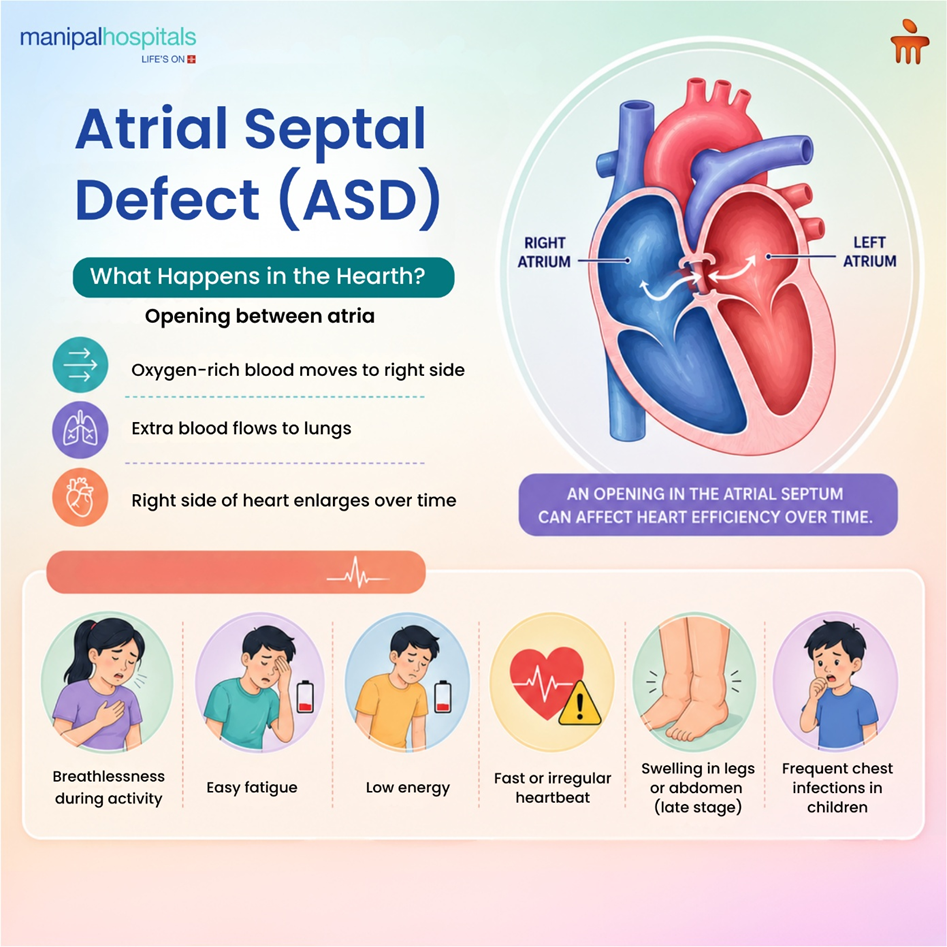
An atrial septal defect is a small opening in the wall that separates the two upper chambers of the heart. Because of this defect, some oxygen-rich blood moves back to the right side of the heart and goes to the lungs instead of being circulated to the rest of the body.
If the opening is small, you may not notice anything at all. Many people live without symptoms for years. When the opening is larger, more blood passes through it and goes to the lungs again and again. Over time, the condition puts extra work on the heart and lungs. The right side of the heart can slowly become bigger because it is handling more blood than it should.
Some small defects can close on their own during childhood. Larger ones need regular follow-up and, in some cases, surgery.
Types of Atrial Septal Defect
Doctors classify this condition based on where the opening is located in the wall between the upper chambers of the heart.
-
Ostium Secundum: The most common type, about 70 to 80 percent of cases. The opening is in the central part of the wall. Many can be treated with a device without open surgery.
-
Ostium Primum: Found in the lower part of the wall and often linked with valve problems. Surgery is usually needed.
-
Sinus Venosus: This type is found in the upper part of the wall, close to the veins that bring blood from the lungs. In many cases, these veins do not connect in the usual way and may drain into a different chamber. Surgery is needed to correct both the defect and the vein connection.
-
Coronary Sinus Defect: A rare type where part of the wall near the heart’s vein is missing. Surgical repair is needed.
Causes of Atrial Septal Defect
In many cases, doctors cannot identify an exact reason behind atrial septal defect causes. Though the change happens while the baby’s heart is forming during pregnancy. In many cases, nothing specific can be pointed to, but some factors are known to increase the chance. The defect is present from birth, even if it is found much later. It is not caused by anything a person does after they are born.
-
The wall between the upper chambers does not fully close as the heart develops before birth.
-
A family history of heart defects can increase the likelihood in some children.
-
Certain health conditions in the mother, such as diabetes, can affect how the baby’s heart forms.
-
Infections during pregnancy may interfere with normal heart development.
-
Alcohol use or some medicines taken during pregnancy can affect the baby’s heart.
Symptoms of Atrial Septal Defect
Many people with an atrial septal defect do not notice symptoms in the early stages. Small openings can remain unnoticed for years. What you experience often depends on the size of the opening and how long the heart has been dealing with it.
-
Breathlessness during activity, such as walking fast or climbing stairs
-
Getting tired more easily than usual, even with simple daily tasks
-
Feeling low on energy without a clear reason
-
Fast or irregular heartbeat, sometimes felt as a flutter
-
Swelling in the legs, feet, or abdomen in later stages
-
Frequent chest infections in children, with repeated cough or breathing difficulty
-
Slower growth or weight gain in some children
How Atrial Septal Defect Is Diagnosed
Doctors often find this condition during a routine check, sometimes after hearing an unusual heart sound. If there are symptoms, a few tests are used to understand them better.
-
Echocardiogram: This is the main test. It shows how the heart is working and helps spot the opening and blood flow.
-
ECG: Checks the heartbeat and can show if the rhythm is uneven or if the heart is under strain.
-
Chest X-ray: Gives a basic view of the heart and lungs and may show if the heart looks bigger than usual.
-
MRI or CT scan: Used when doctors need a clearer or more detailed picture.
-
Cardiac catheterisation: In some cases, a thin tube is guided into the heart to take a closer look before planning treatment.
Atrial Septal Defect Treatment Options
The right atrial septal defect treatment depends on the size of the opening, your symptoms, and how the heart is coping. Doctors look at all of this before deciding the next step.
-
Observation: Small openings may not need immediate treatment. In some children, the gap can close on its own as the heart grows. Even if immediate treatment is not required, regular follow-up is important so the doctor can watch for any changes over time.
-
Medications: Medicines do not close the opening. They are used to manage symptoms. For example, they may help control irregular heartbeat or reduce fluid build-up if the heart is under strain. They are often used along with other treatment plans.
-
Catheter-based closure: In suitable cases, a device can be placed to close the opening without open surgery. A thin tube is passed through a blood vessel, usually from the leg, and guided to the heart. This option is often used for the more common type, where the opening is in the middle of the wall.
-
Surgical repair: Surgery is needed when the opening is large or in a position where a device cannot be used. The surgeon closes the gap using stitches or a patch. This is also required when other heart problems are present.
Comparison of ASD Types and Treatment
Not every atrial septal defect behaves in the same way; treatment can vary from person to person. Some defects may only need regular monitoring, while others might require a procedure or surgery to prevent future complications.
The table below gives an easy snapshot of the common ASD types and how they are usually treated:
|
Type |
Location |
Occurrence |
Treatment Approach |
|
Ostium Secundum |
The middle part of the wall between the upper chambers |
Most common |
It can often be closed using a device without open surgery |
|
Ostium Primum |
Lower part of the wall |
Less common |
Surgery is needed as it often comes with other heart issues |
|
Sinus Venosus |
The upper part near the veins brings blood from the lungs |
Rare |
Surgery is required to fix both the opening and the vein connection |
|
Coronary Sinus |
Near the vein that drains blood from the heart muscle |
Very rare |
Surgery is required due to its location |
When to See a Doctor
Some signs are easy to ignore at first, but it is better to get them checked early.
-
Breathlessness during routine activity or even mild effort
-
Feeling tired more often without a clear reason
-
A fast or irregular heartbeat that you can feel
-
Repeated chest infections in children that keep coming back
-
Trouble keeping up with daily activities compared to before
Conclusion
An atrial septal defect can be managed well when it is found early and followed up properly. The type of opening, its size, and how the heart is handling it all guide the treatment plan. Many people do well with the right approach, whether it is monitoring, a procedure, or surgery. For expert evaluation and care, visit the cardiology care near Hebbal.
If you have been advised to undergo further evaluation or are noticing symptoms, it is important to get a proper check-up. If you are considering atrial septal defect treatment in Hebbal, you can consult our top interventional cardiologists at Manipal Hospital Hebbal, Bangalore, for timely diagnosis and appropriate care.
FAQ's
Yes, some small openings can close as a child grows. Not all of them do, so doctors monitor them closely with regular check-ups before deciding if anything needs to be done.
It depends on the size. Smaller ones may not cause problems for years. Larger openings can put strain on the heart and lungs if left untreated.
Yes, it can stay unnoticed for a long time. Some people only find out in adulthood when they start feeling tired or breathless or notice changes in their heartbeat.
No. The need for treatment depends on the type and size of the opening. Some can be closed with a device, and some only need monitoring.
Outcomes are excellent when treated at the right time. Most people recover well after atrial septal defect treatment and are able to return to normal activity.
Share this article on: