7 Min Read
For countless women, severe period pain is an unwelcome monthly visitor, often dismissed as "just part of being a woman." However, persistent, debilitating pelvic pain can signal underlying conditions that require medical attention. Two such conditions, often confused due to their similar symptoms, are adenomyosis and endometriosis. While both involve uterine tissue, their locations and mechanisms differ significantly. Understanding these distinctions is crucial for accurate diagnosis and effective management. Our gynaecologists in Delhi frequently encounter patients grappling with these challenging conditions and offer specialised care and advanced treatment options.
These conditions affect millions globally, with an estimated 1 in 10 women suffering from endometriosis, and adenomyosis prevalence ranging from 5% to 70% depending on diagnostic methods. Early and accurate diagnosis, often achieved with modern imaging techniques, significantly improves patient outcomes, with up to 70% of women reporting better quality of life after appropriate intervention.
Synopsis
What is Adenomyosis?
Adenomyosis is a condition where the endometrial tissue, which normally lines the uterus, grows into the muscular wall of the uterus (myometrium). This misplaced tissue continues to act as it would during a normal menstrual cycle: it thickens, breaks down, and bleeds. However, because it's trapped within the muscular wall, it cannot exit the body, leading to an enlarged uterus, inflammation, and significant pain. It is one of the common causes of heavy period treatment.
Causes of Adenomyosis
The exact `Adenomyosis causes` are not fully understood, but several theories exist:
-
Invasive Tissue Growth: It's believed that endometrial cells might directly invade the uterine muscle.
-
Developmental Origins: Some experts suggest adenomyosis might originate during fetal development from tissue deposited incorrectly.
-
Uterine Trauma: Previous uterine surgeries, such as C-sections or myomectomies, may contribute to the invasion of endometrial cells into the uterine wall.
-
Hormonal Influence: Estrogen is known to fuel the growth of endometrial tissue, and hormonal imbalances are often implicated.
Adenomyosis Symptoms
The `Adenomyosis symptoms` can vary in intensity, but common indicators include:
-
Severe or Debilitating Menstrual Cramps (Dysmenorrhea): Often described as sharp, knife-like pain, and significantly worse than typical period pain.
-
Heavy or Prolonged Menstrual Bleeding (Menorrhagia): Periods lasting longer than 7 days or requiring frequent pad/tampon changes.
-
Chronic Pelvic Pain: Persistent discomfort in the pelvic area, even outside of menstruation.
-
Painful Intercourse (Dyspareunia): Deep pelvic pain during or after sexual activity.
-
Bloating and Pressure: A feeling of fullness or pressure in the lower abdomen, often due to an enlarged uterus.
-
Fatigue and Anemia: Resulting from chronic pain and significant blood loss.
What is Endometriosis?
Endometriosis is a condition where tissue similar to the lining of the uterus (endometrium) grows outside the uterus. This ectopic tissue can be found on the ovaries, fallopian tubes, outer surface of the uterus, bowels, or other pelvic organs. Like adenomyosis, this misplaced tissue responds to hormonal changes during the menstrual cycle, thickening and bleeding. However, because it has no way to exit the body, it can lead to inflammation, scar tissue formation, adhesions, and severe pain.
Causes of Endometriosis
The precise `Adenomyosis vs endometriosis` causes for endometriosis are also complex and multifactorial:
-
Retrograde Menstruation: The most widely accepted theory suggests that menstrual blood containing endometrial cells flows backwards through the fallopian tubes and implants on pelvic organs.
-
Cellular Metaplasia: Non-endometrial cells outside the uterus may transform into endometrial-like cells.
-
Embryonic Cell Rest: Remnants of embryonic tissue may later develop into endometrial implants.
-
Surgical Scar Implantation: Endometrial cells may attach to surgical incisions, such as after a C-section or hysterectomy.
-
Immune System Dysfunction: A compromised immune system may fail to recognise and destroy misplaced endometrial tissue.
Symptoms of Endometriosis
While sharing some similarities with adenomyosis, endometriosis symptoms can also have unique characteristics:
-
Severe Menstrual Pain: Often more generalised and debilitating than typical cramps.
-
Chronic Pelvic Pain: Can be constant and not limited to menstrual periods.
-
Pain During or After Intercourse: Similar to adenomyosis, often deep and persistent.
-
Painful Bowel Movements or Urination: Especially during menstruation, if implants are on the bowel or bladder.
-
Heavy Menstrual Bleeding: Although less characteristic than in adenomyosis, it can occur.
-
Infertility: Endometriosis can impede fertility in approximately 30-50% of affected women.
-
Fatigue: A common and often debilitating symptom.
Key Differences: Adenomyosis vs Endometriosis
Understanding the distinction is vital for proper diagnosis and `Adenomyosis treatment`.
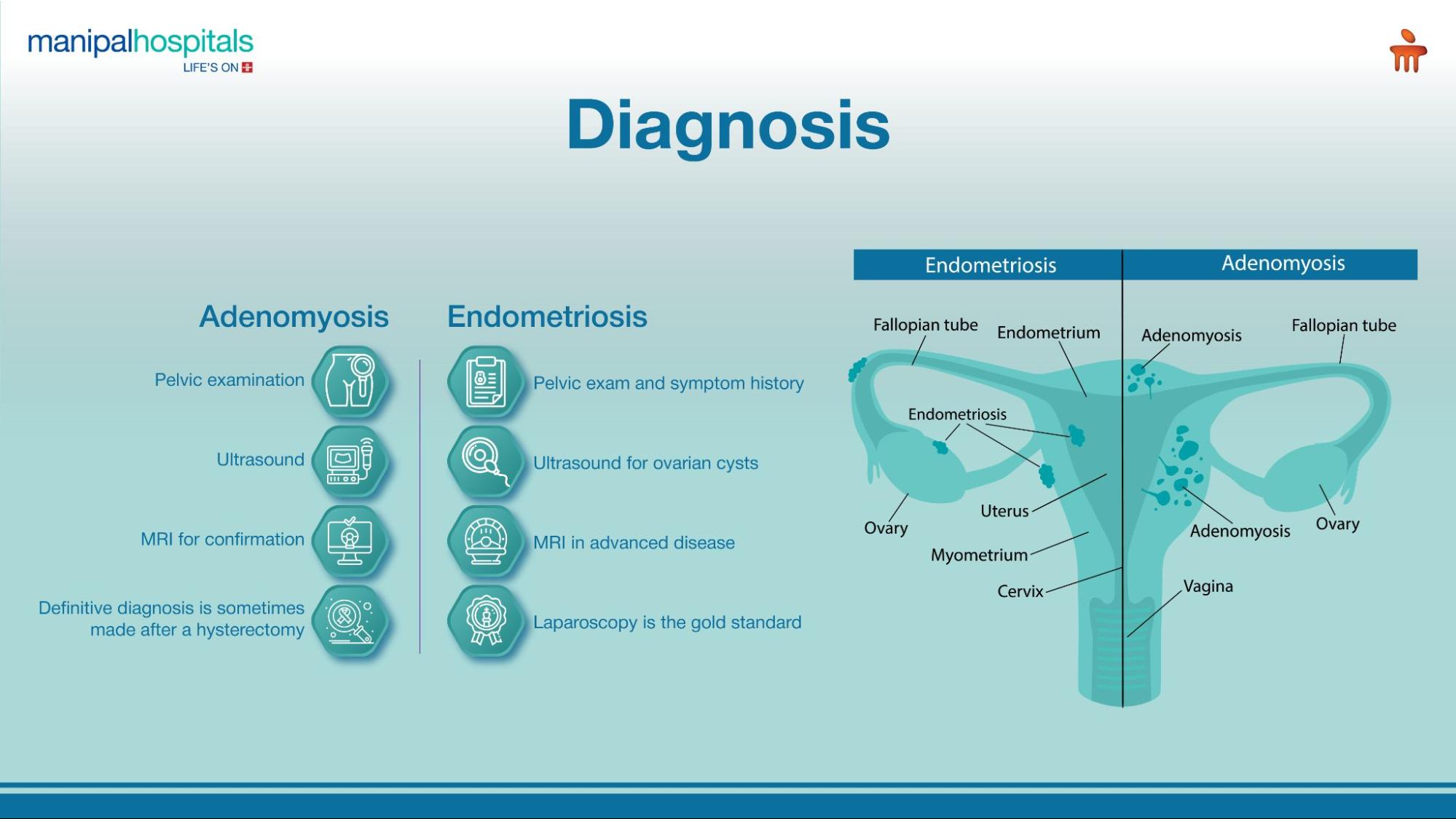
-
Location of Tissue:
-
Adenomyosis: Endometrial tissue grows *into* the muscular wall of the uterus.
-
Endometriosis: Endometrial tissue grows *outside* the uterus, on other pelvic organs or distant sites.
-
-
Diagnosis:
-
Adenomyosis: Often diagnosed through transvaginal ultrasound or MRI, which can show a thickened uterine wall or diffuse lesions.
-
Endometriosis: Definitive diagnosis typically requires laparoscopy, a minimally invasive surgical procedure to visualise and biopsy implants. Imaging (ultrasound, MRI) can suggest endometriosis but may not always confirm it, particularly for superficial lesions.
-
-
Uterine Size:
-
Adenomyosis: Often leads to an enlarged, globular uterus.
-
Endometriosis: The uterus itself is typically normal in size, although ovarian endometriomas (cysts) can be present.
-
-
Fertility Impact:
-
Both conditions can affect fertility, but the mechanisms differ. Endometriosis can cause adhesions and anatomical distortions, while adenomyosis might impact uterine receptivity.
-
Diagnosis and Treatment Options
Accurate diagnosis is the first step toward effective relief. Our gynaecologists in Delhi employ a range of diagnostic tools:
-
Pelvic Exam: To check for tenderness or an enlarged uterus.
-
Imaging: Transvaginal ultrasound and MRI are key for diagnosing adenomyosis and can provide clues for endometriosis.
-
Laparoscopy: The gold standard for definitively diagnosing and staging endometriosis.
Treatment approaches for both conditions are tailored to the individual's symptoms, age, desire for fertility, and disease severity. `Adenomyosis treatment` and endometriosis management often involves a multi-pronged approach.
Managing Adenomyosis and Endometriosis
For `Adenomyosis treatment` and endometriosis, options include:
-
Pain Management:
-
Over-the-counter pain relievers (NSAIDs) can help with mild symptoms.
-
Prescription pain medications may be necessary for severe pain.
-
Hormonal Therapies: These aim to suppress the growth of endometrial tissue and reduce bleeding.
-
Combined oral contraceptives (birth control pills).
-
Progestin-only therapies (pills, injections, IUDs).
-
GnRH agonists and antagonists to induce a temporary menopause-like state.
-
-
Surgical Interventions:
-
For Endometriosis: Laparoscopic excision or ablation to remove endometrial implants and adhesions. Studies show that up to 80% of patients experience significant pain relief after expert laparoscopic surgery for endometriosis.
-
For Adenomyosis: `Adenomyosis surgery` options are more limited if fertility is desired. Uterine artery embolisation can help reduce blood flow to the uterus, and endometrial ablation can be considered for heavy bleeding. For definitive relief, especially when family planning is complete, a hysterectomy (removal of the uterus) is often the most effective `Adenomyosis treatment`, with success rates for complete symptom resolution exceeding 95%. Our gynaecologists in Delhi are experts in minimally invasive hysterectomy techniques.
-
-
Fertility Treatments: For those trying to conceive, options like IVF may be considered alongside or after treatment for these conditions.
If you are experiencing severe period pain or any symptoms, it's crucial to seek timely medical advice. Book an appointment with our expert gynaecologists at Manipal Hospitals today to discuss your concerns and explore personalised treatment options. Your well-being is our priority.
FAQ's
While there is no definitive "cure" in the sense of eliminating the condition without intervention, symptoms can be effectively managed and significantly reduced. For adenomyosis, a hysterectomy is the only definitive cure. For endometriosis, surgical excision can remove lesions, but recurrence is possible.
No, not always. While both can impact fertility in some women, many individuals with adenomyosis or endometriosis can conceive naturally or with fertility assistance. Early diagnosis and `Adenomyosis treatment` can improve fertility outcomes.
Adenomyosis involves the growth of endometrial tissue into the uterine muscle, whereas fibroids are benign muscular tumours that grow within or on the uterus. While both can cause heavy bleeding and pain, they are distinct conditions, although they can sometimes coexist.
Recovery time varies depending on the type and extent of surgery. Minimally invasive laparoscopic procedures typically have a shorter recovery, often a few days to a couple of weeks. More extensive surgeries might require several weeks for full recovery.
Yes, while not a cure, adopting a healthy lifestyle including an anti-inflammatory diet, regular exercise, stress reduction techniques, and avoiding certain environmental toxins can help some women manage their symptoms and improve their overall well-being alongside medical treatments.
Share this article on:


_Care.webp "Robotic Surgery: A New Era in Uterine Cancer (Endometrial Cancer) Care")