8 Min Read
Joint swelling is one of the body’s most noticeable signals that something inside a joint is not functioning normal. A knee that suddenly looks puffy, a finger that feels tight and tender, or an ankle that appears larger than usual can cause immediate concern. Sometimes the swelling arrives after an injury, but at other times, it seems to develop without any mechanical injury. Joint swelling can happen suddenly or slowly, which causes stiffness or discomfort that makes affected joint movement difficult.
What many people do not understand is that this condition occurs because of the collection of more than normal fluid within the joint space and is called "joint effusion." There are various causes of joint effusion, ranging from inflammation to injury, and it can be associated with various medical conditions.
This blog explores the various medical causes of joint effusion and the recovery process that helps the joints regain normal movement.
Synopsis
- What Happens Inside a Swollen Joint?
- Common Causes of Joint Swelling
- Signs That Suggest Joint Effusion
- Joints Most Commonly Affected by Swelling
- Diagnostic Tests Doctors Use to Evaluate Joint Effusion
- Treatment Approaches for Joint Swelling
- Recovery and Rehabilitation After Joint Swelling
- Few red flags needing urgent medical attention
- Conclusion
What Happens Inside a Swollen Joint?
A healthy joint contains a small amount of lubricating fluid that allows bones to glide smoothly over one another. This fluid, called synovial fluid, acts like a natural cushion and reduces friction when you move joints.
When injury or inflammation occurs, the joint lining produces excess fluid. As this liquid between joints builds up, it puts pressure on the joint space, which further leads to joint swelling and the joints feeling tight or heavy. Several changes may occur during this process:
-
The joint capsule stretches due to excess fluid, leading to nerves irritation
-
Surrounding tissues get inflamed
-
Movement can feel restricted or painful
-
Warmth or redness may develop over the affected joints
A small build-up of fluid is often described as a mild joint effusion, which may cause minimal discomfort but still signals that the joint is reacting to some form of stress.
Common Causes of Joint Swelling
Although swelling may look similar from the outside, the reasons behind it can vary widely. Identifying the underlying cause is essential because treatment depends on the type of joint pathology causing joint effusion.
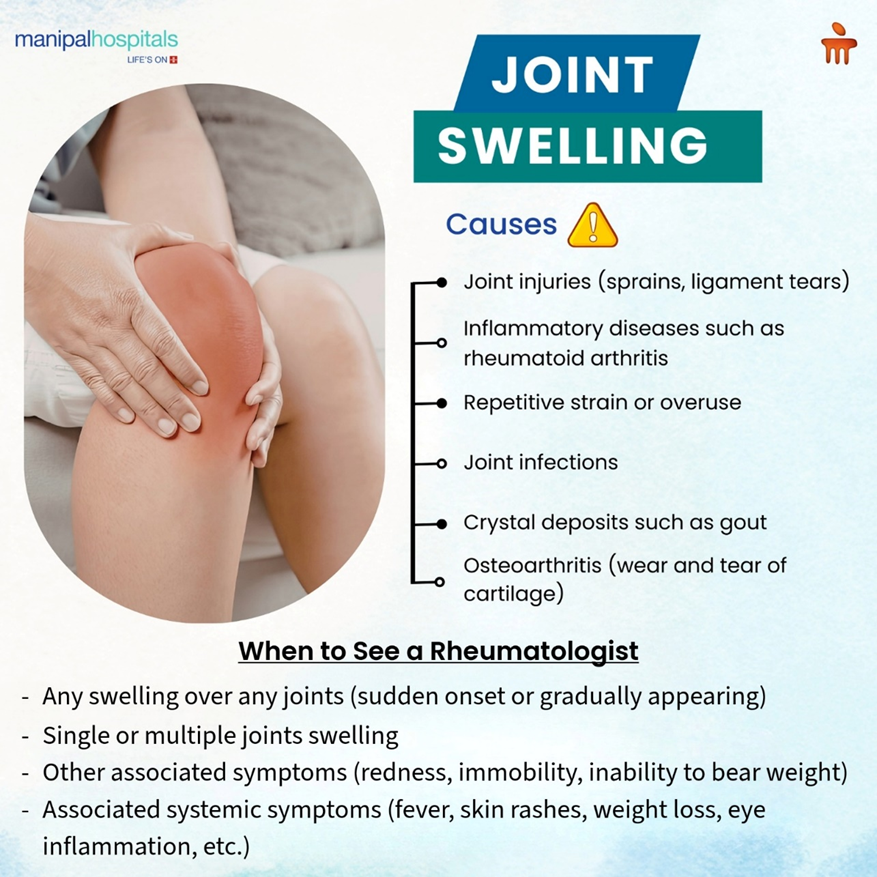
Joint swelling can occur due to:
-
Acute Injuries: Sprains, ligament tears, or cartilage damage can lead to rapid swelling. The body releases inflammatory chemicals that increase fluid within the joint.
-
Overuse or Repetitive Strain: Repeated stress on a joint, which is very common in athletes and those in physically demanding occupations, may irritate the joint lining and produce excess fluid.
-
Inflammatory Joint Diseases: Conditions such as rheumatoid arthritis and other autoimmune arthritides cause the immune system to attack joint tissues, resulting in persistent inflammation and joint swelling.
-
Osteoarthritis: Wear and tear of joint cartilage can gradually lead to swelling, stiffness, and reduced mobility, especially in the knees, hips, and fingers.
-
Infection Inside the Joint: When bacteria enter the joint space, swelling can develop quickly and may be accompanied by fever, severe pain, and reduced movement of the involved joints. This condition requires urgent medical care, as it can lead to permanent damage in the involved joint.
-
Crystal Deposits: Certain metabolic disorders cause crystal deposition in joints, triggering sudden inflammation and fluid accumulation. Common examples are gout (uric acid crystals) and CPPD/pseudogout (CPPD crystals).
All joint swelling should always be evaluated by a rheumatologist, as the medical reasons for causing this are numerous.
Signs That Suggest Joint Effusion
Swelling around a joint rarely appears alone. The body often produces additional signals that indicate fluid accumulation within the joint space.
-
Swelling (grossly enlarged) around the joint area
-
Skin over the joint area appears tight/stretched
-
Difficulty bending or straightening the joint fully
-
Pain that gets worse during movement
-
Fullness or pressure feeling inside the joint
-
Heating sensation around and/or in the joint
In some cases, the joint may feel unstable or weak. Even mild joint effusion can affect movement patterns, which is why early attention helps prevent further irritation.
Joints Most Commonly Affected by Swelling
Although any joint can develop excess fluid, certain joints are more prone to swelling because they bear significant weight or perform repetitive movements throughout the day.
The following joints are prone to swelling:
-
Knee joint: very common due to injury/various autoimmune and degenerative arthritis.
-
Ankle joint: easily sprained/ligament strain and arthritis.
-
Wrist joint: mainly develops from inflammatory conditions like Rheumatoid arthritis, psoriatic arthritis, etc.
-
Finger joint: Systemic autoimmune diseases.
-
Elbow joint: Injury/Arthritis
Each joint has a slightly different structure and range of motion. Therefore, swelling of each joint can create different movement limitations.
Diagnostic Tests Doctors Use to Evaluate Joint Effusion
When a swollen joint is examined in a clinic, the goal is not only to confirm fluid accumulation but also to determine its cause. Relevant investigations may be used to gather detailed information about the joint environment. These investigations provide valuable clues that guide the most appropriate treatment plan.
|
Diagnostic Method |
What the Test Reveals |
Why It Is Helpful |
|
Joint Aspiration (Arthrocentesis) |
A small sample of joint fluid is removed with a needle |
Fluid analysis can detect infection, crystal deposits, or inflammatory conditions. |
|
Ultrasound Imaging |
Real-time visualisation of fluid inside the joint |
Helps detect even small fluid collections and guides procedures like fluid aspiration/injections in joints. |
|
MRI Scan |
Detailed images of soft tissues like cartilage, ligaments, and surrounding tissues |
Useful for identifying structural damage such as ligament tears/tumors. |
|
Blood Tests |
Measures inflammatory markers and immunology tests |
Helps detect autoimmune disorders or systemic inflammation. |
|
X-ray Imaging |
Shows bone alignment and joint space changes. |
Helps identify degenerative changes affecting the joint/bone fractures |
Treatment Approaches for Joint Swelling
Managing joint swelling involves addressing both the symptoms and the underlying cause. A personalised treatment plan is usually recommended based on the diagnosis and severity of the condition. Doctors may recommend the following strategies:
-
Rest and Activity Modification: Allowing the joint time to recover prevents further irritation and gives inflamed tissues a chance to settle.
-
Anti-inflammatory Medication: Certain medications help reduce inflammation within the joint, which can gradually decrease fluid accumulation.
-
Physical Therapy: Targeted exercises improve joint stability and restore strength around the affected area.
-
Joint Fluid Drainage: If a large amount of fluid is present, doctors may remove it to relieve pressure inside the joint cavity and help to improve movement early.
-
Supportive Bracing: Temporary braces or supports help to stabilise the joint during the recovery phase.
Consult a rheumatology specialist for evaluation of joint swelling and personalised treatment at Manipal Hospitals Whitefield Bangalore
Treatment often combines several of these methods, especially when swelling affects mobility or daily activities.
Recovery and Rehabilitation After Joint Swelling
Recovery from joint swelling is not always immediate. Even when the fluid reduces, surrounding muscles and ligaments may remain weak or stiff. Structured rehabilitation helps restore normal joint mechanics and prevent recurrence. The recovery process usually focuses on three key areas:
-
Restoring Range of Motion: Gentle stretching and controlled movement help joints regain flexibility.
-
Strengthening Supporting Muscles: Muscles surrounding the joint play a major role in stabilising movement and reducing stress on the joint.
-
Improving Joint Stability: Balance training and controlled strengthening exercises help prevent repeated swelling episodes.
Gradual progression is important. Returning to strenuous activity too quickly can trigger renewed inflammation and delay healing.
Few red flags needing urgent medical attention
While some swelling improves with rest and conservative medical management, certain symptoms require prompt medical evaluation.
Seek medical attention if swelling is accompanied by:
-
Fever or chills
-
Severe pain that limits movement
-
Sudden swelling after an injury
-
Redness spreading around the joint
-
Inability to bear weight on the affected joint
-
Swelling that persists for several weeks
Early evaluation ensures that infections, autoimmune diseases, or structural joint injuries are treated before complications develop.
Conclusion
Joint swelling is more than just a temporary inconvenience. It is the body’s way of signalling that something within the joint requires attention. Whether the cause is injury, inflammation, or underlying disease, identifying the source of joint swelling helps prevent long-term damage and restore comfortable movement. With the right medical guidance, most individuals can regain joint mobility and return to their daily routines safely. If swelling continues, worsens, or interferes with normal movement, professional evaluation is important.
Individuals experiencing persistent symptoms may benefit from specialised joint pain & swelling treatment in Whitefield, Bangalore, at Manipal Hospital Whitefield, where the clinicians can provide a detailed assessment and personalised care.
FAQ's
Some individuals notice increased joint discomfort during cold or humid weather. While the exact mechanism remains unclear, changes in atmospheric pressure may alter the pressure inside joints and surrounding tissues. These changes can make inflamed joints feel stiffer or more swollen, particularly in people who already have arthritis or previous joint injuries.
Exercise may still be possible depending on the cause and severity of the swelling. Low-impact activities such as gentle stretching, swimming, or controlled strengthening exercises can help maintain mobility without placing excessive stress on the joint. However, high-impact activities should be avoided until a medical professional confirms that the joint has stabilised.
Yes, it can. Some people may experience visible swelling without much pain, especially in the early stages of inflammatory joint disease or mild joint effusion. Even if the pain is mild, the presence of persistent swelling must still be evaluated, as it may indicate an underlying inflammation.
The time frame for the recovery of joint swelling varies. Minor joint swellings due to overuse may resolve in a matter of days. Swellings due to ligament injuries or inflammatory diseases may even take weeks to resolve.
Dietary practices affect how inflamed the joints are. A diet that consists of fresh fruits, vegetables, whole grains, and healthy fats helps maintain healthy joints. Excessive consumption of processed food, sugar, and fatty foods may increase the risk of inflammation, which may cause pain in the joints.
Share this article on: