8 Min Read
A small bulge near the underarm area is something many people ignore at first. Some think it is weight gain, while others assume it is just stubborn fat that does not go away with exercise. But for some people, that fullness is actually axillary breast tissue, which can become more noticeable over time.
The area may feel uncomfortable while wearing fitted clothes, exercising, or even moving the arms normally. Some people also notice swelling, irritation, or tenderness during hormonal changes, pregnancy, or breastfeeding. While it is not always a serious medical problem, it can affect comfort and confidence in daily life.
The good thing is that treatment options are available, and axillary breast removal surgery is commonly done to remove the excess tissue safely. This blog explains the condition, how the procedure is done, recovery after surgery, and what patients should know before considering treatment.
Synopsis
- What is Axillary Breast Tissue?
- Why Does Axillary Breast Tissue Become More Noticeable?
- Common Symptoms of Axillary Breast Tissue
- How Do Doctors Diagnose Axillary Breast Tissue?
- What Are Axillary Breast Treatment Options?
- Axillary Breast Tissue Removal Without Surgery
- When is surgery recommended?
- Axillary Breast Tissue Removal
- Step-by-Step: What Happens During Surgery
- Axillary Breast Tissue Recovery Timeline
- Tips for Smoother Recovery
- Possible Risks and Complications
- Emotional Impact: What Draws a Lot of Patients into Treatment
- Conclusion
What is Axillary Breast Tissue?
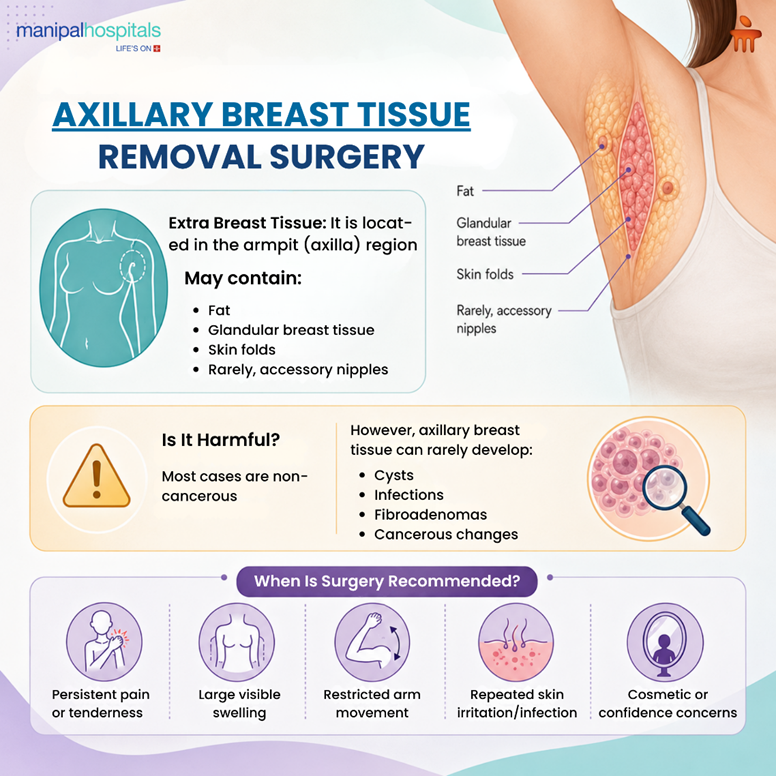
Axillary breast tissue is extra breast tissue that develops in the underarm area, also called the axilla.
Early in foetal development, breast tissue develops along a line called the “mammary ridge or ectodermal milk line", which extends from the axilla down to the medial groin. Most of this tissue usually disappears before birth. Small amounts are sometimes left behind in the underarm region, resulting in axillary breast tissue.
This tissue may contain fat, glandular breast tissue, skin folds, and occasionally accessory nipples. Axillary breast tissue is often first noticed during periods of hormonal change in life, as the tissue can enlarge similarly to normal breast tissue.
Why Does Axillary Breast Tissue Become More Noticeable?
Some people have a very mild condition that never becomes symptomatic. Others see a gradual enlargement over time. Triggers include puberty, pregnancy, breastfeeding, weight gain, hormonal fluctuations, and ageing.
Sometimes the tissue may be tender during the menstrual cycle, behaving similarly to normal breast tissue in response to hormones.
Common Symptoms of Axillary Breast Tissue
Symptoms vary greatly from person to person. Common complaints include the following: Common symptoms can include:
-
Swelling or fullness near the armpit
-
A visible bulge under the arms
-
Tenderness or swelling
-
Rubbing and skin irritation
-
Heaviness in the area
-
Discomfort while moving the arms
-
Difficulty wearing certain bras or clothes comfortably
Some patients have described the sensation as “extra breast tissue spilling into the armpit.” In rare instances, it can become painful during pregnancy or lactation.
How Do Doctors Diagnose Axillary Breast Tissue?
Most axillary breast tissues are benign and not dangerous. But physicians still recommend proper evaluation because axillary breast tissue, like normal breast tissue, can sometimes develop cysts, infections, fibroadenomas, or, rarely, cancerous changes.
Any unexplained lumps or rapid growth should therefore always be investigated medically. Doctors usually start with a physical examination and ask about the swelling, discomfort, or changes noticed in the underarm area. To confirm whether it is axillary breast tissue, tests like ultrasound, mammography, or sometimes an MRI scan may be advised. In rare cases, a biopsy may be needed if anything unusual is seen.
These tests also help rule out other causes of underarm swelling, such as cysts, lipomas, or enlarged lymph nodes.
What Are Axillary Breast Treatment Options?
The best way to handle axillary breast tissue depends entirely on how much it bothers you. If the tissue is small and doesn't cause pain, you might choose to simply leave it alone and monitor it over time. However, if it is affecting your comfort or your self-esteem, there are several paths you can take.
Axillary Breast Tissue Removal Without Surgery
Mild swelling may prompt some patients to ask about non-surgical removal. In certain situations, non-surgical options may be helpful:
-
Weight management
-
Supportive garments
-
Posture improvement
-
Hormonal management in specific cases
However, it’s important to understand that true glandular breast tissue usually doesn’t go away completely without medical intervention. While weight management or non-surgical body contouring (like cryolipolysis) can reduce surrounding fat cells, true glandular tissue can’t be eliminated non-surgically.
When is surgery recommended?
Surgery is usually considered when the physical or emotional impact of the tissue becomes too much to manage with simple lifestyle changes. You might be a good candidate for axillary breast tissue removal if:
-
You experience chronic pain or tenderness that doesn't go away.
-
The tissue is large enough that it limits your range of motion in your arms.
-
You are constantly dealing with skin infections or rashes in the armpit folds.
-
The appearance of the tissue makes you feel self-conscious to the point that you avoid certain social situations or clothing.
Axillary Breast Tissue Removal
If you decide to proceed with surgery, you are looking at a much more refined and precise process than in years past. The goal of the surgeon is to create a smooth, natural-looking underarm with as little visible scarring as possible. Common surgical approaches include:
-
Liposuction: Applied when tissue is predominantly fat.
-
Excision Surgery: Directly removes excess skin and glandular tissue.
-
Combination approach: A combination of liposuction and excision can offer smoother contouring.
Step-by-Step: What Happens During Surgery
Knowing what is going to happen usually helps with anxiety. The steps are as follows:
-
Anaesthesia: Local or general anaesthesia is given depending on the extent of the surgery.
-
Tiny Incisions: Incision sites are planned carefully and placed, when possible, in natural skin creases.
-
Glandular Excision: The surgeon removes excessive fat and glandular tissue.
-
Subdermal Contouring: The underarm line is reformed for a more streamlined look.
-
Closure: Closure of incisions with care to minimise visible scarring.
Axillary Breast Tissue Recovery Timeline
Recovery is usually gradual but manageable. The usual recovery follows the following phases:
|
Recovery Stage |
What to Expect |
|
Week 1 |
Swelling and discomfort gradually improve. |
|
Week 2 - 3 |
Daily activities become easier. |
|
Week 4 - 6 |
Significant healing and contour improvement. |
|
Few Months |
Final results become more visible. |
Recovery is usually gradual but manageable. The usual recovery follows the following phases: Doctors may also suggest the use of compression garments to reduce swelling and aid healing. Consult a plastic surgeon in Whitefield, Bangalore, to understand your condition and explore treatment options.
Tips for Smoother Recovery
Simple habits can help with healing after breast tissue removal. Helpful recovery tips include:
-
Do not lift anything heavy in the initial days after surgery.
-
Follow wound care instructions carefully as guided by the medical team.
-
Wear recommended support garments for faster healing.
-
Don't smoke during the recovery period.
-
Maintain a stable weight with light activities.
Most patients return to their normal activities within a few weeks.
Possible Risks and Complications
Like any surgery, axillary breast surgery carries some risks. Possible complications are swelling, bruising, infection, transient numbness, scarring, fluid collection, asymmetry, and delayed healing.
Fortunately, serious complications are uncommon when surgery is performed by experienced specialists.
Emotional Impact: What Draws a Lot of Patients into Treatment
The emotional impact of this is often underestimated. Some patients avoid:
-
Sleeveless clothing
-
Fitted outfits
-
Swimming
-
Gym activities
-
Social gatherings
Many people report increased confidence and comfort when this condition is successfully removed. Interestingly, many patients say that they waited years to get treatment because they thought the condition was just “normal fat".
Conclusion
Axillary breast tissue is more common than many people realise, but people often ignore it or mistake it for extra fat near the underarm. While mild cases may not need treatment, larger or painful swelling can affect comfort, clothing choices, movement, and confidence in daily life.
The good thing is that treatment options today are much safer and more refined than before. Understanding the condition, recognising symptoms early, and getting proper medical advice can help people decide whether treatment or axillary breast removal surgery is the right option for them.
People considering axillary breast surgery in Whitefield, Bangalore, often look for experienced surgeons, personalised treatment plans, and proper post-surgery care to make recovery smoother and more comfortable.
FAQ's
Yes. During pregnancy and breastfeeding, hormonal changes may cause breast tissue to enlarge and become tender or more prominent than earlier in life.
No. It’s more common in women, but men can also develop breast tissue, especially during hormonal changes or with excess fatty tissue.
Exercise may decrease surrounding fat, but true glandular breast tissue usually persists. Persistent fullness usually requires medical evaluation or special treatment options.
Recurrence is rare with complete excision of glandular tissue. However, the area around it may later be affected by major hormonal changes or significant weight gain.
Generally, light activities can be resumed in two weeks, while strenuous workouts and heavy lifting are typically postponed until healing progresses safely, under medical supervision.
Share this article on: