7 Min Read
Back pain that starts suddenly after a minor fall or even a simple movement can feel alarming, especially when it turns out to be a spinal fracture. Many people are surprised to learn that fragile bones, particularly in older adults or those with weakened bone density, can collapse under everyday stress. The pain can be persistent, posture may slowly change, and routine tasks that were once easy become difficult.
This is where kyphoplasty comes into the conversation. Designed to stabilise fractured vertebrae and restore spinal structure, the procedure has changed how clinicians manage painful vertebral compression fractures. When conservative measures do not ease symptoms, this minimally invasive option can offer meaningful improvement in mobility and comfort.
Synopsis
- Understanding Vertebral Compression Fractures
- Kyphoplasty Meaning and Why Doctors Recommend It
- How the Kyphoplasty Procedure Is Performed
- Who May Benefit From Kyphoplasty?
- Kyphoplasty Compared With Other Spine Treatments
- Recovery and Rehabilitation After Kyphoplasty
- Potential Risks and Safety Considerations
- Conclusion
Understanding Vertebral Compression Fractures
The spine is made up of small bones called vertebrae that stack to support the body and protect the spinal cord. When one of these bones weakens and collapses, the result is a vertebral compression fracture. These fractures frequently affect the middle or lower spine and sometimes follow relatively minor trauma.
While major injuries can fracture healthy bone, many compression fractures happen because the bone itself is weakened. Over time, a damaged vertebra may lose height and change spinal curvature, producing a forward-bending posture and ongoing pain.
Common factors that increase the risk of these fractures include:
-
Osteoporosis, which reduces bone strength
-
Long-term steroid medication use
-
Certain cancers that affect bone integrity
-
Age-related bone density decline
-
Falls or accidents that injure the spine
Pain from a compression fracture often worsens with standing or walking and eases with rest. Without appropriate care, multiple fractures can gradually alter spinal alignment and function.
Kyphoplasty Meaning and Why Doctors Recommend It
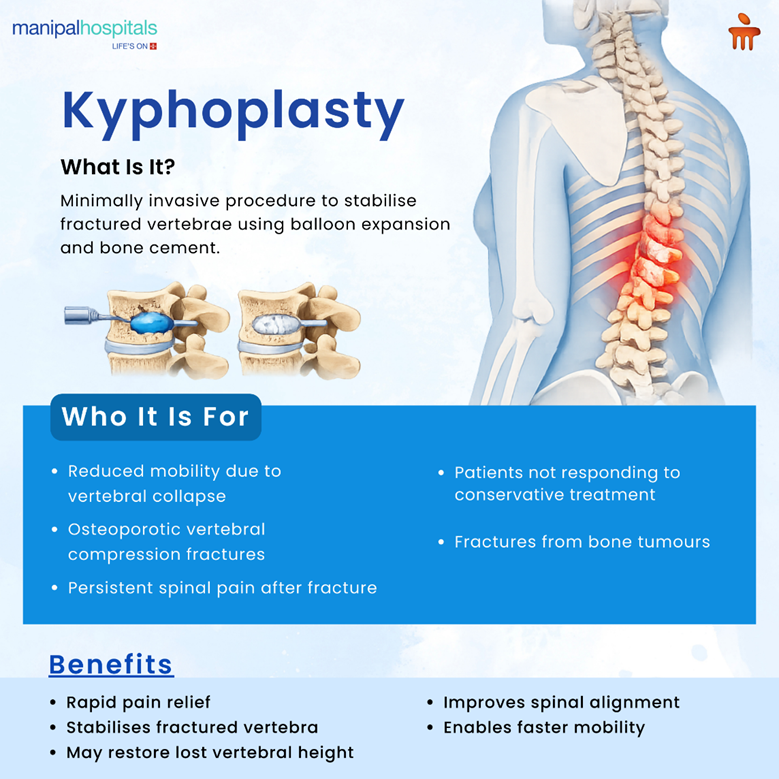
The kyphoplasty meaning becomes clearer when you think of it as a technique to stabilise a collapsed vertebra and, where possible, restore some lost height. The procedure aims to relieve pain, correct deformity, and strengthen the injured bone.
Physicians usually consider kyphoplasty when conservative treatment, such as rest, bracing, and medication, fails to control severe pain. Ongoing fractures can limit movement, and prolonged inactivity weakens muscles and bones further.
Beyond short-term pain relief, kyphoplasty surgery focuses on structural correction and preventing progressive spinal curvature. Stabilising the collapsed bone helps patients move more confidently and resume daily activities sooner than with prolonged conservative care alone.
How the Kyphoplasty Procedure Is Performed
The phrase “spinal procedure” can sound intimidating, but the kyphoplasty procedure is minimally invasive and often done under local or general anaesthesia.
Using real-time imaging like fluoroscopy, the surgeon guides a specialised needle into the fractured vertebra. Precision is vital because the vertebra sits near sensitive nerves and the spinal cord.
Through the needle, a small balloon is inserted and gently inflated. Inflating the balloon creates a cavity inside the bone and can partly restore lost height. After the balloon is removed, the surgeon fills the cavity with medical-grade bone cement. As the cement hardens, it stabilises and reinforces the weakened vertebra.
Each treatment generally takes around one hour, and many patients are able to go home on the same day.
Who May Benefit From Kyphoplasty?
Not every spinal fracture requires surgery. Doctors weigh symptoms, imaging results, and overall health before recommending intervention.
Patients likely to benefit from kyphoplasty typically have significant pain from recent vertebral compression fractures that limit daily activities. Imaging, such as MRI or CT scans, usually confirms the diagnosis.
Situations where kyphoplasty may be considered include:
-
Persistent spinal pain unresponsive to medication
-
Recent compression fractures due to osteoporosis
-
Reduced mobility from vertebral collapse
-
Progressive spinal deformity is linked to the fracture
-
Painful fractures caused by tumours that affect the bone
Timing matters. Kyphoplasty tends to be most effective within several weeks of the fracture, before the bone heals in a compressed position.
Kyphoplasty Compared With Other Spine Treatments
Doctors have several ways to treat vertebral compression fractures, and the right option usually depends on the severity of the fracture, the level of pain, and overall bone health. Some treatments focus on helping the bone heal naturally, while others aim to stabilise the fractured vertebra more quickly. Looking at how these approaches differ can make it easier to understand why a particular treatment is recommended.
|
Treatment Approach |
How It Works |
Typical Recovery Timeline |
Key Advantage |
|
Conservative management |
Uses pain medication, rest, and spinal braces so the fractured vertebra can heal naturally over time |
Several weeks to a few months |
Avoids surgical procedures |
|
Vertebroplasty |
Medical bone cement is injected into the fractured vertebra to stabilise it |
Usually short recovery with early movement |
Provides quick stabilisation of the bone |
|
Balloon kyphoplasty |
A balloon first creates space in the collapsed vertebra, then bone cement is inserted to strengthen it |
Many patients return home the same day |
Can restore some lost vertebral height |
|
Two or more vertebrae are surgically joined to stop painful movement |
Longer hospital stay and rehabilitation |
Helpful in cases of severe spinal instability |
|
|
Bone-strengthening therapy |
Medications improve bone density and reduce further weakening |
Long-term treatment |
Helps prevent future spinal fractures |
Each treatment has its role in managing vertebral fractures. The most suitable option is chosen after considering fracture severity, overall health, and conditions such as osteoporosis that affect bone strength.
Recovery and Rehabilitation After Kyphoplasty
Recovery after kyphoplasty surgery is usually faster than after open spinal operations because the incisions are small and the surrounding tissues are spared.
Many patients feel some pain relief within days, though full recovery varies with general health and the reason for the fracture. Clinicians often encourage gentle movement shortly after the procedure to preserve mobility.
Typical recovery steps include:
-
Gradual return to normal activities
-
Light walking to support circulation and muscle strength
-
Avoiding heavy lifting for several weeks
-
Follow-up imaging to check healing
Physical therapy may be prescribed if the patient has experienced prolonged immobility before treatment. Strengthening the muscles that support the spine helps reduce the risk of future injury.
Potential Risks and Safety Considerations
Like any intervention, kyphoplasty carries possible risks, but experienced specialists rarely cause serious complications when they perform the procedure.
Surgeons discuss risks before treatment so patients can decide with full information. The most important step is ensuring the fracture is suitable for the procedure.
Possible risks include:
-
Leakage of bone cement outside the vertebra
-
Infection at the injection site
-
Nerve irritation
-
Allergic reaction to materials used during the procedure
Careful imaging guidance and surgical skill minimise these risks. Most patients tolerate kyphoplasty well and report significant symptom relief.
Conclusion
Persistent pain from vertebral compression fractures can disrupt daily life and gradually alter posture and mobility. Kyphoplasty offers a targeted way to stabilise weakened vertebrae and restore structural support in the spine. By reinforcing damaged bone with hardened bone cement, the procedure can reduce pain and allow many patients to return to normal activities sooner than with extended conservative care. Understanding the purpose, benefits, and recovery path for kyphoplasty surgery helps patients approach treatment decisions with greater confidence.
For those seeking kyphoplasty treatment in Whitefield, Bangalore, consult our spine care specialists at Manipal Hospital Whitefield for a thorough assessment and personalised plan.
FAQ's
Yes. Surgeons can treat more than one fractured vertebra in the same session if needed. The decision depends on how many levels are affected, the patient’s overall health, and fracture severity. Treating multiple levels in one sitting can reduce the need for repeat procedures.
Kyphoplasty stabilises the treated vertebra rather than fusing vertebrae together. Because the treated bone remains part of the normal spine, overall flexibility is usually preserved. Most patients regain normal movement as healing progresses.
The bone cement used in the procedure sets fast and is meant to stay in the bone permanently. The cement will not dissolve or weaken over time. After the procedure, the vertebral body will remain structurally stable for the remainder of the patient’s life with the cement in place.
There are no strict age restrictions. The condition of the patient is taken into consideration before the procedure is recommended. Kyphoplasty is usually used to treat elderly patients with osteoporotic vertebral compression fractures; however, the procedure is not limited to the elderly.
Yes. Strengthening bone health is important after any spinal fracture. Doctors often advise calcium-rich nutrition, vitamin D supplements, weight-bearing exercise, and medications to improve bone density when appropriate. These measures lower the risk of new fractures in other vertebrae.
Share this article on: