7 Min Read
Persistent knee pain might limit your ability to go around and be independent. If medicines, physical therapy, and lifestyle modifications don’t help, your doctor may consider knee replacement surgery. It is most commonly suggested for people with orthopaedic problems like severe arthritis, joint injuries, or knees that wear away over the years. A total knee replacement can help relieve pain, restore flexibility, and return you to regular activities of everyday living. Knowing what to expect before, during, and after surgery can help you feel more comfortable and prepared for surgery.
Synopsis
- What is knee replacement surgery?
- Conditions that May Require Knee Replacement Surgery
- Types of Knee Replacement Surgeries
- Preoperative Preparation for Knee Replacement Surgery
- What Happens During a Knee Replacement?
- What to Expect Immediately After Surgery?
- Knee Replacement Recovery Time
- How Important is Physical Training After Surgery?
- Conclusion
What is knee replacement surgery?
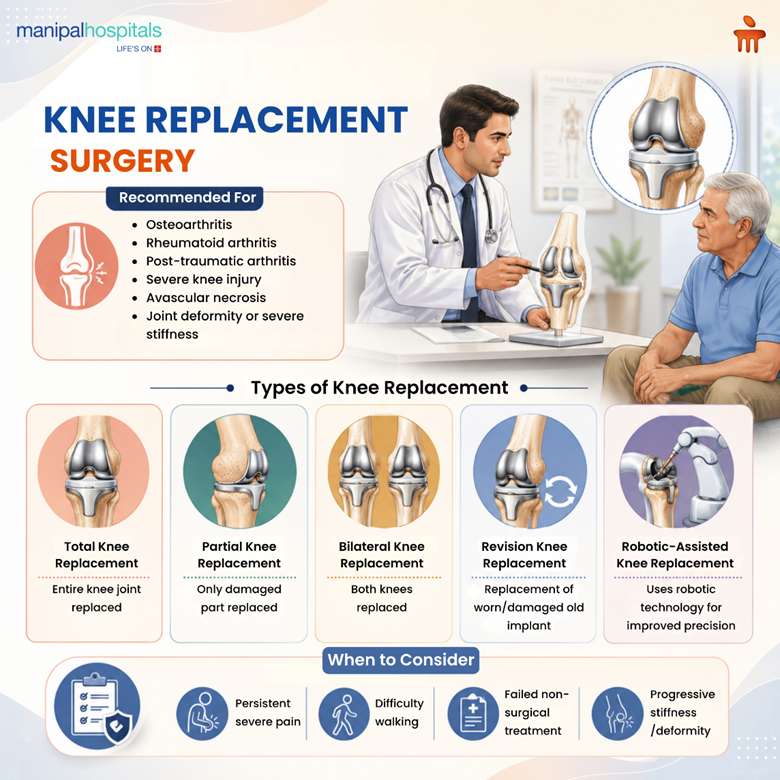
Knee replacement surgery (arthroplasty) is a highly refined surgical procedure in which the worn-out bone ends and damaged cartilage of an arthritic knee joint are removed and replaced with biocompatible artificial implants (prostheses). These artificial components mimic the natural motion of a healthy joint while improving movement and reducing pain. Usually, this surgery is advised for individuals with:
-
Severe, unremitting joint pain that limits walking, bending, or climbing stairs
-
Chronic, visible knee swelling and structural joint stiffness that persists despite rest
-
Significant structural deformities, such as severe bow-leggedness (varus) or knock-knees (valgus)
-
Inability to perform simple activities of daily living due to severe movement restrictions
Conditions that May Require Knee Replacement Surgery
There are many medical conditions that may lead to a need for knee replacement. Osteoarthritis is the most common reason patients need knee surgery. This condition occurs in the knee when the cartilage that cushions the joint wears down over time.
-
Rheumatoid Arthritis: A chronic, systemic inflammatory illness where the body’s immune system mistakenly attacks the knee joint, destroying cartilage and bone over time.
-
Post-traumatic Arthritis: Following a severe knee injury, such as a fracture, meniscus tear, or ligament rupture, the joint can gradually deteriorate.
-
Avascular Necrosis (Osteonecrosis): An extremely painful condition where a localised disruption in blood supply to the bone tissue causes the cellular elements of the bone to die, eventually leading to a structural collapse of the joint surface.
-
Serious Knee Injury: A high-impact accident or sports injury can damage a knee irreparably, requiring surgery.
If you are experiencing persistent knee pain or related symptoms, consult an experienced orthopaedic doctor in Whitefield for proper evaluation and treatment options.
Types of Knee Replacement Surgeries
There are numerous sorts of knee replacement surgeries that can be done. The following are the various types of surgeries:
|
Knee Replacement Surgery Types |
Clinical Description |
Ideal For |
|
Total Knee Replacement (TKR) |
The entire knee joint is replaced with artificial metal and plastic components. |
Patients with widespread, multi-compartmental arthritis or advanced joint deformity. |
|
Only the damaged part of the knee is replaced, while healthy bones, ligaments, and tissues are preserved. |
Patients with localised arthritis confined to a single compartment (typically the medial side). |
|
|
Bilateral Knee Replacement |
Both knees are replaced either during the same surgery or through separate procedures. |
Patients with debilitating, symmetrical arthritis in both knees who are medically fit for extended anaesthesia. |
|
Revision Knee Replacement |
This surgery is performed when an older knee implant becomes loose, damaged, or worn out over time. |
Patients experiencing mechanical loosening, implant wear-and-tear, or periprosthetic infection after many years. |
|
Robotic-assisted Knee Replacement |
Doctors use robotic technology to improve accuracy and help position the implant more precisely during surgery. |
Patients seeking a highly personalized fit, minimal soft-tissue trauma, and a streamlined recovery. |
Preoperative Preparation for Knee Replacement Surgery
Being well-prepared is a significant part of ensuring surgery goes well and recovery goes smoothly.
-
Complete Medical Examination: A detailed check-up of a person’s health by a doctor before performing surgery. Tests may include blood, X-rays, or MRIs; an ECG and heart examination; and a physical check.
-
Medication Review: Patients may need to stop certain medicines before surgery, especially blood thinners.
-
Getting Your Body Ready: Strengthening exercises and physiotherapy before surgery can help improve recovery.
-
Lifestyle Changes: Your doctors may recommend you reduce weight, stop smoking, consume a healthy diet, and manage your diabetes.
-
Preparing the Home: Patients should make small changes at home, such as installing support rails, removing objects that may cause falls, and arranging a comfortable resting area, as movement may be limited initially.
Talking to the orthopaedic surgeon and understanding what to expect before surgery can also help reduce anxiety and make patients feel more prepared. The procedure normally takes 1 to 2 hours to perform.
What Happens During a Knee Replacement?
-
Anaesthesia: General or spinal anaesthesia is given to keep the patient comfortable during the procedure.
-
Surgical Incision: The surgeon makes an incision over the knee to reach the damaged joint.
-
Removal of Damaged Tissue: Damaged cartilage and bone from the femur, tibia, or kneecap are carefully removed, depending on whether you need a TKR or a PKR surgery.
-
Implant Placement: Metal and plastic implants are placed to help restore normal knee movement.
-
Checking the Joint: The surgeon checks the stability, flexibility, and alignment of the new knee joint.
-
Monitoring During Surgery: Throughout the procedure, the medical team monitors the patient’s heart rate, blood pressure, and oxygen levels.
-
Advanced Surgical Techniques: In some cases, minimally invasive or robotic-assisted techniques may be used for better precision and faster recovery.
-
Closure: The incision is closed with sutures or staples, and the knee is covered with a dressing.
What to Expect Immediately After Surgery?
After surgery, the person is brought to a recovery room to be monitored.
-
Dealing with Pain: Your doctors will offer you drugs to aid with pain and soreness after surgery.
-
Early Movement: Patients should begin moving their foot and ankle shortly after surgery to enhance circulation and prevent blood clots.
-
Physiotherapy: Most people will begin physiotherapy within 24 hours following their operation. Therapists teach their patients how to do things to help them move and get stronger again.
-
Remain in the Hospital: Most people stay in the hospital for two to five days, depending on how well they are doing.
It’s crucial to begin therapy straight away to get your knees moving again and avoid pain.
Knee Replacement Recovery Time
How long it takes to recover from a knee replacement depends on a person's age, health and how hard they work at rehabilitation.
The First Few Weeks
-
Requiring mobility devices such as walkers or crutches to go around
-
Some swelling and soreness are expected.
-
The physical training sessions remain the same.
-
4-6 Weeks Later
Most people will be able to:
-
Go for short walks on your own.
-
Do light activities every day.
-
Drive again.
3 Months Later
At this point, you may be able to walk about a lot more easily and have less pain, although recovery still continues gradually.
Complete Recovery
Complete recovery after the surgery can take anywhere between 6 months and a year. During this time, the knee gradually becomes stronger and more flexible. Following the doctor’s advice, attending physiotherapy sessions regularly, and staying active can help improve recovery and support better long-term results.
How Important is Physical Training After Surgery?
Physiotherapy is an important part of recovery after total knee replacement. It helps improve movement, strengthen muscles, reduce stiffness, improve balance, and support a safer return to daily activities. Benefits include:
-
Increases joint mobility
-
Builds muscle
-
Improves agility and balance.
-
Relieves stiffness
-
Helps patients comfortably return to their usual lives
Conclusion
Knee replacement surgery has transformed the lives of millions of people who have suffered from knee pain and restricted movement. If you are dealing with serious knee problems because of arthritis, an injury, or age-related wear and tear, even simple daily activities can start becoming difficult over time. You can get options in all types of knee replacement in Whitefield, Bangalore, helping you access safer operations, recover faster, and receive more individualized orthopedic treatment. For expert consultation and advanced care, visit Manipal Hospitals Whitefield.
FAQ's
Total knee replacement surgery is a procedure in which the damaged elements of the knee joint are replaced with artificial implants. This helps with persistent discomfort, makes it easier to walk, restores joint function, and generally improves life.
Most people return to normal activities about six weeks after total knee replacement. Full recovery takes a few months, though, depending on age, health, healing speed, and sticking with rehab.
Prior to knee replacement surgery, doctors will perform physical examinations, blood tests, X-rays, and medical evaluations. They will also give guidance on medicines, rehabilitation, lifestyle changes, and preparing for recuperation after surgery.
Total knee replacement, partial knee replacement, bilateral replacement, revision surgery, and robotic-assisted surgeries are some forms. The kind of surgery will be determined by the extent of injury.
Knee replacement surgery is a treatment for people who have severe knee pain, stiffness, oedema, and loss of mobility that does not improve with medications, physical therapy, exercise, or other non-surgical treatments.
Share this article on: