6 Min Read
As men get older, changes in urination become fairly common. The urine flow may feel weaker, trips to the bathroom become more frequent, and waking up at night to urinate may start happening more often. Most men brush these changes off as a normal part of ageing.
But after a point, one concern starts coming up quite often: is it just an enlarged prostate, or could it be prostate cancer?
The confusion is understandable because both conditions affect the prostate gland and can cause similar urinary symptoms. However, an enlarged prostate and prostate cancer are not the same. One is a non-cancerous condition that commonly develops with age, while the other involves abnormal cancerous growth inside the prostate gland. Knowing the difference between the two can help men understand when symptoms should not be ignored, when screening becomes important, and when to seek medical advice early.
Synopsis
- What Exactly is the Prostate?
- Common Symptoms of Enlarged Prostate and Cancer: Why They Feel Similar
- Enlarged Prostate Vs Prostate Cancer: What’s the Difference?
- What Causes an Enlarged Prostate?
- What Causes Prostate Cancer?
- Diagnosis
- Treatment for Enlarged Prostate
- Prostate Cancer Treatment Options
- When Should You See a Doctor?
- Conclusion
What Exactly is the Prostate?
The prostate is a small walnut-shaped gland found only in men. It sits just beneath the bladder and surrounds the urethra, the tube through which urine flows out of the body. The gland helps make seminal fluid.
In younger men, the prostate is about the size of a walnut. But with age, it often starts to enlarge. This is called prostate gland enlargement, and it is increasingly common after the age of 50. Studies suggest that nearly half of men over 60 develop some degree of prostate enlargement. Not all of them have symptoms.
Common Symptoms of Enlarged Prostate and Cancer: Why They Feel Similar
One reason men confuse prostate cancer with an enlarged prostate is that both conditions affect urination.
Enlarged Prostate Symptoms
The condition can be symptomatic because it narrows the urethra and blocks the flow of urine. Typical symptoms include:
-
Difficulty starting urination
-
Weak urine stream
-
Dribbling after urination
-
Feeling that the bladder has not emptied completely
-
Sudden urgency to urinate
-
Some men even start planning travel around bathroom breaks. For most men, the changes happen so slowly that they barely notice them at first.
Prostate Cancer Symptoms
Early cancer often causes no symptoms. That is why screening is important for older men.
Symptoms may include the following:
-
Difficulty urinating
-
Blood in your urine or semen
-
Pelvic Pain
-
Bone pain in later stages
-
Sudden weight loss
-
Erectile dysfunction
In some men, symptoms may worsen more quickly than they do with benign enlargement.
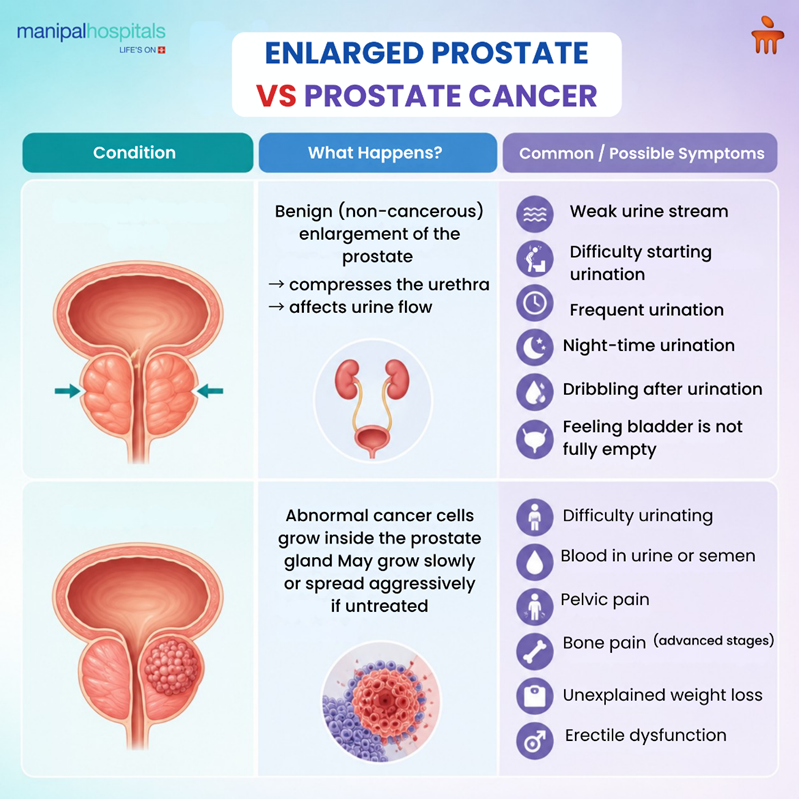
Enlarged Prostate Vs Prostate Cancer: What’s the Difference?
Although both conditions affect the prostate, they behave in very different ways.
-
An enlarged prostate is called benign prostatic hyperplasia (BPH). It is not cancer. This condition occurs as the prostate tissue slowly grows and squeezes the urethra.
-
In contrast, prostate cancer develops when abnormal cells grow out of control inside the prostate gland. In some men, it is slow-growing. In others, it may spread aggressively if not treated.
Here’s something many patients don’t realise. Having an enlarged prostate doesn’t automatically increase the risk of prostate cancer. They can occur separately, but some men may have both conditions. The following are the differences between the two:
|
Feature |
Enlarged Prostate |
Prostate Cancer |
|
Nature |
Non-cancerous growth |
Malignant tumour |
|
Common Age Group |
Men above 50 |
Risk rises after 50 |
|
Growth Pattern |
Slow enlargement |
Can be slow or aggressive |
|
Urinary Symptoms |
Very common |
May occur later |
|
Blood in Urine |
Less common |
More concerning |
|
Risk to Life |
Usually not life-threatening |
Can become serious if untreated |
This comparison helps patients understand the importance of a proper evaluation, rather than assuming every urinary symptom is cancer.
What Causes an Enlarged Prostate?
The exact reason behind an enlarged prostate is still not completely clear, but it is mostly linked to ageing and changes in hormone levels as men grow older.
Certain factors may make prostate enlargement more likely, including:
-
Increasing age
-
Changes in hormones like DHT
-
Family history
-
Excess weight and low physical activity
-
Diabetes and other metabolic problems
Many men also notice that their symptoms feel worse after drinking too much caffeine, sitting for long hours, or travelling for extended periods.
What Causes Prostate Cancer?
This cancer, like all cancers, develops from abnormal mutations of cells.
Risk factors include:
-
Older age
-
Family history of cancer
-
Obesity
-
Tobacco use
-
High-fat diets
-
Mutations in genes
Diagnosis
Symptoms alone are not a good way to distinguish between the two conditions. Doctors use several tests to evaluate the prostate.
Common Diagnostic Tests:
-
PSA Blood Test: Check the blood for PSA levels. Both prostate cancer and enlarged prostate show increased levels.
-
Digital Rectal Examination (DRE): Allows doctors to feel the prostate for enlargement or abnormal hard areas.
-
Ultrasound or MRI: Imaging helps evaluate prostate size and suspicious changes.
-
Biopsy: A biopsy can be done if there is suspicion of cancer to see if abnormal cells are present.
Many patients are surprised to learn that PSA levels can rise even with non-cancerous prostate gland enlargement.
Treatment for Enlarged Prostate
The approach to care depends entirely on which condition is present and how much it is affecting your quality of life.
Lifestyle Modifications
Mild cases may be adjusted with simple changes:
-
Reduce caffeine and alcohol
-
Reducing fluid intake a few hours before bedtime may help reduce nighttime urination
-
Regular workout
-
Healthy weight control
-
Exercises for bladder training
Sometimes, even small lifestyle changes can noticeably reduce urinary discomfort.
Medications
Doctors commonly prescribe:
-
Alpha-blockers: Relax prostate muscles and enhance urine flow.
-
5-alpha reductase inhibitors: Aid in the gradual reduction of the prostate.
Usually, these medications provide excellent symptom relief without surgery.
Minimally Invasive Procedures
If medicines aren’t working well enough, procedures may be recommended.
Some examples include:
-
Laser prostate surgery
-
UroLift procedure
-
TURP (Transurethral Resection of the Prostate)
-
Rezūm Water Vapor Therapy
Many modern procedures now allow patients to return home much sooner than traditional surgery.
Prostate Cancer Treatment Options
Your treatment will depend on the cancer stage, age, general health, and aggressiveness of the tumour. Common treatment approaches for prostate cancer:
-
Active Surveillance: Slow-growing cancer may simply be monitored regularly.
-
Surgery: In some patients, the prostate gland may be recommended for removal.
-
Radiation Therapy: Targets cancer cells specifically.
-
Hormone Therapy: Decreases testosterone stimulation of cancer cells.
-
Chemotherapy: Used mainly in advanced prostate cancer.
Modern cancer treatment has improved dramatically over the past decade, and especially so if the cancer is detected early. Patients coming for prostate cancer treatment in Whitefield often want multi-disciplinary cancer management, personalised care, and advanced imaging.
When Should You See a Doctor?
Many men ignore urinary symptoms because they think it is just a part of ageing. Such behaviour can delay an important diagnosis.
You should seek medical evaluation if you notice:
-
Trouble urinating
-
Haematuria (Blood in urine)
-
Frequent urination at night
-
Alterations in urination
-
Pelvic pain
-
Unintentional weight loss
Early evaluation also helps rule out serious disease and improves outcomes for both BPH and prostate cancer. BPH affects nearly half of men over 60. If you are experiencing any of the above symptoms, consult a urologist in Whitefield, Bangalore, for proper evaluation and timely treatment.
Conclusion
Urinary symptoms can be worrying, particularly when words such as enlarged prostate and prostate cancer start popping up on the internet. Both conditions involve the same gland, but they are very different medical problems with very different risks and treatments. Being aware of the signs, having prostate gland enlargement diagnosed early, and seeking medical advice quickly can greatly affect the outcomes.
Advanced evaluation of prostate conditions, including imaging, PSA testing, minimally invasive urology procedures, and comprehensive prostate cancer treatment in Whitefield, Bangalore, at Manipal Hospitals. The best way to keep your prostate healthy over the long term is to catch any issues early and get the right care.
FAQ's
No. An enlarged prostate does not always turn into this cancer. Both conditions, however, may sometimes coexist in older men.
No. Early cancer does not produce any symptoms. Routine PSA screening finds many cases before later urinary symptoms or pain occur.
Most men should talk about prostate screening after age 50. Those with a family history or higher risk may need early evaluation around age 45.
Yes. Regular exercise helps maintain a healthy bladder, control weight, improve blood circulation, and potentially reduce urinary symptoms of an enlarged prostate gland in the long run.
In many cases, this cancer is very treatable if it is diagnosed early. Results depend on the stage of cancer, how aggressive it is, your overall health, and how quickly treatment starts.
Share this article on: