8 Min Read
Many people do not realise they have kidney disease until the damage becomes more serious. Symptoms like swelling in the feet, tiredness, or waking up multiple times at night to urinate are often ignored in the beginning, but they can sometimes be early signs of chronic kidney disease (CKD). In India, CKD contributes to a high percentage of kidney problems, with recent studies showing a pooled prevalence of around 13-17% among adults and rising from 11% (2011-2017) to 16% (2018-2023).
These diseases are becoming more common due to lifestyle changes, stress, obesity, poor eating habits, and lack of exercise. Now doctors are seeing kidney damage at an earlier age. Over time, uncontrolled diabetes and high blood pressure can damage the tiny blood vessels inside the kidneys, reducing their ability to filter waste properly.
In this blog, we will discuss how diabetes affects the kidneys, the connection between high BP and kidney disease, common warning signs of CKD, and ways to protect long-term kidney health.
Synopsis
- Our Kidneys: What Do They Do?
- How Does Diabetes Affect Kidneys?
- How High Blood Pressure Hurts the Kidneys?
- How Do the Kidneys Help Regulate Blood Pressure?
- How Do Diabetes and High Blood Pressure Increase CKD Risk?
- Early Warning Signs of Kidney Damage
- Chronic Kidney Disease: Stages and How It Progresses
- What is kidney failure?
- How Doctors Diagnose Kidney Disease?
- Managing Diabetes to Protect the Kidneys
- Managing High Blood Pressure for Kidney Protection
- Managing Advanced Kidney Disease
- Conclusion
Our Kidneys: What Do They Do?
The kidneys are two bean-shaped organs situated near the lower back. Although they are relatively small, they do some of the most important work in the body.
Kidneys help:
-
Remove waste from the blood
-
Balance body fluids
-
Regulate minerals
-
Produce hormones
-
Support red blood cell production
-
Help regulate blood pressure
In simple terms, the kidneys are working 24x7, filtering around 180 litres of fluid daily. So, even a little damage left unmanaged over a long time can affect their functionality.
How Does Diabetes Affect Kidneys?
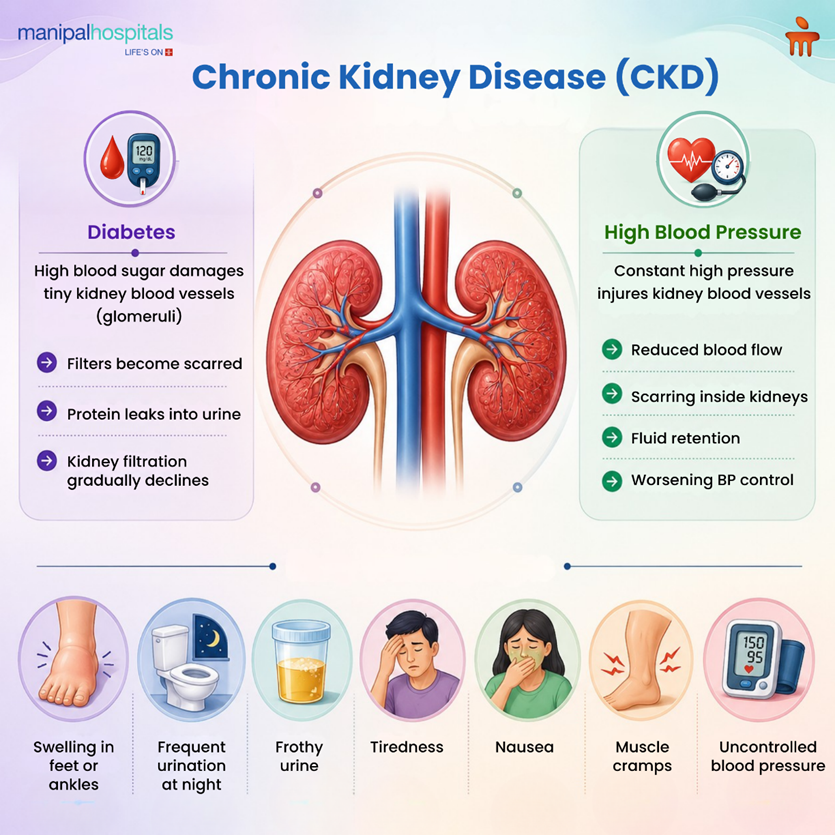
Many people with diabetes are aware of eye problems or nerve damage, but fewer know how diabetes affects the kidneys. Over time, high blood sugar damages the tiny blood vessels in the kidneys called glomeruli. These filters get more and more scarred and less efficient.
Diabetic Nephropathy: Early Kidney Damage in Diabetes
Over several years, hyperglycemia causes the tiny blood vessels inside the kidney filters to thicken. This leads to a condition called diabetic nephropathy. As the damage progresses:
-
The kidney filters gradually become scarred.
-
The “leaky” blood vessels allow albumin (a blood protein) to pass into the urine, a condition known as albuminuria.
-
The kidney filtration rate, called the Glomerular Filtration Rate (GFR), begins to decline.
-
Waste products begin to build up in the blood and affect overall health.
Because early-stage diabetic nephropathy is often asymptomatic, regular screening for protein in the urine is essential for anyone diagnosed with diabetes.
How High Blood Pressure Hurts the Kidneys?
Many patients are surprised to learn how closely related kidney disease and high blood pressure are. The kidneys have thousands of tiny blood vessels. Over time, constant pressure can damage these delicate vessels, reducing blood flow and impairing kidney function.
Long-Term Effects of High Blood Pressure on the Kidneys
High blood pressure that stays high may cause the following:
-
Narrowing of the kidney blood vessels
-
Scarring inside the kidney tissue
-
Reduced filtration ability
-
Fluid buildup
-
Worsening blood pressure control
This is a dangerous cycle, because damaged kidneys can also cause further increases in blood pressure.
How Do the Kidneys Help Regulate Blood Pressure?
The kidneys regulate blood pressure through the Renin-Angiotensin-Aldosterone System (RAAS), which controls fluid balance and hormone signals in the body. When the kidneys sense a drop in blood flow or a change in sodium levels, they release an enzyme called renin. This triggers a hormonal chain reaction that causes blood vessels to constrict and the body to retain salt and water, thereby raising blood pressure. When the kidneys are diseased, this system can become overactive, leading to:
-
Fluid retention increases
-
Sodium balance changes
-
Hormones become dysregulated
This results in blood pressure being harder to control. This phenomenon explains why high BP and kidney disease are medically linked.
How Do Diabetes and High Blood Pressure Increase CKD Risk?
Diabetes and high blood pressure are concerning conditions on their own that need consistent and regular management. However, when they occur together, it can affect the kidneys as well. When both blood sugar and blood pressure remain uncontrolled for a long time, kidney damage may progress faster and lead to serious complications.
This may increase the risk of:
-
Faster decline in kidney function
-
Heart disease
-
Stroke
-
Kidney failure
In India, doctors are increasingly seeing younger patients developing CKD as diabetes and hypertension are appearing at an earlier age.
Early Warning Signs of Kidney Damage
Kidney disease generally develops quietly. Common early symptoms include the following:
-
Swelling in the feet or ankles
-
Tiredness, loss of appetite
-
Frequent urination at night
-
Frothy urine
-
Uncontrolled blood pressure
-
Muscle cramps
Many people ignore the symptoms as they appear gradually. Unfortunately, by the time symptoms appear, the kidneys may already have sustained significant damage.
Chronic Kidney Disease: Stages and How It Progresses
Chronic Kidney Disease (CKD) develops gradually over time, often progressing silently for years before noticeable symptoms appear. As kidney function declines, waste products and excess fluids begin accumulating in the body. Understanding the stages of CKD can help with timely diagnosis and better disease management:
|
CKD Stage |
What Happens |
|
Early Stage |
Mild kidney damage with few symptoms |
|
Moderate Stage |
Waste products begin building up |
|
Advanced Stage |
Symptoms become noticeable |
|
Severe Stage |
Kidney function drops significantly |
|
End Stage |
Kidney failure may require dialysis or a transplant |
Early diagnosis makes a big difference in halting progression.
What is kidney failure?
Kidney failure occurs when the kidneys can no longer adequately filter waste and fluid from the body.
This can lead to the following conditions:
-
Severe swelling
-
Breathing difficulty
-
Dangerous electrolyte imbalance
-
Toxin buildup
-
Heart complications
Kidney failure can be life-threatening without treatment.
How Doctors Diagnose Kidney Disease?
Usually, doctors start with simple investigations. Common tests include:
-
Blood Tests: Measure kidney function and creatinine levels.
-
Urine Tests: Detects protein leakage or blood.
-
Monitoring Blood Pressure: Important to evaluate high BP and kidney disease.
-
Ultrasound: Checks kidney size and structural changes.
-
eGFR Calculation: Estimates kidney filtering capacity.
Consult a nephrologist in Whitefield for timely kidney evaluation, accurate diagnosis, and personalised treatment guidance.
Managing Diabetes to Protect the Kidneys
Good control of blood sugar greatly reduces the risk of kidney damage. Helpful measures include:
-
Regular glucose monitoring
-
Healthy eating habits
-
Exercise
-
Weight control
-
Taking medications properly
-
Periodic kidney screening as suggested by doctors
For many patients, learning how diabetes can affect the kidneys is a strong motivator to get more serious about managing their diabetes over the long term.
Managing High Blood Pressure for Kidney Protection
Controlling high blood pressure is one of the best ways to slow the progression of CKD.
Strategies for blood pressure control:
-
Reduce Salt Intake: Excess salt can increase fluid retention and raise blood pressure.
-
Stay Active: Exercise helps circulation and helps control BP.
-
Maintain a Healthy Weight: Obesity increases strain on the kidneys.
-
Avoid Smoking: Smoking damages blood vessels even more.
-
Take Medicines Consistently: Missing medications worsens kidney injury.
Lifestyle management and medication adjustments are often needed for patients with high blood pressure in Whitefield.
Managing Advanced Kidney Disease
With proper treatment and lifestyle changes, early kidney damage can sometimes be slowed or stabilised. However, severe kidney damage is often permanent, which is why early diagnosis and regular treatment are important.
If chronic kidney disease progresses to an advanced stage, more specialised treatment may be needed, including:
-
Dialysis: Dialysis is a treatment that helps remove waste, toxins, and excess fluid from the body when the kidneys can no longer function properly. The two main types are haemodialysis and peritoneal dialysis.
-
Kidney Transplant: Some patients with advanced kidney failure may be suitable candidates for a kidney transplant. Compared to long-term dialysis, a successful transplant can significantly improve quality of life and overall health outcomes.
Conclusion
Diabetes and hypertension are on the rise in India, leading to an increase in chronic kidney disease. Understanding the impact of diabetes on the kidneys and how the kidneys control blood pressure helps patients to understand why these conditions should never be ignored.
Patients seeking blood pressure treatment in Whitefield, Bangalore, often look for expert kidney-focused hypertension care, diabetes and kidney management, advanced diagnostics, personalised treatment, and long-term monitoring. Visit Manipal Hospitals Whitefield for comprehensive care tailored to your health needs.
FAQ's
Yes. Kidney disease may start off slowly, and there may be no symptoms at all. Periodic tests for blood and urine could detect any changes and prevent more damage to the kidneys.
When the kidneys are damaged, they cannot remove excess fluid efficiently. This makes the body retain water and causes swelling in the feet, ankles, and legs, or sometimes around the eyes.
Not always, at first, but many people eventually develop high blood pressure because damaged kidneys can no longer appropriately regulate fluid balance and blood vessel hormones.
Yes. Repeated episodes of dehydration can reduce blood flow to the kidneys and place additional stress on already weakened kidneys, particularly in individuals with diabetes, severely high blood pressure, or pre-existing kidney damage.
Yes. Obesity, diabetes, unhealthy diets, and uncontrolled blood pressure are leading to kidney disease increasingly occurring in younger Indian adults.
Share this article on: