8 Min Read
Hearing that you might need brain or spine surgery can feel overwhelming. For many people, the first thoughts that come to mind involve large incisions, long hospital stays, and weeks of difficult recovery. Understandably, the idea of traditional neurosurgery can create a lot of anxiety. Medicine, however, has undergone a radical transformation in the last few decades. Today, surgeons are able to perform operations on patients suffering from neurological disorders using techniques that involve smaller incisions and high-tech imaging. This approach, known as minimally invasive neurosurgery, focuses on reaching the affected area while causing as little disturbance as possible to the surrounding healthy tissue.
The aim is straightforward: treat the condition effectively, and at the same time, assist your body in recovering from the procedure as quickly and smoothly as possible. In this blog, we will inform you about what is minimally invasive neurosurgery, the various types of minimally invasive neurosurgery procedures performed today, and what is involved in the recovery process.
Synopsis
- What Is Minimally Invasive Neurosurgery?
- Conditions That Can Be Treated with Minimally Invasive Neurosurgery
- Common Minimally Invasive Neurosurgery Procedures
- Benefits of Minimally Invasive Neurosurgery
- How Minimally Invasive Neurosurgery Differs from Traditional Surgery
- Recovery After Minimally Invasive Neurosurgery
- Conclusion
What Is Minimally Invasive Neurosurgery?
Advances in surgical technology have allowed neurosurgeons to treat complex brain and spine conditions through much smaller openings than before. Rather than making major surgical incisions, surgeons today use accurate imaging, microscopes, and specialised tools to gain access to the involved area.
But what is minimally invasive neurosurgery? Simply put, it is a surgical method that enables surgeons to gain access to the brain, spinal cord, or nerves via small incisions, minimal surgical corridors, and image guidance systems.
To make such an approach possible, surgeons combine several technologies during the operation. These tools allow them to work with exceptional accuracy while keeping the procedure controlled and safe.
Technologies that are commonly employed include:
-
Operating microscopes give magnified and high-resolution images of small nerve fibres
-
Endoscopic cameras enable the surgeon to visualise the inside of the body through a narrow pathway
-
Neuronavigation systems serve as a GPS for the brain and spinal cord during surgery
-
Specialised tubular retractors separate tissues instead of cutting through them
-
High-precision surgical instruments designed for delicate work in the nervous system
These technologies combined enable the surgeon to treat a condition that previously needed major surgery with a far more refined technique.
Conditions That Can Be Treated with Minimally Invasive Neurosurgery
Not all conditions of the nervous system require open surgery. In fact, many conditions can be treated through smaller surgical pathways with the same effectiveness.
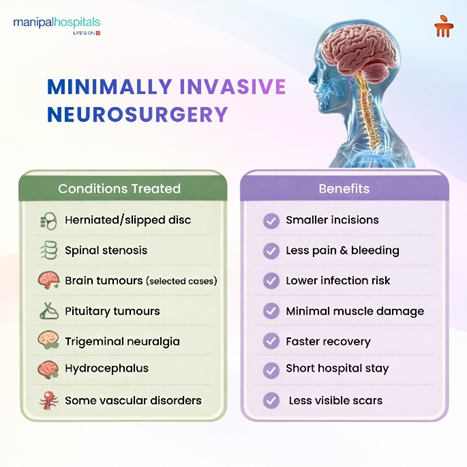
The doctors would consider minimally invasive neurosurgery as an option if the condition can be safely approached without fully exposing the surrounding areas.
Examples of conditions commonly treated this way include:
-
Herniated or slipped discs in the spine
-
Spinal stenosis causing nerve compression
-
Certain brain tumours located in accessible areas
-
Pituitary tumours affecting hormone balance
-
Trigeminal neuralgia causes severe facial pain
-
Hydrocephalus requiring shunt placement or endoscopic treatment
-
Some vascular abnormalities of the brain
Each condition is carefully evaluated with imaging such as MRI or CT scans. This helps the neurosurgeon determine whether a minimally invasive technique is suitable for your situation.
Common Minimally Invasive Neurosurgery Procedures
The field of neurosurgery now includes several advanced techniques designed to treat neurological conditions while minimising surgical trauma. These procedures rely heavily on precision instruments and imaging guidance.
Some widely used minimally invasive neurosurgery procedures include:
Endoscopic Brain Surgery
This technique uses a thin camera called an endoscope inserted through a small opening in the skull or nasal passage. It allows surgeons to remove tumours or treat fluid build-up in the brain without large craniotomies.
Microdiscectomy for Herniated Disc
A small incision is made in the lower back, and specialised instruments are used to remove the portion of a disc pressing on a nerve. This relieves pain while preserving most of the surrounding structures.
Minimally Invasive Spinal Fusion
Instead of opening a large section of the back muscles, surgeons insert implants through narrow channels to stabilise unstable spinal segments.
Endoscopic Pituitary Tumour Surgery
Tumours located at the base of the brain can often be removed through the nasal passages using an endoscope, avoiding external incisions.
Keyhole Brain Surgery
Small openings in the skull allow surgeons to reach specific brain areas while limiting exposure to healthy tissues.
Benefits of Minimally Invasive Neurosurgery
One of the most advantageous aspects of these modern methods is how much they alleviate the physical discomfort that comes with surgery. Of course, there is always some risk involved with any surgical procedure, but the goal of minimally invasive surgery is to make the process easier on the body.
The following are some of the benefits of minimally invasive neurosurgery:
-
Smaller incisions that result in less noticeable scarring
-
Less damage to the muscles, especially in spinal surgery
-
Less chance of infection because less of the body is exposed
-
Less bleeding during surgery
-
Shorter recovery time, sometimes only a day or two in the hospital
-
Faster return to normal activities compared to traditional surgery
-
Less pain after surgery, sometimes eliminating the need for strong pain medication
How Minimally Invasive Neurosurgery Differs from Traditional Surgery
While both approaches aim to treat the underlying condition effectively, the way surgeons access the problem area is quite different. The choice between these approaches depends on the complexity and location of the condition:
|
Feature |
Minimally Invasive Neurosurgery |
Traditional Neurosurgery |
|
Surgical access |
Small incisions or natural openings |
Larger incisions with wider exposure |
|
Tissue disruption |
Minimal muscle and bone disturbance |
Greater separation of muscles and tissues |
|
Visualisation tools |
Endoscopes, microscopes, and navigation systems |
Direct visual access with surgical exposure |
|
Operating time |
Often shorter for selected procedures |
May be longer due to a larger surgical field |
|
Blood transfusion need |
Generally uncommon |
Higher likelihood in some procedures |
|
Rehabilitation timeline |
Many resumes have routine activities sooner |
The recovery period may be longer |
|
Cosmetic outcome |
Smaller scars or hidden incisions |
Larger visible surgical scars |
Recovery After Minimally Invasive Neurosurgery
One of the biggest concerns people have before surgery is how long recovery will take. While healing time varies depending on the procedure, minimally invasive techniques are designed to help you return to normal life sooner.
In many cases, it is encouraged to start gentle movement within a day of surgery. Walking early helps reduce stiffness and improve circulation, both of which support healing.
Recovery usually involves a combination of medical follow-up and gradual activity adjustments.
General post-operative care advice may include the following:
-
Short hospital stay and subsequent discharge in a few days
-
Return to normal activities in a few weeks
-
Physiotherapy if the muscles in the spine require strengthening
-
Follow-up imaging to check the outcome of the surgery
-
Temporary lifting or exercise restriction
These will be adjusted according to the type of surgery and the patient’s health by your doctor.
Conclusion
Facing neurological surgery can be intimidating, but understanding the available options often brings reassurance. Minimally invasive neurosurgery has revolutionised the way many brain and spinal disorders are managed. It provides very effective solutions with minimal surgical trauma and recovery. By using advanced imaging, specialised instruments, and highly refined techniques, neurosurgeons can often treat complex conditions through smaller openings and more precise pathways. The result is a safer surgical experience for many and a smoother recovery journey. For expert care and guidance, you can consult experienced neurosurgeons at Manipal Hospital Sarjapur Road.
If you are exploring treatment options or seeking expert care, consulting experienced specialists is an important step. Those looking for care at a top neurosurgery hospital in Sarjapur Road, Bangalore, can consider the advanced neurological services available at Sarjapur Road, Manipal Hospitals.
FAQ's
Seniors often benefit from minimally invasive surgery because of the faster recovery time associated with smaller incisions and less tissue trauma. However, their heart and lung health, as well as pre-existing conditions, are also considered before surgery.
Most brain and spine surgeries are performed under general anaesthesia, meaning you will be asleep during the procedure. However, in some special operations, surgeons may occasionally use awake techniques to monitor speech or movement.
Yes, spinal tumours can be treated by minimally invasive techniques. Surgeons use tubular retractors and advanced imaging techniques to access the tumour site while protecting the surrounding nerve and spinal tissues.
Surgical time varies widely depending on the condition being treated. Some spinal procedures may take one to two hours, while more complex brain surgeries may require longer operating times.
Possible concerns include nerve irritation, infection, bleeding, or incomplete symptom relief. Careful patient selection, advanced imaging, and experienced surgical teams help minimise these risks.
Share this article on: