7 Min Read
Some people notice a sharp pain in their elbow without a clear reason and wonder how they may have injured themselves. Golfer’s elbow, also called medial epicondylitis, is a condition that causes pain on the inner side of the elbow. The discomfort begins where the forearm muscles attach near the elbow.
What often goes unnoticed is that repeated use of the hand and wrist, such as gripping or lifting, can strain this area even when the activity is not heavy. Small areas of strain can build up slowly over time, causing irritation and pain in the area. The name can feel misleading, as many people who get golfer’s elbow have never played golf at all.
In this blog, a top orthopaedic and sports injuries specialist in Hebbal, Bangalore, walks you through what this condition is, how it develops, and what you can do to manage the pain and feel more comfortable.
Synopsis
What Is Golfer’s Elbow?
The inner side of your elbow has a small area where the forearm muscles are attached. These muscles help you hold things, grip, and move your wrist throughout the day. Medial epicondylitis begins in this exact spot.
The problem does not usually come from a single injury. It builds gradually with repeated movements like gripping, lifting, or even routine work that stresses the same area every day. At first, the discomfort is usually mild and easy to ignore. Over time, small amounts of damage build up if the strain continues, and the area becomes irritated.
Pain tends to become more noticeable when you use your hand again. But this time, even simple actions like holding a cup or turning your wrist can bring it on, because the same muscles are being used each time.
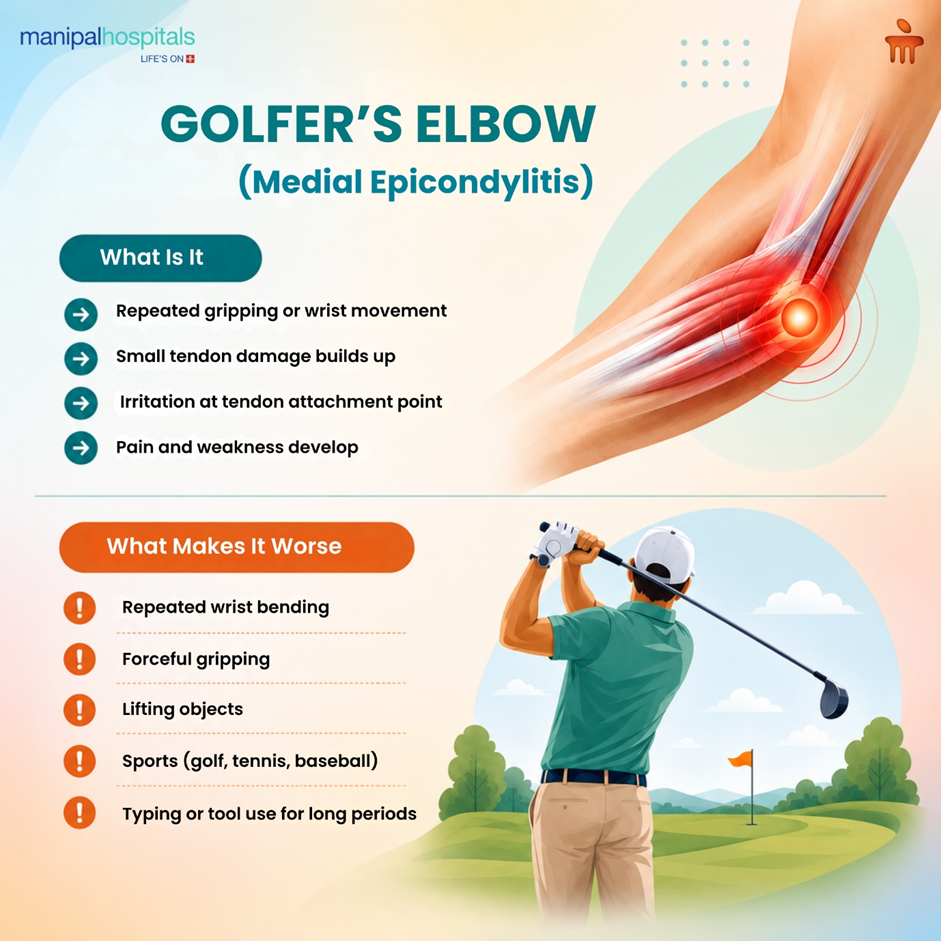
Symptoms of Golfer’s Elbow
Most people first notice a mild pain on the inner side of the elbow that does not feel serious at the beginning. It tends to build slowly and becomes more noticeable with regular use of the hand. Over time, other changes start to appear as the strain continues. Recognising these golfer's elbow symptoms early can help you avoid making the condition worse. Common symptoms include:
-
Pain on the inner side of the elbow, which may feel dull at first and then become sharper with use.
-
Pain that can spread down into the forearm, especially during movement.
-
Stiffness around the elbow, making it uncomfortable to bend or straighten the arm fully.
-
Weak grip strength makes it harder to hold objects firmly.
-
Tingling or numbness that may travel into the ring and little finger.
Pain that increases with gripping objects, lifting even light items, and bending the wrist or using the hand repeatedly.
Golfer’s Elbow at a Glance
The table below gives an overview of common symptoms, what may be causing them, and the usual steps that can help ease the strain and support recovery:
|
What You May Notice |
What It Often Means |
What Helps |
|
Pain on the inner side of the elbow |
The strain is where the forearm muscles attach |
Rest and reduce activities that trigger pain |
|
Pain spreading into the forearm |
Continued stress on the same muscle group |
Ice application and short-term pain relief if needed |
|
Weak grip or difficulty holding objects |
Muscles are not able to function at full strength |
Support straps and guided strengthening exercises |
|
Stiffness during movement |
Irritation is building up in the area over time |
Gentle stretching and physiotherapy |
|
Tingling in fingers |
The nearby nerve is getting irritated due to strain |
Medical evaluation if symptoms persist |
Common Causes and Risk Factors
The condition usually develops gradually rather than from one sudden injury. Repeated use of the forearm muscles without enough recovery time slowly puts stress on the tendon.
-
Repeated wrist and forearm movements like bending the wrist or turning the arm occur throughout the day.
-
Sports such as golf, baseball, or tennis, especially when the grip or form is not right.
-
Everyday work like plumbing, carpentry, or typing for long hours where the same motion keeps repeating.
-
Using the wrong technique or equipment can put more pressure on the elbow than expected.
-
Forceful movements that are done again and again without giving the arm time to recover.
-
More common between 30 and 60 years, when this kind of repeated strain starts to accumulate.
How Doctors Diagnose Golfer’s Elbow
Most of the time, the diagnosis comes from what you describe and how your elbow responds during a simple examination. Here is how it’s done:
-
Asking about your symptoms, how the pain started, and what activities worsen it.
-
Pressing on the inner side of the elbow to check for tenderness at the exact spot.
-
Asking you to bend your wrist or grip against resistance to see if it brings out the pain.
-
Checking how strong your grip is and whether it feels weaker than usual.
-
X-rays may be advised in some cases to rule out other problems like bone injury.
-
MRI scans are only considered if the pain is severe, long-standing, or not clearly explained.
Most cases do not need scans, as the condition can be identified through examination alone.
Treatment for Golfer’s Elbow
Understanding the right golfers' elbow treatment early can help prevent the pain from becoming long-lasting.
-
Reducing or stopping activities that trigger the pain, so the elbow gets time to recover.
-
Applying ice packs on the inner side of the elbow helps reduce discomfort after use.
-
Taking pain relief medicines like anti-inflammatory drugs if advised by a doctor.
-
Use a support strap around the forearm to reduce stress on the affected area.
-
Starting physiotherapy to gently stretch the muscles and slowly build strength again.
-
The following exercises improve movement without putting extra strain on the elbow.
-
In some cases, injections may be considered if pain does not improve with basic treatment.
-
Surgery is only considered if symptoms continue for several months and do not respond to other care.
When to See a Doctor:
You should see a doctor if you notice any of the following:
-
Pain that does not improve or keeps coming back
-
Discomfort that starts affecting daily activities
-
Weakness in the hand or difficulty holding objects
-
Numbness or tingling in the fingers, especially if it spreads
If it is diagnosed early, one can avoid making it more permanent and difficult to control.
Conclusion
Elbow pain may seem minor at first, but if it continues, it can start affecting daily activities. Ignoring it or repeating the same movements without change can make recovery slower and more difficult. Taking early steps, like reducing strain, adjusting how you use your hand, and allowing time for rest, can help manage the condition better.
Most people improve with the right care, but paying attention to early signs makes a real difference. If the pain is not settling or begins to interfere with your routine, it is best to get it checked. With our experienced orthopaedic and sports injuries specialists at Manipal Hospital Hebbal, Bengaluru, you can access the right guidance and support for golfer’s elbow treatment in Hebbal so the condition is managed before it becomes long-term.
FAQ's
Mild cases can settle with rest and reduced strain. If the same activity continues, the pain tends to come back. Simple care early on helps recovery move faster.
The difference is in where the pain is felt. Golfer's elbow affects the inner side of the elbow, while tennis elbow causes pain on the outer side. The cause is similar, but the area involved is different.
Yes, very often. Many people develop it from daily work or repetitive tasks like typing, lifting, or using tools, even if they have never played sports.
It depends on how early the strain is reduced. Some people improve in a few weeks, while others may take a few months if the condition has been present for longer.
If the pain does not improve, keeps returning, or you notice weakness or numbness in your hand or fingers, it is best to get it checked out.
Share this article on: