7 Min Read
Knee pain can gradually take away the freedom to walk, climb stairs, exercise, and enjoy daily activities. While many people assume that a knee replacement is the only solution for severe knee arthritis, that is not always the case. A high tibial osteotomy is an effective knee-preserving procedure that can delay or even prevent the need for joint replacement in carefully selected patients.
Our orthopaedics in Gurugram frequently evaluate patients with early to moderate knee arthritis who wish to remain active and preserve their natural knee joint for as long as possible. In such cases, a high tibial osteotomy may offer an excellent long-term solution.
Synopsis
- What Is a High Tibial Osteotomy?
- Why Is High Tibial Osteotomy Performed?
- How Does HTO Surgery Knee Correction Work?
- Who Is an Ideal Candidate for High Tibial Osteotomy?
- High Tibial Osteotomy Procedure: What Happens During Surgery?
- Benefits of High Tibial Osteotomy
- High Tibial Osteotomy Recovery Timeline
- Risks and Complications of High Tibial Osteotomy
- Tibial Osteotomy vs Knee Replacement: Which Is Better?
- Can High Tibial Osteotomy Prevent Knee Replacement?
- When Should You Consult a Specialist?
- Conclusion
What Is a High Tibial Osteotomy?
A high tibial osteotomy is a specialised knee preservation surgery designed to correct knee alignment and redistribute weight away from the damaged part of the knee joint.
In many patients with knee arthritis, the inner (medial) side of the knee bears excessive pressure due to bow-legged alignment. During a high tibial osteotomy, the upper portion of the shin bone (tibia) is carefully cut and realigned to shift body weight towards the healthier side of the knee.
This correction helps reduce pain, improve function, and slow the progression of arthritis while preserving the patient's natural joint.
Why Is High Tibial Osteotomy Performed?
A high tibial osteotomy is generally recommended for younger and active individuals who have:
-
Early to moderate knee osteoarthritis
-
Bow-legged knee alignment (varus deformity)
-
Cartilage damage is primarily on one side of the knee
-
Persistent knee pain despite non-surgical treatment
-
A desire to postpone total knee replacement
Unlike joint replacement surgery, a high tibial osteotomy preserves the native knee structures and allows patients to maintain a more active lifestyle.
How Does HTO Surgery Knee Correction Work?
The primary objective of HTO surgery knee correction is to change the mechanical axis of the leg.
When arthritis affects only one compartment of the knee, excessive body weight continues to pass through the damaged area with every step. A high tibial osteotomy alters the alignment of the tibia so that weight is distributed more evenly across the knee.
This biomechanical correction can:
-
Relieve pain
-
Reduce joint stress
-
Improve knee function
-
Slow cartilage degeneration
-
Delay knee replacement surgery
Because the patient's own joint is preserved, many individuals experience a more natural-feeling knee compared with artificial joint replacement.
Who Is an Ideal Candidate for High Tibial Osteotomy?
Not every patient with knee pain is suitable for a high tibial osteotomy.
The best candidates typically include:
-
Adults below 60 years of age
-
Active individuals wishing to continue sports or physical activity
-
Patients with isolated medial compartment arthritis
-
People with good knee range of motion
-
Individuals without severe ligament instability
A thorough clinical assessment and imaging evaluation by our bone specialist in Gurugram can help determine whether a high tibial osteotomy is the most suitable treatment option.
High Tibial Osteotomy Procedure: What Happens During Surgery?
During a high tibial osteotomy, the surgeon carefully creates a controlled cut in the upper tibia.
Depending on the patient's anatomy and correction required, one of two techniques may be used:
Opening-Wedge High Tibial Osteotomy
In this method, a small wedge-shaped gap is created and gradually opened to correct alignment. The gap may be filled with bone graft material and stabilised using specialised plates and screws.
Closing-Wedge High Tibial Osteotomy
This technique involves removing a wedge of bone and bringing the remaining bone surfaces together to achieve the desired correction.
Both approaches aim to restore optimal knee alignment and improve long-term joint function.
Benefits of High Tibial Osteotomy
A high tibial osteotomy offers several advantages for appropriately selected patients:
-
Preserves the Natural Knee Joint - Unlike replacement surgery, the original joint structures remain intact.
-
Delays Knee Replacement - Many patients can postpone total knee replacement by several years or even decades.
-
Supports Active Lifestyles - A high tibial osteotomy often allows patients to continue recreational activities and sports.
-
Reduces Arthritis Symptoms - Correcting alignment significantly decreases pressure on damaged cartilage.
-
Improves Quality of Life -Patients frequently experience better mobility, reduced pain, and greater independence.
At our orthopaedics in Gurugram, preserving natural joint function whenever possible remains a key treatment objective.
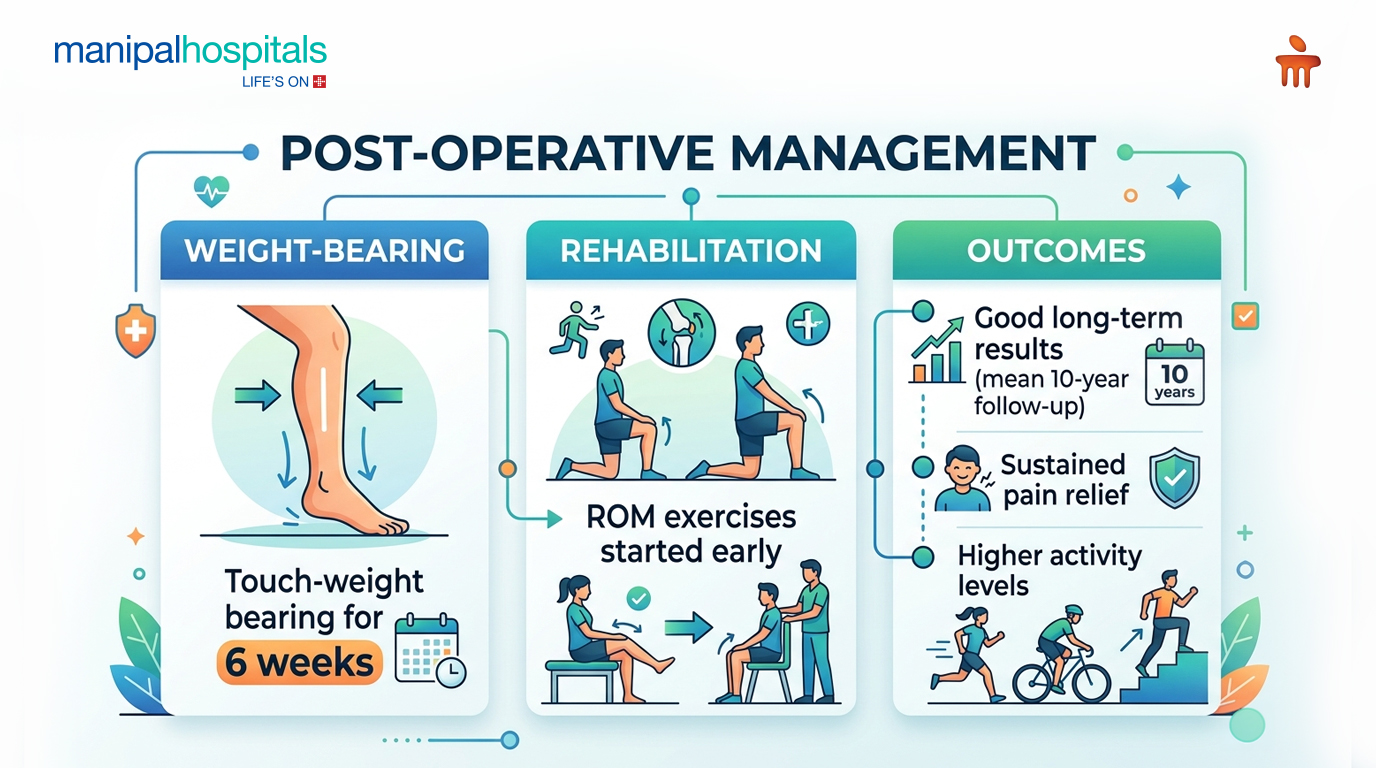
High Tibial Osteotomy Recovery Timeline
Recovery following a high tibial osteotomy occurs gradually.
First Few Weeks
-
Pain and swelling are managed with medication
-
Walking aids may be required
-
Physiotherapy begins early
6 to 12 Weeks
-
Progressive weight-bearing is introduced
-
Muscle strength improves
-
Mobility gradually returns
3 to 6 Months
-
Most patients resume routine daily activities
-
Functional recovery continues
6 to 12 Months
-
The full benefits of the high tibial osteotomy become more evident
-
Many patients return to recreational activities
Following rehabilitation guidelines is crucial for achieving the best outcome.
Risks and Complications of High Tibial Osteotomy
Like all surgical procedures, a high tibial osteotomy carries certain risks.
Potential complications include:
-
Infection
-
Blood clots
-
Delayed bone healing
-
Nerve or blood vessel injury
-
Persistent pain
-
Overcorrection or undercorrection
However, careful patient selection and experienced surgical techniques significantly reduce these risks.
Tibial Osteotomy vs Knee Replacement: Which Is Better?
One of the most common questions patients ask is about tibial osteotomy vs knee replacement.
|
High Tibial Osteotomy |
Knee Replacement |
|
Preserves natural joint |
Replaces damaged joint |
|
Suitable for younger active patients |
Often preferred for advanced arthritis |
|
Maintains natural knee mechanics |
Artificial joint mechanics |
|
Delays future replacement |
Provides definitive treatment |
|
Allows higher activity levels in selected cases |
Activity restrictions may apply |
The choice between tibial osteotomy vs knee replacement depends on age, arthritis severity, alignment, activity level, and overall knee condition.
At our orthopaedics in Gurugram, treatment decisions are individualised to ensure the most appropriate long-term outcome.
Can High Tibial Osteotomy Prevent Knee Replacement?
A high tibial osteotomy cannot completely stop arthritis progression. However, by redistributing pressure within the knee, it can significantly slow joint deterioration.
For many patients, this procedure delays knee replacement for years and sometimes much longer, making it an excellent option for those who are not yet ideal candidates for joint replacement surgery.
When Should You Consult a Specialist?
Seek medical evaluation if you experience:
-
Persistent knee pain
-
Difficulty walking
-
Bow-legged knee alignment
-
Reduced physical activity due to discomfort
-
Early arthritis diagnosed on imaging
Early intervention often improves treatment outcomes and expands the available options for knee preservation surgery.
Conclusion
A high tibial osteotomy remains one of the most valuable procedures for preserving the natural knee in active individuals with early to moderate arthritis. By correcting alignment and reducing stress on damaged cartilage, this advanced knee preservation surgery can relieve pain, improve mobility, and delay the need for joint replacement.
If you have been considering options beyond joint replacement, discussing HTO surgery knee correction with an experienced orthopaedic specialist may help you preserve your natural joint and maintain an active lifestyle for years to come.
FAQ's
A successful high tibial osteotomy can provide symptom relief for 10–15 years or longer, depending on patient factors, activity levels, and arthritis progression.
Post-operative discomfort is expected, but pain is effectively managed with medications, rehabilitation, and physiotherapy.
Modern HTO surgery knee procedures have reported success rates exceeding 80–90% in appropriately selected patients.
Many patients return to low-impact and recreational sports after recovery, although recommendations vary depending on individual circumstances.
The decision between tibial osteotomy vs knee replacement depends on age, arthritis severity, alignment abnormalities, activity demands, and overall joint health. An orthopaedic evaluation is essential for determining the best option.
Share this article on:


.webp "Liver Cancer Treatment")


--What-Every-Prostate-Cancer-Patient-Should-Know.webp "Prostate Cancer Surgery: LRP Procedure & Recovery Guide")