7 Min Read
When it comes to our health, we seldom try to pay more attention to the signs, as we are too busy running our daily lives. This approach often proves ineffective, as heart diseases rarely make themselves known in their early stages. Being masters of compensation, our hearts can often function with significant underlying issues until a catastrophic event occurs. It builds quietly, plaque forming in arteries, blood flow subtly reducing, until one day, symptoms appear suddenly. That’s why cardiac screening isn’t just a test; it’s an early warning system.
The preventive screenings are all about identifying the silent markers of heart attacks or any cardiovascular disease before they are manifested. By shifting our focus from reactive treatment to proactive mapping, we can intervene with the lifestyle changes or the minor medical adjustments required that can result in extending life by decades. To put it in a nutshell:
Preventive heart screening helps with:
-
Detect hidden risks before symptoms begin
-
Identify lifestyle-related damage early
-
Guide timely medical intervention
-
Reduce the risk of heart attack and stroke
Think of it this way: you wouldn’t wait for your car to break down before servicing it; your heart deserves even more attention.
Synopsis
- Why Standard Check-ups Sometimes Miss the Big Picture
- What is a TMT (Treadmill Test) and How Does It Work?
- The Precision of CT Coronary Angiogram Explained
- TMT vs. CT Angiogram: Understanding the Key Differences
- Functional Assessment vs. Anatomical Mapping
- Conclusion: Investing in Your Heart’s Future
Why Standard Check-ups Sometimes Miss the Big Picture
One of the first steps to understanding your overall health is to do routine health checkups. Blood tests, ECGs, and blood pressure monitoring provide crucial insights into how your body is functioning while you are resting. They can help in flagging conditions like high cholesterol, diabetes, or irregular heart rhythms, which are all key contributors that usually lead to heart disease.
But here’s the catch: the heart doesn’t always reveal its problems when it’s at rest.
Most of the early-stage cardiac issues often develop quietly, without causing any noticeable symptoms or abnormalities in routine tests. This is because standard screenings offer a snapshot in time, typically when your body is calm, and your heart isn’t under any stress.
Let’s break down what they might miss:
-
Early plaque build-up in coronary arteries: If you have higher levels of cholesterol, the deposits of the same in your blood can start being collected in your arteries years before symptoms start to appear. These plaques may not immediately obstruct blood flow, so your ECG and basic tests can still appear completely normal, even when the disease process has already begun.
-
Reduced blood flow during exertion: On a day-to-day basis, you may feel perfectly fine; however, when you are exercising or climbing stairs, you experience discomfort, breathlessness, or fatigue. Routine tests don’t simulate these real-life conditions, which means exercise-induced issues can go undetected.
-
Silent ischemia (lack of oxygen to the heart): In certain cases, the heart muscle may not be getting enough oxygen, yet there might be no pain or warning signs. This condition is especially common in individuals who have diabetes. Standard tests may miss this condition entirely because the imbalance only becomes evident when the heart is working harder.
To put it simply, routine check-ups tell you how your heart is doing while it is resting, but not how it is performing under pressure or what’s happening inside your arteries.
That’s where advanced diagnostics come in:
-
A Treadmill Test (TMT) pushes your heart to work harder, helping uncover problems that only appear during physical stress.
-
A CT coronary angiogram goes a step further by providing a detailed, inside view of your coronary arteries, detecting even early plaque build-up before it causes symptoms.
Together, these tests help bridge the gap between “everything looks normal” and “everything actually is normal.”
What is a TMT (Treadmill Test) and How Does It Work?
The treadmill test, or TMT, is the gold standard for functional heart assessment. It is designed to observe how your heart handles physical exertion.
The Science of Stress: Measuring Functional Heart Capacity
During a TMT, you walk on a treadmill while connected to an ECG machine. Every three minutes (following the Bruce Protocol), the speed and incline of the treadmill increase. The goal is to push your heart rate to its predicted maximum.
As your heart pumps harder, it requires more oxygen-rich blood. If the coronary arteries are narrowed, they may be able to supply enough blood while you are sitting, but fail to do so during exercise. This mismatch causes specific changes in the ECG electrical patterns, signalling to the doctor that the heart is under "ischemic" stress.
The Precision of CT Coronary Angiogram Explained
If the TMT is about how the heart works, the CT coronary angiogram is about what the heart looks like.
3D Imaging: Visualising Plaque and Blockages Without Surgery
Unlike traditional angiography, which requires a catheter to be threaded through your groin or wrist, a CT angiogram is non-invasive. You lie in a doughnut-shaped scanner while a contrast dye is injected into a vein in your arm.
The scanner takes hundreds of high-resolution X-ray images, which a computer reconstructs into a detailed 3D model of your coronary arteries. This allows doctors to see the "pipes" of the heart in vivid detail, identifying even minor fatty deposits (plaque) that haven't yet caused a blockage.
The Significance of the Calcium Score in Predictive Health
A key component of this scan is the calcium score. This measures the amount of calcified (hard) plaque in your arteries.
-
Score of 0: Very low risk of a heart attack in the next 5 years.
-
Score over 400: High likelihood of significant artery disease, even if you feel perfectly healthy.
TMT vs. CT Angiogram: Understanding the Key Differences
Understanding which test to take requires knowing the difference between function and anatomy.
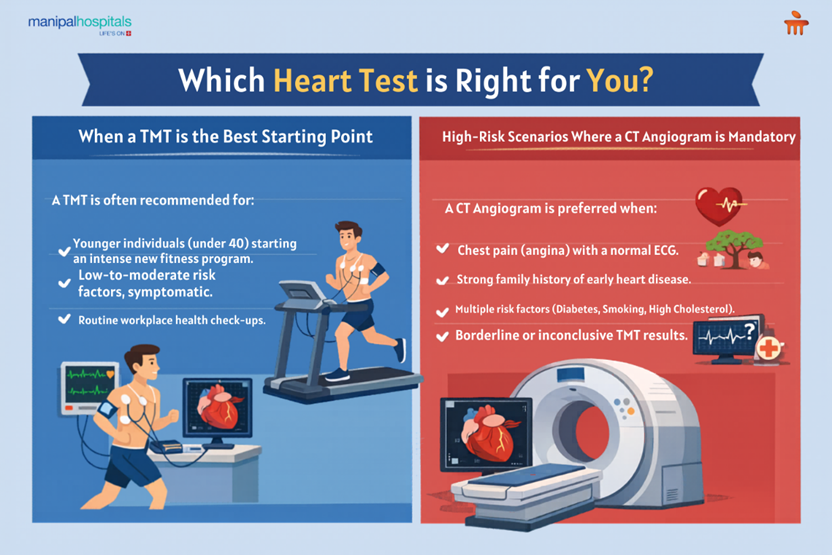
Functional Assessment vs. Anatomical Mapping
|
Feature |
TMT (Treadmill Test) |
CT Coronary Angiogram |
|
Primary Goal |
Evaluate heart performance under stress |
Visualise the physical structure of arteries |
|
Invasiveness |
Non-invasive (physical exercise) |
Minimally invasive (IV contrast injection) |
|
Key Output |
ECG changes and exercise capacity |
3D map of plaque and blockages |
|
Radiation |
Zero |
Minimal (X-ray-based) |
Conclusion: Investing in Your Heart’s Future
Your heart is a high-performance organ that rarely complains until the situation is critical. Choosing between a TMT and a CT angiogram isn't about which test is "better," but which one answers the specific questions your doctor has about your health.
Whether it’s the functional "road test" of the TMT or the high-definition "map" of the CT scan, investing a few hours in screening today can provide the peace of mind and the medical data needed to keep your heart beating strong for a lifetime. Talk to our cardiologist at Varthur Road today about which screening is right for you.
At Manipal Hospital Varthur Road, we offer a comprehensive range of advanced cardiac diagnostic services, from stress testing to high-speed CT imaging. Our expert cardiologists and state-of-the-art technology are dedicated to providing early detection and personalised care in your neighbourhood. Don’t wait for a warning sign; talk to the cardiologist specialists at Manipal Hospital Varthur Road today about which cardiac screening is right for you.
FAQ's
Preventive heart screening helps detect hidden risks before symptoms appear. It identifies early signs of cardiovascular disease, enables timely medical intervention, and reduces the risk of heart attacks and strokes by encouraging proactive care instead of reactive treatment.
Routine tests like ECGs and blood tests assess heart function at rest, but many heart issues develop silently and only appear during physical stress. Advanced diagnostic tests may be needed to notice conditions like early plaque build-up or reduced blood flow during exertion.
A TMT evaluates how your heart performs under physical stress. It is commonly recommended to detect exercise-induced heart issues, assess functional capacity, and identify reduced blood flow that may not be visible in resting conditions.
A CT coronary angiogram provides detailed 3D images of the coronary arteries, helping detect plaque and blockages. While TMT assesses heart function during stress, a CT angiogram focuses on the anatomical structure of the heart and identifies early-stage disease even before symptoms arise.
The choice depends on your symptoms, risk factors, and your doctor’s evaluation. A TMT is typically used to assess functional performance, while a CT angiogram is recommended for a more detailed view of artery health. Consulting a cardiologist is the best way to determine the right test for you.
Share this article on: