7 Min Read
Did you know that many newborns develop a yellowish tint on their skin within the first few days of life? While the condition can be worrying for parents, neonatal jaundice is quite common and, in most cases, harmless. It usually starts around the face or eyes and may gradually spread downward, becoming more noticeable over time.
This condition occurs when bilirubin builds up in a baby’s blood. A newborn’s liver is still developing, so it may not clear bilirubin well, which leads to the yellowish skin and eyes seen in jaundice.
While most cases resolve naturally as the liver strengthens, understanding the specific triggers and variations is key to ensure that your baby's health is well. Depending on the severity and timing, some infants may require specialized medical intervention to prevent complications.
In this guide, we will break down:
-
The different types of neonatal jaundice.
-
Common causes and risk factors.
-
Modern treatment options, ranging from simple home care to professional phototherapy.
-
Where to find expert jaundice treatment in Varthur Road to ensure your little one receives the best possible care.
Synopsis
- What Is Neonatal Jaundice?
- Why Does Jaundice Occur in Newborns?
- Types of Jaundice in Newborns
- Symptoms of Jaundice in Newborns
- Risk Factors for Neonatal Jaundice
- Diagnosis of Neonatal Jaundice
- Jaundice Treatment Options
- How Doctors Decide Treatment for Neonatal Jaundice
- Monitoring During Treatment
- When to Seek Medical Attention
- Conclusion
What Is Neonatal Jaundice?
Neonatal jaundice refers to the yellow discolouration of the skin and sclera in newborn babies. It usually shows up after the first 24 hours of life. With routine monitoring, mild neonatal jaundice usually resolves on its own within one to two weeks. This condition is more common in babies who are born too early because liver enzyme systems are less mature.
Before birth, bilirubin is cleared through the placenta. After delivery, the baby’s liver takes over this function. As the liver is still adapting, bilirubin may accumulate temporarily, which leads to jaundice in newborns. Monitoring ensures that bilirubin levels remain within safe limits.
Why Does Jaundice Occur in Newborns?
Several physiological adjustments occur after birth. Babies have higher red blood cell counts than adults. These cells break down after delivery, producing bilirubin. The newborn liver sometimes takes time to process this increased load.
Some common causes of jaundice are
-
immature liver enzymes
-
a faster turnover of red blood cells
-
delayed feeding.
Since the newborn livers aren't fully developed by this time, premature babies often get neonatal jaundice. Getting bruised during delivery may also make more bilirubin. When the mother's and baby's blood types don't match, red blood cells can break down more quickly. The severity of jaundice causes vary, which become the deciding factor in deciding whether treatment is required.
Types of Jaundice in Newborns
Doctors classify neonatal jaundice into different categories based on timing and underlying mechanism.
|
Physiological Jaundice |
This is the most common type. It appears after 24 hours and resolves naturally. Physiological neonatal jaundice rarely requires treatment and improves with feeding. |
|
Breastfeeding Jaundice |
This occurs when the baby receives insufficient breast milk during the first few days. Reduced intake slows bilirubin elimination. Increasing feeding frequency usually improves the condition. |
|
Breast Milk Jaundice |
This type appears after the first week. Substances in breast milk may temporarily affect bilirubin metabolism. Babies continue to feed well and remain healthy. |
|
Haemolytic Jaundice |
This develops when red blood cells break down quickly. Blood group incompatibility is a common cause. This type requires closer observation. |
|
Pathological Jaundice |
Pathological jaundice in newborns appears early or persists longer than expected. It may indicate an underlying disease and requires evaluation. |
When the newborn is diagnosed with jaundice, knowing which one of the different types of jaundice they have got helps the management decide the course of treatment.
Symptoms of Jaundice in Newborns
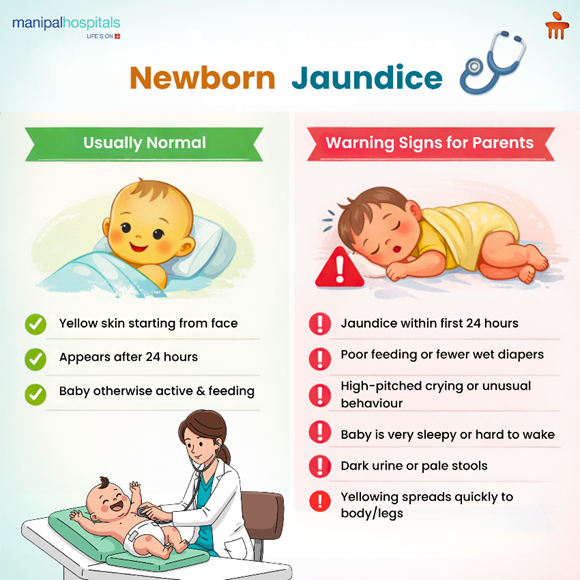
Some common signs of jaundice in newborns include:
-
Yellow discolouration of the skin, usually starting on the face and spreading downward
-
Dark urine or pale stools, which may need prompt medical attention
-
Reduced activity or a baby who seems unusually sleepy
-
Difficulty waking the baby for feeds
Recognising these symptoms early can help ensure timely care.
Risk Factors for Neonatal Jaundice
Some babies are more likely to get neonatal jaundice. Family history, low birth weight, and premature birth increase risk. Blood group incompatibility is another factor. Babies with bruising during delivery may also develop higher bilirubin levels. Inadequate feeding during early exclusive breastfeeding may contribute to jaundice in newborns.
Diagnosis of Neonatal Jaundice
Doctors check for jaundice by looking at the patient and measuring the bilirubin level. A handheld device can estimate bilirubin levels through the skin. Blood tests confirm levels when necessary. Age-specific charts are used to compare the results. Testing again helps keep track of progress.
Jaundice Treatment Options
Treatment depends on bilirubin levels and the baby’s age.
-
Phototherapy
-
Phototherapy is the most common treatment. The baby is placed under special lights that convert bilirubin into a form easily excreted. This treatment is safe and effective.
-
-
Feeding Support
-
Frequent breastfeeding helps improve hydration and promotes bilirubin elimination.
-
-
Intravenous Fluids
-
In some cases, IV fluids may be given to maintain hydration.
-
-
Exchange Transfusion
-
Severe neonatal jaundice may require exchange transfusion. This procedure replaces the baby’s blood to reduce bilirubin levels quickly.
-
These approaches form standard care for jaundice in newborns.
How Doctors Decide Treatment for Neonatal Jaundice
Doctors look at a few key factors before deciding the right treatment for neonatal jaundice.
|
Factor Considered |
What Doctors Look For |
Why It Matters |
|
Baby’s Age |
Hours or days since birth |
Early jaundice may indicate serious causes |
|
Bilirubin Level |
Measured through blood or skin tests |
Determines need for phototherapy or advanced care |
|
Feeding Pattern |
Frequency and adequacy of breastfeeding |
Poor feeding can worsen neonatal jaundice |
|
Birth Weight / Prematurity |
Low birth weight or preterm babies |
Higher risk of complications |
|
Rate of Increase |
How quickly are bilirubin levels rising |
A rapid rise may require urgent treatment |
Monitoring During Treatment
Babies undergoing treatment require regular bilirubin checks. Feeding, temperature, and hydration are monitored closely. Continuous assessment ensures safe recovery.
When to Seek Medical Attention
Parents should seek medical advice if they notice:
-
Jaundice in newborns appearing during the first day of life, as this may indicate underlying causes that need prompt evaluation
-
Yellowing that spreads quickly from the face to the abdomen or legs and becomes more noticeable over time
-
Poor feeding or the baby not feeding as usual
-
Reduced urine output or fewer wet diapers than expected
-
Difficulty waking the baby for feeds or unusually low activity levels
-
The baby appearing floppy, overly irritable, or not responding as usual
-
High-pitched crying or any behaviour that seems unusual
Monitoring is especially important in premature babies with neonatal jaundice, as they may need closer observation.
Conclusion
Jaundice in newborns usually shows up in the first week of life and often clears with close monitoring and good feeding. Still, knowing the possible causes and types of jaundice helps parents and doctors spot warning signs early. Parents should monitor feeding patterns, urine colour, and changes in skin tone, as these may indicate rising bilirubin levels. Prompt medical evaluation helps determine whether simple monitoring or active treatment is required.
If your baby shows persistent neonatal jaundice or needs specialised jaundice treatment in Varthur Road, consult the neonatology specialist at Manipal Hospital Varthur for timely assessment and appropriate care.
FAQ's
Yes, neonatal jaundice affects many newborns during the first week of life. It occurs due to immature liver function and increased bilirubin production. Most cases resolve with feeding and monitoring.
Jaundice causes include immature liver function, prematurity, and rapid breakdown of red blood cells. Blood group incompatibility may also contribute. Identifying the cause helps guide treatment.
Jaundice in newborns usually appears between days two and four after birth. Yellowing often begins on the face and spreads downward. Early onset requires evaluation.
Treatment includes phototherapy, feeding support, and monitoring bilirubin levels. Severe cases may require an exchange transfusion. Doctors decide treatment based on the bilirubin level.
Parents should consult a neonatologist if symptoms appear. Specialised centres provide monitoring and phototherapy. Professional care ensures safe jaundice treatment in Varthur Road.
Share this article on: