
Coronary Angiography
Manipal Hospitals delivers highly reliable diagnostic cardiac care, offering coronary angiography in India to precisely identify blockages and narrowing in the heart's arteries. This minimally invasive procedure utilises contrast dye and X-ray imaging to show how blood flows through the coronary vessels. Care pathways involve comprehensive pre-procedure evaluation, execution by expert interventional cardiologists in advanced catheterisation labs, and structured post-procedure monitoring. Teams prioritise patient safety and comfort, often utilising the radial (wrist) approach for faster recovery.
Hospital Locations
-

Old Airport Road - Bengaluru
-
.webp)
Mysuru
-

Mangaluru
-
Dwarka - Delhi NCR
-

Patiala
-

Jaipur
-

Vijayawada
-
Salem
-
Kharadi - Pune
-

Salt Lake - Kolkata
-

Bhubaneswar
-

Siliguri
-

Ranchi

How It Works
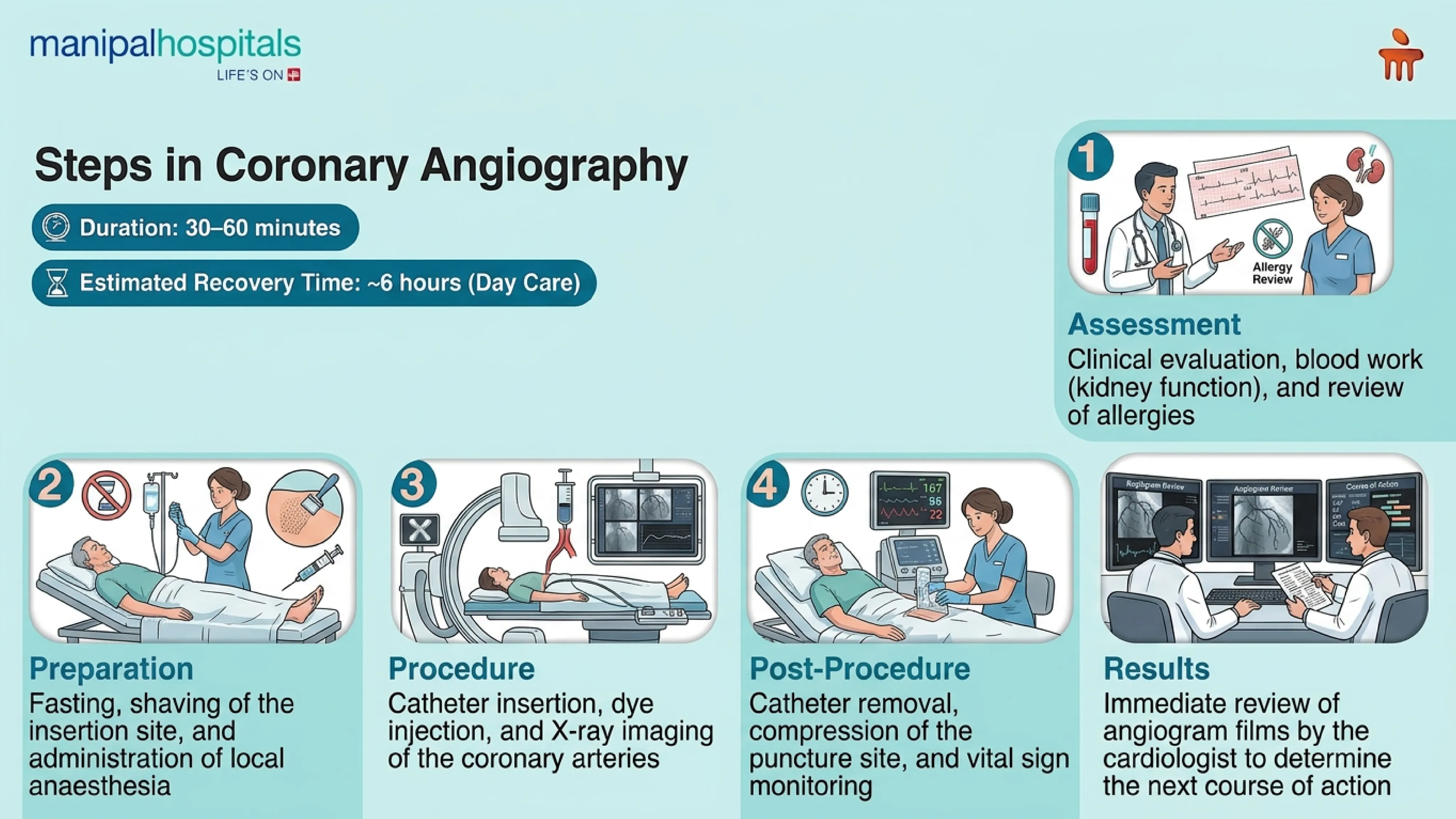
The coronary angiography procedure in India at Manipal Hospitals is performed in a high-tech catheterisation lab (Cath Lab). A thin, flexible tube called a catheter is guided through the blood vessel to the heart. Once in position, a contrast dye is injected through the catheter. As the dye flows through the coronary arteries, real-time X-ray movies (fluoroscopy) capture the blood flow. This reveals the exact location and severity of any blockages.
After the imaging is complete, the catheter is removed, and pressure is applied to the insertion site to prevent bleeding. The entire process is monitored continuously to ensure haemodynamic stability. If a significant blockage is seen, the doctor may discuss options for further treatment.
Advanced monitoring systems ensure patient safety, and the medical team explains every step to reduce anxiety and improve comfort. Dye reactions are uncommon, but the team monitors for them as a precaution. Clear instructions are provided for post-procedure care, helping patients resume recovery smoothly at home.
Didn’t find what you were looking for?
Request a CallbackBenefits
Coronary Angiography at Manipal Hospitals offers several important patient benefits:
-
The "Gold Standard" for diagnosing coronary artery disease
-
Real-time, high-definition visualisation of arterial blockages
-
Minimally invasive approach, often via the wrist, reducing bed rest
-
Expert interventional cardiologists ensure safety and precision
-
Many cases were completed as day-care procedures for a shorter hospital stay
What to Expect
Consultation and Diagnosis
The cardiologist explains the need for the procedure based on symptoms like angina or abnormal stress test results. Risks and benefits are discussed.
Pre-Operative Preparation
Patients are instructed to fast for 4–6 hours. Patients with diabetes or on blood thinners may receive personalised instructions from their doctor. An IV line is placed for hydration and medication.
Procedure Day
In the Cath Lab, the patient remains awake but may receive mild sedation. The heart rate and oxygen levels are monitored throughout the procedure.
During the Angiogram
The doctor guides the catheter to the heart. Patients might feel a warm flush when the dye is injected, but the procedure is generally not painful.
Recovery Room Monitoring
After the procedure, patients are moved to a recovery area. If the wrist approach was used, mobility is regained quickly; the groin approach requires lying flat for a few hours.
Discharge
Most diagnostic angiograms allow for same-day discharge. Patients receive instructions on wound care and activity restrictions.
Treatment Planning
The doctor reviews the images with the patient and family to decide if medication, stenting (angioplasty), or surgery is required.
Why Manipal Hospitals?
Manipal Hospitals is a preferred destination for the coronary angiography procedure in India, as it is performed with a strong focus on safety and accuracy. The hospital features advanced flat-panel Cath Labs that deliver high-resolution imaging with reduced radiation exposure. A skilled team of interventional cardiologists and technicians prioritises the trans-radial (wrist) access approach, helping minimise discomfort and lower the risk of bleeding for patients.
The hospital also provides efficient admission processes, streamlined care pathways, and digital image archiving for smooth workflow and quick reporting. Focus on infection control, advanced haemodynamic monitoring, and patient-centric protocols ensures accurate diagnoses with minimal stress. These combined strengths allow patients to receive timely assessment, faster recovery, and effective treatment planning for coronary artery disease.
Centre of Excellence
The Cardiology Department at Manipal Hospitals is a specialised centre for interventional and non-invasive cardiac care. The department is staffed by experienced cardiologists who manage both planned and emergency cases. It focuses on precision medicine, using the latest catheterisation technology to manage coronary artery disease, structural heart defects, and rhythm disorders.
Services Offered
Manipal Hospitals offers a wide range of cardiac services, including:
-
Diagnostic Coronary Angiography (Radial and Femoral)
-
Percutaneous Coronary Intervention (Angioplasty and Stenting)
-
Primary Angioplasty for acute heart attacks (24/7)
-
Fractional Flow Reserve (FFR) and IVUS for precise lesion assessment
-
Structural heart disease interventions (TAVI, MitraClip)
-
Pacemaker and ICD implantations
-
Comprehensive cardiac rehabilitation
Facilities & Services
The hospital provides advanced cardiac facilities, including:
-
State-of-the-art Flat Panel Digital Cath Labs
-
Intravascular Ultrasound (IVUS) and OCT imaging
-
Dedicated radial lounge for patient comfort
-
Advanced hemodynamic monitoring systems
-
Cardiac Critical Care Units (CCU)
-
24/7 emergency cardiac response team
-
Integrated digital reporting and image archival
-
Specialised post-procedure recovery zones
Frequently Asked Questions
Coronary angiography is an advanced X-ray test. It shows how blood moves through the heart’s arteries. It helps detect blockages and narrowing caused by heart disease. Manipal Hospitals performs this test for accurate diagnosis and treatment decisions.
The procedure is usually not painful. Local anaesthesia numbs the wrist or groin. You may feel mild pressure during catheter insertion. A warm sensation can occur when dye is injected. Discomfort is minimal.
The contrast dye usually leaves the body within 24 hours through the kidneys. Staying well-hydrated helps your body remove it smoothly.
Manipal Hospitals offers advanced catheterisation labs, high-resolution imaging systems, and skilled interventional cardiologists. These facilities help ensure accurate diagnosis and a smooth experience for patients undergoing Coronary Angiography in India.
If needed, angioplasty or stenting can sometimes be performed during the same session. The decision depends on the patient’s condition, the findings, and pre-procedure consent.
Consult our Experts



You’re on Our Indian Website
Visit the Global site for International patient services
'Click' to chat with us
