8 Min Read
There are moments in life when every second truly matters. A cardiac emergency is one of them. I still remember a case shared by a senior doctor—someone collapsed during a morning walk, and the people around thought he had simply fainted. No one acted immediately. By the time help arrived, precious minutes had already slipped away.
This is exactly why understanding the difference between a heart attack and sudden cardiac arrest is not just medical knowledge; it is life-saving awareness.
At Manipal Hospital Pune, doctors often emphasise that quick recognition and immediate action in the first 10 minutes can dramatically increase survival rates. Let’s break this down in a simple, real-world way.
Synopsis
Heart Attack vs Cardiac Arrest: What’s the Real Difference?
People often use these terms interchangeably, but they are not the same.
Heart Attack – A “Circulation Problem”
A heart attack happens when blood flow to the heart muscle is blocked.
Think of it like a pipe getting clogged. Blood cannot reach a part of the heart, and that area starts getting damaged.
Common signs include:
-
Chest pain or pressure
-
Pain spreading to the arm, jaw, or back
-
Sweating
-
Breathlessness
The person is usually conscious and able to communicate.
Doctors at Manipal Hospital Pune highlight that if treated early, heart attack survival rates are very high. Timely treatment can prevent major damage.
Sudden Cardiac Arrest- An “Electrical Problem”
Cardiac arrest is far more sudden and dangerous.
Here, the heart’s electrical system fails. The heart stops pumping blood effectively.
What you’ll notice:
-
Sudden collapse
-
No response
-
No breathing or only gasping
-
No pulse
The person becomes unconscious immediately.
This is where things get critical. Without immediate help, survival chances drop every minute.
At Manipal Hospital Kharadi, emergency specialists often say:
"Cardiac arrest doesn’t give warnings - it demands instant action."
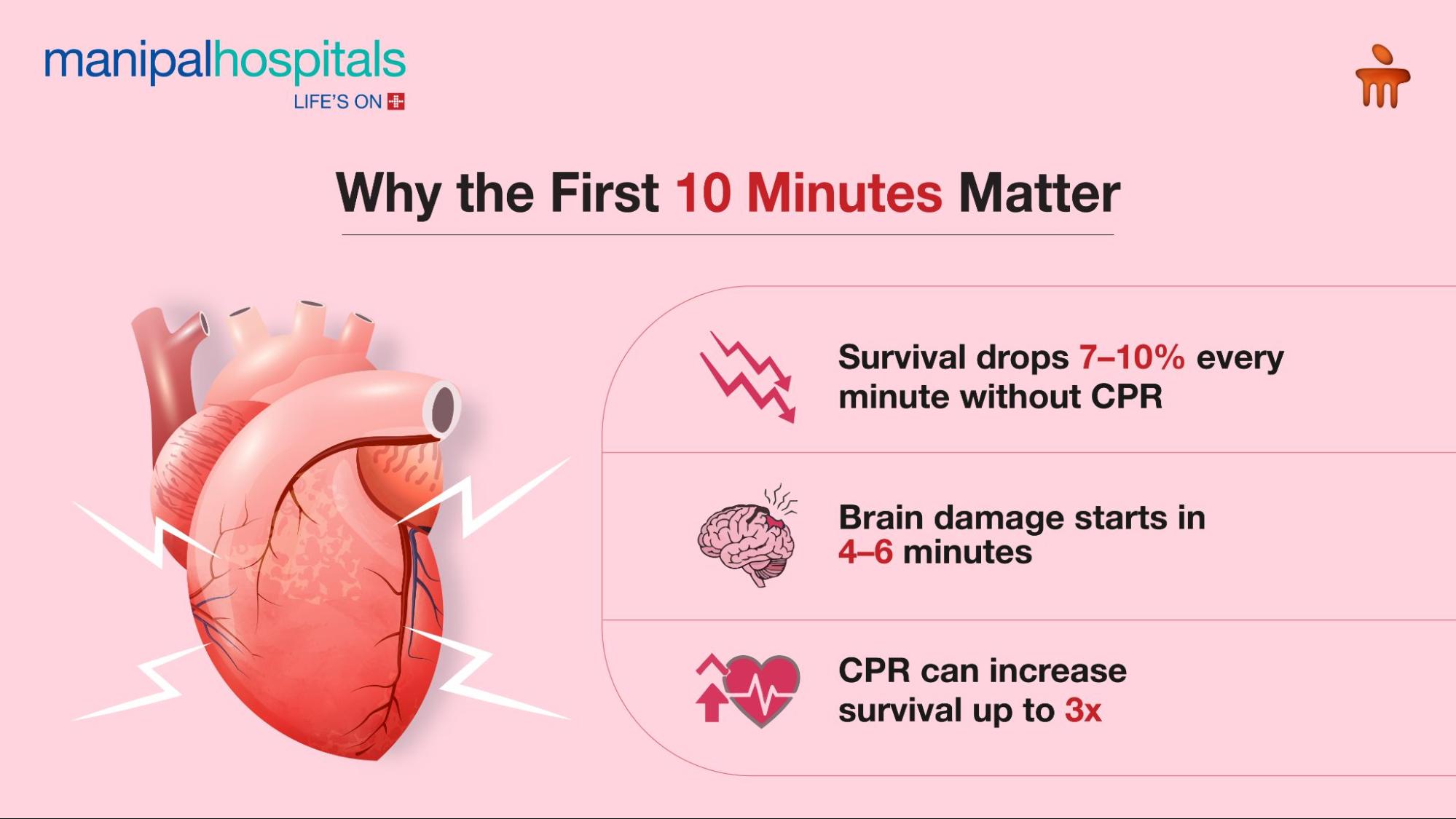
Why the First 10 Minutes Matter
This is not an exaggeration.
-
Every minute without CPR reduces survival by 7–10%
-
Brain damage can begin within 4–6 minutes
-
Immediate CPR can double or triple survival rates
So yes, those first 10 minutes are everything.
What To Do in the First 10 Minutes
Let’s make this very practical. Imagine you’re the only one around when someone collapses.
Step 1: Call for Help Immediately
Dial 102 or 108 in India.
Do not wait. Do not assume.
Even if you're unsure, call.
Step 2: Check Responsiveness
-
Tap the person
-
Shout loudly
-
Look for breathing
If there is no response and no breathing, treat it as cardiac arrest.
Step 3: Start CPR Immediately
This is where you can save a life.
Hands-only CPR:
-
Place your hands in the centre of your chest
-
Push hard and fast
-
Aim for 100–120 compressions per minute
-
Push at least 2 inches deep
A simple trick: follow the rhythm of the song “Stayin’ Alive."
Do not stop unless:
-
Help arrives
-
The person starts breathing
Step 4: Use an AED (If Available)
An AED is a life-saving device that gives a shock to restart the heart.
-
Turn it on
-
Follow voice instructions
Even a non-medical person can use it safely.
What If It’s a Heart Attack Instead?
If the person is conscious and complaining of chest pain:
-
Help them sit down comfortably
-
Keep them calm
-
Loosen tight clothes
-
Do not give food or water
-
Stay with them
Most importantly, do not delay medical care.
Doctors at Manipal Hospital Pune stress that early hospital care can prevent complications and save the heart muscle.
Do’s and Don’ts in a Cardiac Emergency
Do’s:
-
Call emergency services immediately
-
Start CPR if needed
-
Stay calm and act quickly
-
Follow instructions from emergency responders
Don’ts:
-
Don’t ignore symptoms
-
Don’t assume the person will “feel better."
-
Don’t leave them alone
-
Don’t delay CPR
Recovery After the Emergency
Surviving is just the first step. Recovery matters just as much.
After a Heart Attack
Patients usually need:
-
Medications
-
Lifestyle changes
-
Regular follow-ups
-
Cardiac rehabilitation
At Manipal Hospital Pune, structured rehab programs help patients regain strength and confidence. Many return to normal life with proper care.
After Cardiac Arrest
Recovery can be more complex.
It may involve:
-
ICU care
-
Brain function monitoring
-
Physiotherapy
-
Long-term heart care
The faster CPR is given, the better the recovery chances.
This is why awareness is so important.
A Real-Life Reflection
A middle-aged man once collapsed at a gym. Luckily, a trainer nearby had basic CPR knowledge. He immediately started compressions before the ambulance arrived.
That man survived.
Later, doctors said, "Those first 5 minutes saved his life."
It wasn’t luck. It was awareness and action.
Cardiac emergencies don’t wait. They don’t give second chances.
But you can make a difference.
Knowing the difference between a heart attack and cardiac arrest—and acting quickly—can turn a tragedy into survival.
At Manipal Hospital Pune, doctors continuously work towards spreading awareness because they know that sometimes, the first responder is not a doctor—it’s you.
And in those critical 10 minutes, your action can mean everything.
Disclaimer: This article is for informational purposes only and does not replace professional medical advice. Always consult a qualified healthcare provider for any concerns.
FAQ's
Yes. A severe heart attack can disrupt the heart rhythm and lead to cardiac arrest.
No. With immediate CPR and defibrillation, survival rates improve significantly.
Yes. Hands-only CPR is simple and can be done by anyone.
Not always, but it should never be ignored. Always seek medical advice.
Learn CPR. Attend a basic training session. It could help you save someone someday.
Share this article on: