5 Min Read
Heart disease continues to be one of the leading causes of health complications worldwide, often requiring timely and effective treatment. One of the most trusted solutions for blocked arteries is the angioplasty procedure, a minimally invasive intervention that restores blood flow to the heart.
At Manipal Hospital Kharadi, advancements in technology have elevated the traditional angioplasty procedure to a new level. With imaging-guided techniques, cardiologists can now perform this life-saving treatment with unmatched precision, ensuring better safety and long-term outcomes.
Synopsis
- What is an angioplasty procedure?
- Evolution of the Angioplasty Procedure
- Advanced Imaging in Angioplasty Procedure
- Benefits of Imaging-Guided Angioplasty Procedure
- Angioplasty Procedure at Manipal Hospital Kharadi
- Recovery After Angioplasty Procedure
- Do’s and Don’ts After Angioplasty Procedure
- Conclusion
What is an angioplasty procedure?
The angioplasty procedure, also known as percutaneous coronary intervention (PCI), is used to treat narrowed or blocked coronary arteries caused by plaque buildup. This condition can lead to chest pain (angina) or even heart attacks if left untreated.
During the angioplasty procedure, a thin catheter is inserted through the wrist or groin and guided to the affected artery. A small balloon is inflated to widen the artery, and a stent is placed to keep it open. This angioplasty procedure helps restore normal blood flow and reduces the risk of serious cardiac events.
Evolution of the Angioplasty Procedure
Earlier, the angioplasty procedure relied mainly on X-ray imaging (fluoroscopy), which provided only a basic 2D view of the arteries. While effective, this approach had limitations in accurately assessing the blockage and ensuring optimal stent placement.
Today, the modern angioplasty procedure has evolved with advanced imaging technologies. Imaging-guided methods provide detailed, real-time visuals from inside the artery, allowing cardiologists to perform the angioplasty procedure with greater accuracy and confidence.
Advanced Imaging in Angioplasty Procedure
At Manipal Hospital Kharadi, the angioplasty procedure is enhanced using cutting-edge imaging tools that improve precision and patient outcomes.
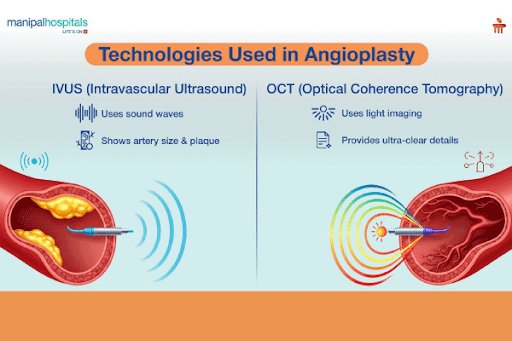
Intravascular Ultrasound (IVUS)
IVUS uses sound waves to create detailed cross-sectional images of the artery. During the angioplasty procedure, this helps doctors measure vessel size, assess plaque, and ensure proper stent expansion.
Optical Coherence Tomography (OCT)
OCT uses near-infrared light to provide ultra-high-resolution images. This technology allows cardiologists to detect even minor issues during the angioplasty procedure, ensuring optimal stent placement.
These technologies have transformed the angioplasty procedure into a highly precise and personalised treatment.
Benefits of Imaging-Guided Angioplasty Procedure
Accurate Diagnosis
The angioplasty procedure becomes more effective with precise imaging, allowing better understanding of artery structure.
Perfect Stent Placement
Imaging ensures that the stent is correctly positioned during the angioplasty procedure, reducing complications.
Reduced Risk
The advanced angioplasty procedure helps detect potential issues early, lowering the risk of restenosis or clot formation.
Better Long-Term Outcomes
Patients undergoing an imaging-guided angioplasty procedure often experience fewer repeat procedures and improved recovery.
Personalised Treatment
Every angioplasty procedure is tailored to the patient’s specific heart condition for maximum effectiveness.
Angioplasty Procedure at Manipal Hospital Kharadi
At Manipal Hospital, the angioplasty procedure is performed by experienced interventional cardiologists in Kharadi using advanced infrastructure.
Before the Angioplasty Procedure
-
Medical history evaluation
-
ECG and blood tests
-
Echocardiogram or stress test
During the Angioplasty Procedure
The angioplasty procedure is carried out in a catheterisation lab under local anaesthesia. A catheter is inserted and guided to the heart, followed by imaging guidance. The balloon is inflated, and a stent is placed to restore blood flow.
The angioplasty procedure time usually ranges from 30 minutes to a few hours.
After the Angioplasty Procedure
Patients are monitored closely after the angioplasty procedure. Most individuals can go home within 1–2 days with proper medication and care instructions.
Recovery After Angioplasty Procedure
Recovery after an angioplasty procedure is generally quick. Most patients can resume light activities within a few days and return to normal routines within a few weeks.
Cardiac rehabilitation after the angioplasty procedure plays a key role in improving heart health. It includes supervised exercise, dietary guidance, and lifestyle counselling to ensure long-term benefits.
Do’s and Don’ts After Angioplasty Procedure
Do’s
-
Take medications regularly after the angioplasty procedure
-
Follow a heart-healthy diet
-
Attend follow-up appointments
-
Engage in light physical activity
Don’ts
-
Do not skip medicines after the angioplasty procedure
-
Avoid heavy lifting immediately
-
Do not ignore symptoms like chest pain
-
Avoid smoking and unhealthy habits
Conclusion
The angioplasty procedure has evolved into a highly advanced and precise treatment with the introduction of imaging guidance. At Manipal Hospital Kharadi, patients benefit from cutting-edge technology and expert care, ensuring the best possible outcomes.
If you or your loved one is experiencing symptoms of heart disease, early diagnosis and a timely angioplasty procedure can make a life-saving difference.
Book your consultation today at Manipal Hospital Kharadi and take a step towards a healthier heart.