8 Min Read
Most of us have experienced that sharp, gnawing sensation in the upper belly that we usually blame on a spicy meal or a stressful deadline. We often reach for an antacid and wait for the "heartburn" to pass, assuming it’s just a temporary digestive glitch. However, when that burning sensation becomes a recurring guest, it is often a signal of something more significant happening in your digestive lining.
A peptic ulcer is a sore that forms inside your digestive system. In peptic ulcer disease, the sore develops when the balance between stomach acid and the protective lining is disturbed, and the inner lining can no longer handle the acid inside the stomach. These ulcers can show up in two places. One is the stomach, and the other is the first part of the small intestine called the duodenum.
Knowing the types of peptic ulcers makes it easier to understand your symptoms. The timing of pain, how it feels after eating, and how your body responds can vary depending on the ulcer's location. That is why doctors look at the type before deciding on treatment.
In this blog, an experienced gastroenterologist in Hebbal, Bengaluru, explains peptic ulcers and goes into detail about everything you need to know to stay informed.
Synopsis
What is a Peptic Ulcer?
Inside your stomach and small intestine, there is a thin layer of mucus that protects the surface from strong digestive juices. When that layer becomes weak or gets worn down, a sore can form in that area. That sore is what we call an ulcer.
In peptic ulcer disease, two causes often come up. One is a bacterial infection called Helicobacter pylori, which is a common cause linked to many cases. The other is the frequent use of painkillers like aspirin or ibuprofen over a long time. Both of these slowly damage that protective mucus layer.
Once that protection reduces, the acid in your stomach starts irritating the surface directly. Over time, that irritation deepens into a sore. That is how peptic ulcer disease develops and why the cause needs to be treated, not just the symptoms.
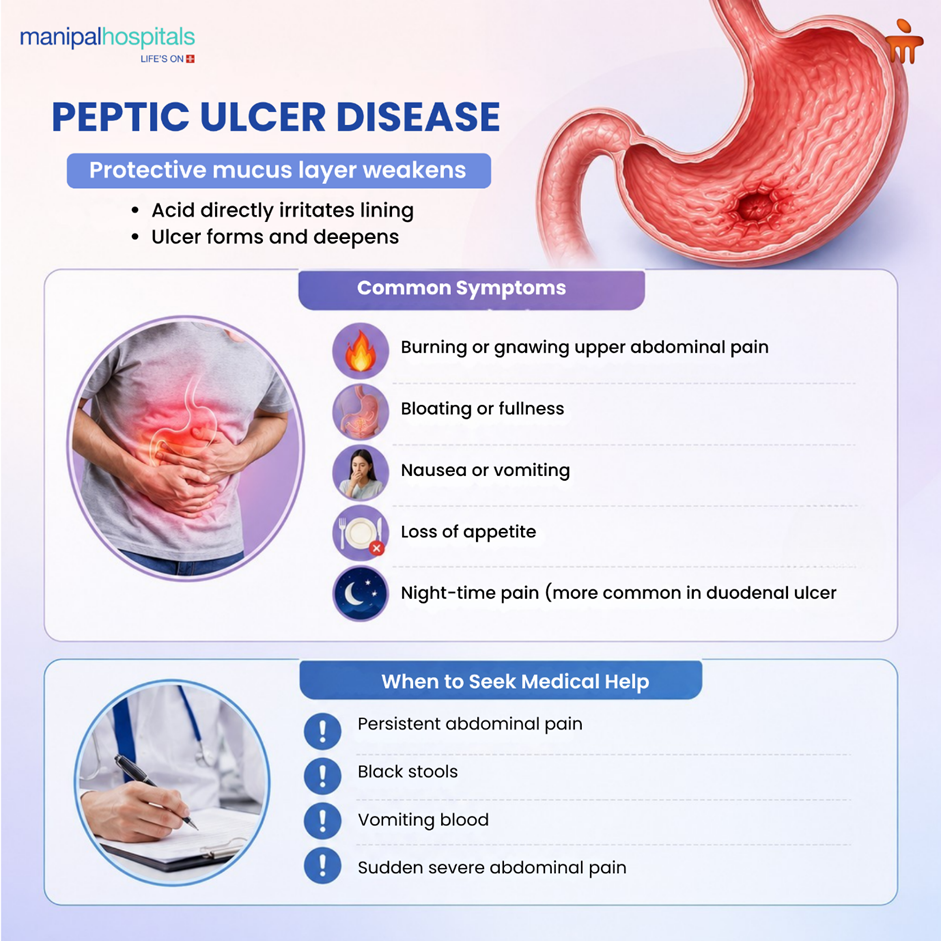
Types of Peptic Ulcer
Doctors group ulcers based on where they form inside the digestive tract. These are the main types of peptic ulcer, and knowing the location helps explain why symptoms feel different from person to person.
Stomach Ulcer (Gastric Ulcer)
This type affects the stomach lining. The pain often follows a pattern that many people notice and usually starts soon after eating. Eating stimulates acid production, which can irritate the ulcer further, so meals may make the discomfort worse instead of relieving it.
The common causes remain the same. Infection with Helicobacter pylori can weaken the stomach’s protection over time. Regular use of painkillers like aspirin or ibuprofen also damages that protective layer. Once the surface is exposed, acid keeps irritating it, and the sore deepens.
You may notice symptoms like:
-
Burning or gnawing pain in the upper abdomen
-
Pain that begins shortly after meals
-
Nausea or occasional vomiting
-
Feeling full very quickly while eating
-
Loss of appetite in some cases
If the ulcer worsens, it can start bleeding. That may show up as black stools or vomiting that looks dark. When comparing stomach ulcers and duodenal ulcers, you have to understand that a gastric ulcer is more likely to cause pain after eating rather than when the stomach is empty.
Duodenal Ulcer
This type occurs in the first part of the small intestine, called the duodenum, and has a different pain pattern. Many people notice pain when the stomach is empty, such as between meals or late at night. Eating may bring temporary relief, as food can reduce the direct effect of acid for a short time.
The causes are similar. Helicobacter pylori infection and long-term use of painkillers can weaken the protective lining in this area. Once that protection reduces, acid irritates the surface and an ulcer forms. Duodenal ulcers are also more common than stomach ulcers.
You may notice symptoms like:
-
Burning pain in the upper abdomen
-
Pain that comes when the stomach is empty
-
Discomfort that wakes you up at night
-
Relief for a short time after eating
Key Differences Between Stomach and Duodenal Ulcers
A side-by-side comparison makes it easier to understand how these two differ in daily life.
|
Feature |
Stomach Ulcer |
Duodenal Ulcer |
|
Location |
Inner lining of the stomach |
First part of the small intestine (duodenum) |
|
Pain timing |
Begins shortly after eating |
Starts when the stomach is empty, between meals or at night |
|
Effect of food |
Food often makes pain worse |
Food may reduce pain for a short time |
|
Nature of pain |
Burning or gnawing discomfort after meals |
Burning pain that comes and goes, often at night |
|
Frequency |
Seen less often |
Seen more often in practice |
|
Common cause pattern |
Frequently linked to long-term NSAID use |
Strongly linked to Helicobacter pylori infection |
|
Appetite pattern |
Eating may feel uncomfortable, and reduced intakeEating may feel uncomfortable, and reduced intake |
Eating may temporarily reduce discomfort |
|
Night symptoms |
Less common |
More commonly, it may wake you from sleep |
|
Risk of complications |
Higher chance of bleeding in some cases |
Complications are possible if untreated |
Causes and Risk Factors
Most ulcers develop because of a combination of infection and medication effects.
-
Helicobacter pylori infection: The bacteria damage the stomach’s protective mucus lining, allowing acid to irritate the tissue. It is a common cause of many cases of peptic ulcer disease.
-
Regular use of NSAIDs: Drugs like aspirin and ibuprofen weaken the stomach’s protective lining. With repeated use, the lining becomes more vulnerable to acid, increasing the risk of ulcers.
-
Smoking: Smoking reduces blood flow to the stomach lining and slows healing. Ulcers may last longer and are more likely to come back.
-
Alcohol intake: Alcohol irritates the stomach lining and can worsen existing damage. While it is not usually a direct cause on its own, it can increase discomfort and delay healing, making peptic ulcer symptoms more noticeable.
-
Stress: Stress does not directly create ulcers, but it can influence acid levels and make peptic ulcer symptoms feel stronger or more frequent.
How Peptic Ulcers Are Treated
Treatment focuses on healing the ulcer and removing the cause.
-
Antibiotics for Helicobacter pylori: When this infection is present, a course of antibiotics is given to clear the bacteria. It is usually combined with acid-reducing medicines to help the lining heal.
-
Medicines that reduce acid (PPIs): These lower stomach acids, giving the sore time to heal. They are a key part of peptic ulcer treatment.
-
Stopping NSAIDs where possible: If painkillers are contributing, doctors may advise stopping them or switching to safer options, as continued use can delay healing.
-
Other acid-reducing medicines: Some drugs reduce acid in different ways and are used when needed.
-
Medicines that protect the lining: These help coat the inner surface and support healing by reducing direct acid contact.
-
Severe cases: Surgery is rarely needed and is considered only if complications like bleeding, perforation, or blockage occur.
Possible Complications of Peptic Ulcers
Ignoring symptoms can lead to serious internal damage.
-
Bleeding can occur if the ulcer reaches a blood vessel. Stools may turn black, and vomit may look dark, and you may feel weak or low on energy.
-
In severe cases, the ulcer can deepen and create a hole in the stomach or duodenal wall. This can cause sudden, severe pain and needs immediate medical care.
-
Swelling or scarring can block the movement of food. You may feel full very quickly, vomit often, or find it difficult to eat.
-
If peptic ulcer treatment is delayed, these problems can worsen and may require emergency care.
Conclusion
Stomach ulcers and duodenal ulcers can feel similar, but the pattern of pain helps tell them apart. If you notice ongoing burning pain, nausea, black stools, or vomiting, it is better not to wait. These are signs your body is asking for attention. Early diagnosis makes treatment simpler and helps avoid complications. You can consult the best gastro hospital near Hebbal for expert evaluation and treatment.
Consult our experienced gastroenterologists at Manipal Hospital Hebbal, Bengalore, for a detailed evaluation of your symptoms, identification of the cause, and the right treatment plan.
FAQ's
The main difference is when the pain shows up. If you feel pain after eating, it could be a stomach ulcer. If the pain comes when your stomach is empty and feels better after eating, it may be a duodenal ulcer.
Some mild ulcers may settle for a while, but the underlying cause does not go away on its own. If the infection or trigger is not treated, the ulcer can come back or get worse.
Watch for warning signs. Black stools, vomiting blood, sudden severe pain, or feeling very weak are not normal. These need medical attention without delay.
Yes, it can be treated with a course of antibiotics along with medicines that reduce acid. Once treated properly, the ulcer can heal.
Food triggers can vary from person to person. If certain foods, like spicy or acidic items, make your pain worse, it is better to avoid them until healing improves.
Share this article on: