6 Min Read
Breaking a bone is a common injury, affecting millions of people each year. While the human body possesses an incredible ability to heal itself, especially when it comes to mending broken bones, the recovery process isn't always straightforward. Most fractures heal without complications, typically within several weeks to a few months with proper medical care and patient adherence. However, sometimes, despite best efforts, a fracture may not heal as expected, leading to what is known as delayed union or nonunion. Recognising the signs that a broken bone is not healing properly is crucial for preventing long-term complications and ensuring a complete recovery.
Synopsis
Understanding How Broken Bones Heal
When a bone breaks, the body immediately initiates a complex healing process, which comprises the following stages:
-
Inflammation: Immediately after the injury, a blood clot forms around the fracture site, initiating an inflammatory response. This stage clears away damaged cells and replaces them with healing cells.
-
Soft Callus Formation: Within a few days, new blood vessels grow, and specialised cells begin to produce cartilage and fibrous tissue, forming a soft callus that bridges the gap between the broken bone ends.
-
Hard Callus Formation: Over the next few weeks, the soft callus is gradually replaced by a hard callus made of woven bone. This provides a more rigid structure, though it's not yet as strong as the original bone.
-
Bone Remodelling: This is the longest phase, lasting months or even years. The woven bone is slowly replaced by stronger, lamellar bone, and the bone is reshaped to its original form and strength, guided by the stresses placed upon it.
A broken bone's healing time varies greatly depending on the type and location of the fracture, the patient's age, overall health, and treatment adherence. For example, a child's fracture might heal in 4-6 weeks, while a complex adult fracture could take 3-6 months or longer. It's essential to respect this timeline and not rush the recovery process.
Signs Your Fracture Is Not Healing Properly
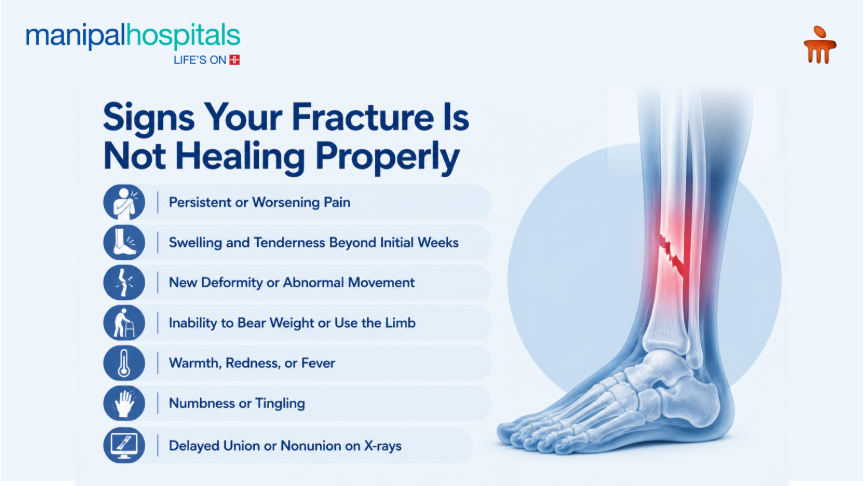
While some discomfort is normal, certain symptoms can indicate that your bone is not mending as it should be. If you experience any of these signs that a broken bone is not healing, it's vital to contact your orthopaedic specialist immediately:
-
Persistent or Worsening Pain: It is normal to have some pain after a fracture, especially during the initial weeks. However, if your pain does not subside over time, or if it suddenly worsens weeks or months after the injury, it could be a significant indicator that your broken bone has not healed properly. This pain might intensify with movement or weight-bearing, suggesting instability at the fracture site.
-
Swelling and Tenderness Beyond Initial Weeks: While initial swelling is expected, persistent or increasing swelling and tenderness around the fracture site long after the injury (e.g., several weeks or months) can indicate something serious. It may point to ongoing inflammation or infection, which can hinder the healing process.
-
New Deformity or Abnormal Movement: If you notice that the injured limb appears crooked, bent, or if there's any unusual movement or clicking at the fracture site that wasn't there before, it's a serious sign. This could indicate that the bone fragments are not uniting or have shifted.
-
Inability to Bear Weight or Use the Limb: As healing progresses, you should gradually regain the ability to put weight on the limb or use it normally (as per your doctor's instructions). If you cannot bear weight on the affected limb, or if using it causes severe pain and weakness, it suggests that the bone union is incomplete.
-
Warmth, Redness, or Fever: These symptoms, particularly when accompanied by pus or foul odour from a wound (if applicable), are strong indicators of an infection at the fracture site. Infections significantly impede bone healing and require urgent medical attention.
-
Numbness or Tingling: While less common as a direct sign of non-healing, persistent numbness, tingling, or weakness in the limb could signify nerve damage or compression, which might be related to the fracture not being stable or healed correctly.
-
Delayed Union or Nonunion on X-rays: Your doctor will use X-rays to monitor the healing process. If serial X-rays show little to no progress in bone formation over an extended period (typically several months beyond expected healing time), it is classified as a delayed union. If the bone shows no signs of healing after 6-9 months, it's considered a nonunion. Timely detection through imaging is key to effective intervention.
Factors Influencing Broken Bone Healing Time
Several factors can influence the broken bone healing time and potentially lead to complications if a broken bone is not healed properly:
-
Severity and Type of Fracture: Complex, comminuted (multiple fragments), or open fractures (where bone breaks through the skin) generally take longer to heal and have a higher risk of complications.
-
Location of Fracture: Bones with a good blood supply (like ribs) heal faster than those with a limited blood supply (like the navicular bone in the wrist or certain areas of the tibia).
-
Age: Children's bones typically heal much faster than adult bones due to their higher metabolic rate and greater healing potential.
-
Overall Health: Chronic conditions like diabetes, vascular disease, malnutrition, and osteoporosis can impair the body's healing capacity.
-
Smoking and Alcohol Use: Both nicotine and excessive alcohol consumption are known to significantly delay bone healing and increase the risk of nonunion.
-
Infection: Infections at the fracture site are a major impediment to healing and require aggressive treatment.
-
Inadequate Immobilisation: If the fractured bone is not properly stabilised (e.g., with a cast, brace, or surgical fixation), excessive movement can disrupt the formation of the callus and prevent union.
When to Seek Help
If you observe any of the signs that a broken bone is not healing or have concerns about your recovery, it's imperative to seek prompt medical attention. Early detection and intervention for a broken bone not healed properly can drastically improve outcomes and prevent long-term disability. Our expert orthopaedic surgeons at Manipal Hospitals, Goa, are equipped with state-of-the-art diagnostic tools and advanced treatment options, ensuring you receive the best possible care for your fracture and any healing complications.
Conclusion
We understand the anxiety and discomfort associated with a fracture that isn't healing properly. Our multidisciplinary approach means you'll have access to specialists in orthopaedic surgery, physical therapy, pain management, and nutritional counselling, all working together to facilitate your recovery. With our commitment to patient-centric care, we strive to make your journey back to full health as smooth and successful as possible, helping thousands of patients achieve successful bone healing each year.
FAQ's
Delayed union means the fracture is taking longer than expected to heal, but still shows signs of progress. Nonunion means the fracture has failed to heal completely after a significant period (typically 6-9 months), and there's no longer any sign of bone healing.
While open fractures have a higher risk, infections can sometimes occur in closed fractures, often spreading through the bloodstream or during surgical procedures. Symptoms like persistent pain, redness, swelling, and fever should prompt immediate medical evaluation.
Treatment options for a broken bone not healed properly vary based on the cause and severity. They can range from improved immobilisation, bone grafting (using bone from another part of your body or a donor to stimulate healing), to surgical fixation with plates, screws, or rods, and even advanced techniques like electrical stimulation or specialised growth factor injections.
The broken bone healing time varies significantly. Simple fractures in children might heal in 4-6 weeks, while complex adult fractures can take 3-6 months or even longer. Factors like age, overall health, fracture type, and location all play a role.
Absolutely. A diet rich in calcium, Vitamin D, and protein is essential for optimal bone repair. Malnutrition can significantly impede the healing process. Your doctor or a nutritionist can provide specific dietary recommendations.
If left untreated, a nonunion can lead to chronic pain, deformity, instability, reduced limb function, muscle weakness, and even nerve damage. Early intervention is key to preventing these long-term issues.
Share this article on: