6 Min Read
While many associate breast cancer with a palpable lump, some forms present differently. One such form is inflammatory breast cancer, a rare yet aggressive type that often doesn't start with a lump. Because its signs can be subtle and mimic common skin conditions, it's frequently misunderstood, leading to delayed diagnosis. Despite its rarity, the rapid progression of inflammatory breast cancer makes early detection vital. Understanding its unique presentation is your first line of defence. With timely intervention, significant strides have been made in improving outcomes. Specialists in the Department of Oncology play a crucial role in the early diagnosis, evaluation, and personalised treatment of inflammatory breast cancer.
Synopsis
Understanding Inflammatory Breast Cancer
Inflammatory breast cancer is characterised by its rapid growth and tendency to spread quickly. Unlike other breast cancers, this type rarely presents as a distinct tumour or lump that can be felt during a self-examination or detected on a mammogram in its early stages. Instead, it involves the cancer cells blocking the lymphatic vessels in the skin of the breast, leading to the characteristic "inflamed" appearance.
This blockage causes the breast to appear red, swollen, and warm, often without an obvious infection. It is crucial not to dismiss these changes, as they are key inflammatory breast cancer early symptoms. The term "inflammatory" refers to the outward appearance of the breast, not necessarily an infection, though it can often be mistaken for one. This unique presentation makes recognising inflammatory breast cancer symptoms challenging but absolutely critical for prompt medical attention.
The Crucial Early Signs of Inflammatory Breast Cancer You Must Not Ignore
The problem with inflammatory breast cancer is that it appears as less serious conditions, such as a skin infection (mastitis) or an allergic reaction. This highlights the importance of knowing the early symptoms of inflammatory breast cancer. These symptoms tend to develop rapidly, often within weeks or months. If you notice any of these changes, especially if they are new, persistent, or worsening, seek medical advice immediately:
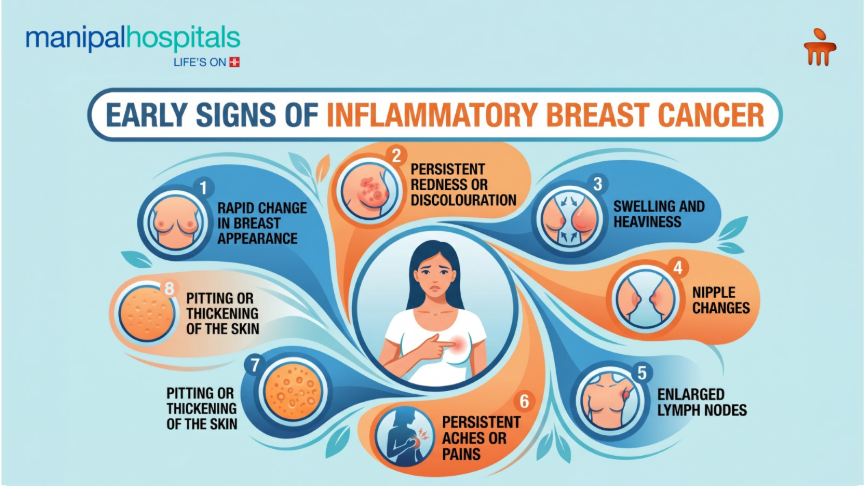
-
Rapid Change in Breast Appearance: One of the most telling signs is a sudden, noticeable change in the affected breast's size, shape, or feel. This can happen over a matter of days or weeks.
-
Persistent Redness or Discolouration: A red, purplish, or pinkish area on the breast that covers a third or more of the breast. This redness typically doesn't subside with antibiotics, which would be the case for a bacterial infection. This is the classic inflammatory breast cancer rash.
-
Swelling and Heaviness: The breast may feel unusually warm, tender, or heavy due to fluid retention and inflammation. This swelling is often generalised rather than localised to a specific spot.
-
Pitting or Thickening of the Skin (Peeled Orange Texture): The skin on the breast may start to look dimpled or pitted, similar to the skin of an orange peel. This indicates swelling and blockage of the lymphatic channels.
-
Nipple Changes: The nipple may suddenly retract inward, flatten, or point in a different direction. It may also become itchy or have discharge.
-
Persistent Aches or Pains: While breast pain can have many causes, a persistent ache, tenderness, or burning sensation in the breast that doesn't resolve should be evaluated.
-
Enlarged Lymph Nodes: Swollen lymph nodes under the arm, above the collarbone, or near the breastbone can also be a sign, indicating that the cancer may have spread.
Diagnosing Inflammatory Breast Cancer
Due to its unique presentation, diagnosing inflammatory breast cancer requires a thorough evaluation, which typically involves:
-
Clinical Examination: A detailed physical examination by a specialist, assessing the appearance, texture, and temperature of the breast, and checking for swollen lymph nodes.
-
Imaging Tests: While a mammogram might not always show a distinct lump, it's often used in conjunction with breast ultrasound and MRI. MRI is particularly useful for assessing the full extent of the disease.
-
Biopsy: A small tissue sample from the affected breast skin or underlying tissue is taken and examined under a microscope to confirm cancer cells and identify their type.
-
Staging: Preferably a positron emission tomography (PET) scan, where a scanner detects an injected radiotracer to determine the progression and stage of the inflammatory breast cancer.
Navigating Inflammatory Breast Cancer Treatment Options
The aggressive nature of inflammatory breast cancer necessitates a multi-modal and intensive treatment approach. A multidisciplinary team of oncologists, surgeons, radiation therapists, etc collaborates to create a personalised inflammatory breast cancer treatment plan for each patient. Treatment strategies are tailored based on the stage of the cancer, its molecular characteristics, and the patient's overall health. Some of the strategies include:
-
Chemotherapy: Powerful drugs are used to kill cancer cells throughout the body. For inflammatory breast cancer, chemotherapy is typically given before surgery (neoadjuvant chemotherapy) to shrink the tumour, reduce inflammation, and eliminate any distant microscopic spread, improving the chances of successful surgery.
-
Targeted Therapy: For specific types of breast cancer, such as HER2-positive cancer, targeted drugs (e.g., trastuzumab, pertuzumab) can specifically block growth pathways in cancer cells, often used in combination with chemotherapy.
-
Hormone Therapy: If the cancer cells are found to be hormone receptor-positive (estrogen receptor-positive or progesterone receptor-positive), hormone therapy may be used to block hormones that fuel cancer growth.
-
Local Therapy (Surgery and Radiation): These treatments target the cancer directly in the breast and surrounding areas.
-
Surgery: For inflammatory breast cancer, a modified radical mastectomy is typically performed after systemic therapy (which can be followed by chemotherapy or targeted therapy). This involves removing the entire breast and some lymph nodes under the arm. Breast-conserving surgery (lumpectomy) is generally not recommended for this type of breast cancer due to its diffuse nature.
-
Radiation Therapy: Following surgery, radiation therapy is almost always recommended for inflammatory breast cancer. It uses high-energy rays to destroy any remaining cancer cells in the chest wall and lymph nodes, reducing the risk of local recurrence.
-
Immunotherapy: In some cases, immunotherapy, which helps the body's immune system fight cancer, may be considered, particularly for advanced forms or aggressive forms.
Conclusion
Recognising the subtle and rapid changes associated with inflammatory breast cancer is the single most critical factor in ensuring a timely diagnosis and effective treatment. By remaining vigilant to persistent redness, skin thickening, or swelling, you can get early intervention. If symptoms do not improve with initial treatments like antibiotics, never hesitate to question the diagnosis, seek a second opinion, and insist on further evaluation through biopsies or advanced imaging. Early intervention saves lives, and securing expert, compassionate medical guidance is the most crucial step you can take.
If you notice any unusual or persistent changes in your breasts, visit our experts at the Department of Oncology at Manipal Hospital, Goa, for an immediate and thorough evaluation.
FAQ's
Not always. While some women experience pain, tenderness, or a burning sensation, others may not. The absence of pain does not rule out inflammatory breast cancer.
The symptoms of inflammatory breast cancer typically progress rapidly, often appearing and worsening within a few weeks or months. This rapid onset is one of its distinguishing features.
While rare, men can develop inflammatory breast cancer, just like other forms of breast cancer. However, it is far more common in women.
Both conditions can cause redness, swelling, and warmth in the breast. However, IBC symptoms typically do not improve with antibiotics, and there may be other signs like pitting of the skin or nipple changes that are not typical of mastitis.
Be aware of your breasts and seek immediate medical attention for any unexplained, persistent, or rapidly changing symptoms such as redness, swelling, or skin texture changes.
Share this article on: