7 Min Read
Hair loss is a common concern that affects millions, and for men, male pattern baldness symptoms are often the earliest indicators of a condition known medically as androgenetic alopecia. While many associate balding with old age, its onset can begin much earlier, sometimes even in the late teens or early twenties. Recognising these subtle signs early is crucial, as timely intervention can significantly affect the progression and management of hair loss. At Manipal Hospitals, we believe in empowering our patients with knowledge, helping them understand their bodies and seek expert care when needed. Specialists in the Department of Dermatology provide comprehensive evaluation and advanced treatment options to help diagnose and manage male pattern baldness effectively.
Synopsis
Understanding Male Pattern Baldness (Androgenetic Alopecia)
Male pattern baldness is a hereditary condition primarily caused by a combination of genetics and hormones. It accounts for more than 95% of hair loss in men.
The main hormone behind male pattern baldness is dihydrotestosterone (DHT). In genetically weaker hair follicles, DHT binds to receptors and causes them to shrink, a process known as miniaturisation. Over time, these miniaturised follicles produce finer, shorter, and weaker hairs until they eventually stop producing hair altogether. This progressive miniaturisation leads to the characteristic thinning and balding patterns associated with the condition.
Early Male Pattern Baldness Symptoms
Being aware of the earlier male pattern baldness symptoms can help you know if you are experiencing the onset of androgenetic alopecia, as early intervention can slow down the progression of this condition.
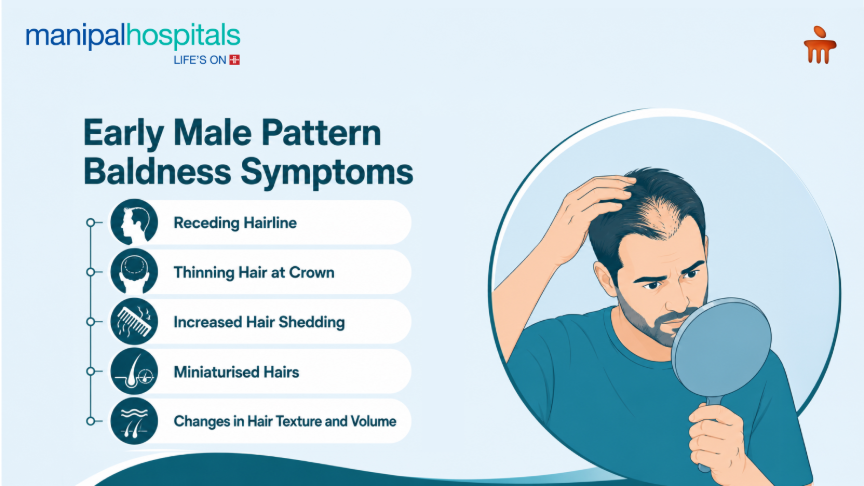
1. Receding Hairline
One of the most common and earliest male pattern baldness symptoms is a receding hairline. This typically starts at the temples, where the hair begins to thin and move backwards, creating an M shape. Instead of a straight or slightly rounded hairline, you might notice your hairline forming distinct V-shapes on either side of your forehead.
2. Thinning Crown
Another prevalent symptom is thinning hair on the crown or vertex of the scalp. This area, located at the top of the head, often shows signs of diffuse thinning or a widening part before a distinct bald spot appears. You might notice that your scalp becomes more visible under direct light or that your hair in this area feels less dense than before.
3. Increased Hair Shedding
While shedding 50-100 hairs daily is a normal part of the hair growth cycle, a noticeable increase in hair shedding can be an early indicator of male pattern baldness. You might find more hair on your pillow, in your shower drain, or on your comb/brush. Consistently losing upwards of 150-200 hairs can be a warning sign, and proactive measures can often help retain hair. It's not just the quantity, but also the quality – shedding thinner, weaker hairs is a key characteristic.
4. Miniaturised Hairs
As hair follicles miniaturise, they produce finer, shorter, and less pigmented hairs. You might observe a mix of normal, thick hairs alongside these thinner, almost peach-fuzz-like strands in the affected areas. These hairs are weaker and break more easily.
5. Changes in Hair Texture and Volume
Your hair might start to feel less dense, lose its usual volume, and become noticeably finer to the touch. It may also become more difficult to style, as the individual strands are weaker and have less body. These changes often occur gradually, making them easy to overlook until the thinning becomes more pronounced.
Male Pattern Baldness Stages - The Norwood Scale
The Norwood Scale (or Hamilton-Norwood Scale) is the most widely used classification system to measure the extent of male pattern baldness. It helps dermatologists assess the severity and track progression, providing a common language for diagnosis and treatment planning for various male pattern baldness stages.
-
Stage I: Minimal or no recession of the hairline.
-
Stage II: Slight recession at the temples, often forming a triangular area.
-
Stage III: Significant recession at the temples, with a distinct "M" shape. Early thinning may appear on the crown.
-
Stage IV: Further recession at the temples, and a more prominent bald spot on the crown, separated by a band of hair.
-
Stage V-VII: Increasing severity, with the bald areas at the temples and crown growing larger and eventually merging, leaving only a horseshoe-shaped band of hair around the sides and back.
How to Prevent Male Pattern Baldness & Early Intervention
While genetics play a significant role in determining who experiences male pattern baldness, adopting certain lifestyle practices and seeking early intervention can significantly slow its progression and, in some cases, even encourage regrowth. Beyond medical treatments, several lifestyle and hair care practices can support overall hair health:
-
Proper Nourishmengt: A balanced diet rich in essential nutrients like proteins, iron, zinc, and vitamins (especially B vitamins and Vitamin D) is crucial for healthy hair growth. Consider incorporating foods such as lean meats, eggs, leafy greens, nuts, and seeds.
-
Manage Stress Effectively: High levels of chronic stress can impact hair cycles and exacerbate hair loss. Practicing stress-reduction techniques like meditation, yoga, regular exercise, or spending time in nature can contribute positively to hair health.
-
Gentle Hair Care Practices: Treat your hair and scalp with care. Use mild, sulfate-free shampoos and conditioners that cleanse without stripping natural oils. Avoid harsh scrubbing, aggressive towel-drying, and excessive brushing of wet hair, which is more fragile.
-
Protect Your Scalp: Maintain a clean and healthy scalp environment. Avoid excessive heat styling, tight hairstyles that pull on the hair roots, and chemical treatments that can damage hair follicles and strands.
-
Consider Natural Supplements: While not a standalone solution, some natural supplements like biotin, saw palmetto, and marine protein complexes are explored for their potential benefits in supporting hair health. Always consult a healthcare professional before starting any new supplement regimen.
-
Early Consultation is Key: The most effective prevention is early detection and professional consultation. As soon as you notice signs of thinning or a receding hairline, consulting a dermatologist can provide you with tailored advice and early treatment options.
Seeking Expert Help
If you're noticing any of the male pattern baldness symptoms, it's vital to consult a specialist. A dermatologist or trichologist can accurately diagnose your condition, determine its severity, and recommend the most appropriate male pattern baldness treatment plan tailored to your specific needs.
At Manipal Hospital, Goa, our experts in the Department of Dermatology are equipped with state-of-the-art diagnostic tools and a comprehensive understanding of hair loss conditions. They will create personalised treatment strategies, ranging from advanced medical therapies to lifestyle modifications and cutting-edge procedures, all designed to achieve effective outcomes, so that you can go back to living your life with more confidence.
FAQ's
While there isn't a complete cure in the sense of reversing the genetic predisposition, modern treatments can effectively halt progression, stimulate regrowth, and maintain existing hair. Early intervention significantly improves success rates.
Male pattern baldness can begin as early as the late teens or early twenties, though it often becomes more noticeable in the late twenties to thirties. Its progression varies greatly among individuals.
Most home remedies lack scientific evidence to support their effectiveness for male pattern baldness, which is primarily genetic and hormonal. Professional medical treatments are usually required for meaningful results.
Hair transplants offer a very effective and often permanent solution for restoring hair to balding areas, as the transplanted follicles from the back and sides of the head are generally resistant to DHT. However, it doesn't stop further loss of existing, non-transplanted hair, so complementary medical therapy might be recommended.
Consistency is key. Results from medical treatments typically take 3-6 months to become noticeable, with optimal results often seen after 12 months. Continued treatment is usually necessary to maintain benefits.
While stress itself doesn't directly cause male pattern baldness, it can exacerbate existing hair loss conditions, including androgenetic alopecia, and trigger other forms of temporary hair loss like telogen effluvium.
Share this article on: