9 Min Read
Hearing that you need a bone biopsy can bring a surge of anxiety. The word “biopsy” immediately raises thoughts of serious illness, and the idea of a procedure involving your bones can feel especially daunting. However, a bone biopsy is a precise, minimally invasive test that can provide clear answers when other investigations do not. It offers definitive information about abnormal tissue, infection, or bone marrow conditions, helping your medical team plan the most effective treatment.
Understanding exactly what the procedure involves, why it is necessary, the level of accuracy it provides, and what recovery truly looks like can ease much of this uncertainty. If your doctor has recommended this investigation, consulting specialists at a top orthopaedic hospital in Yeshwanthpur, Bangalore, can help you receive expert evaluation and personalised care throughout the diagnostic process.
In this blog, you will learn the step-by-step bone biopsy procedure, how reliable the bone biopsy test is, and the recovery timeline you can realistically expect.
Synopsis
What a Bone Biopsy Reveals
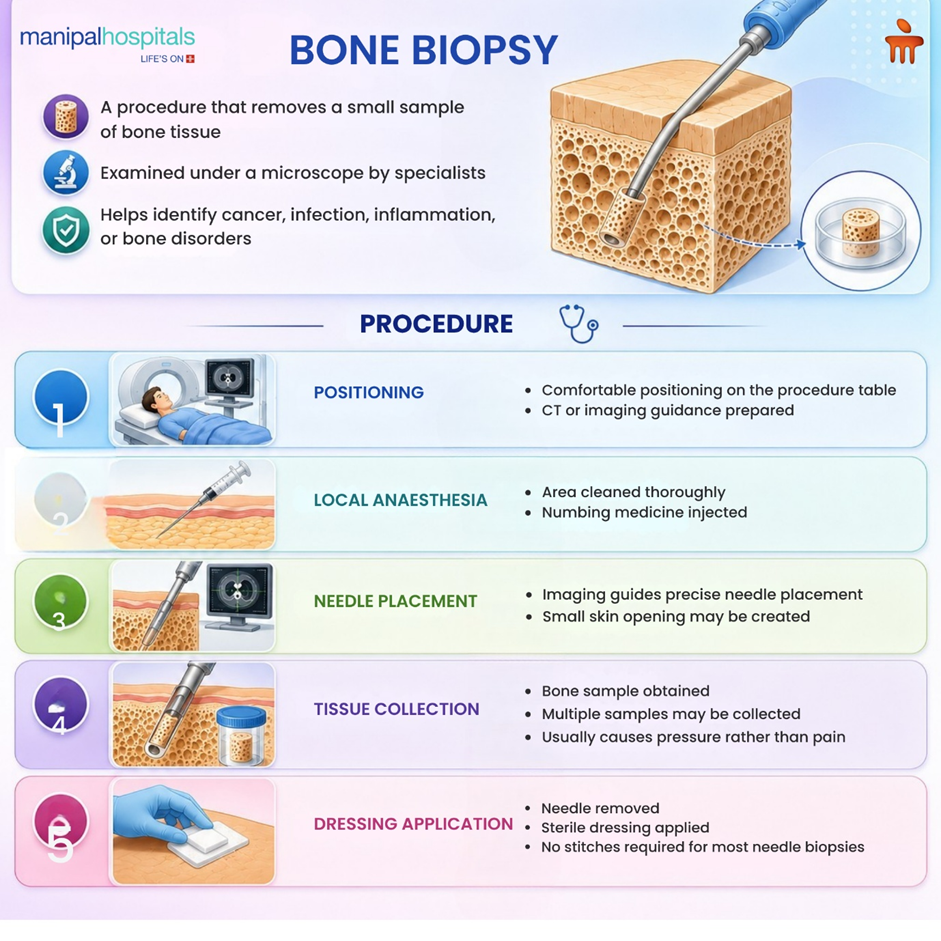
A bone biopsy is a procedure in which a small sample of bone tissue is removed and examined under a microscope. It is the gold standard for diagnosing several conditions that cannot be confirmed by blood tests or imaging alone. Unlike X-rays, CT scans, or MRIs that show structure, a biopsy reveals cellular details, whether cells are benign, malignant, infected, or reactive.
The test is commonly used to:
-
Differentiate between a benign bone tumour and a primary bone cancer.
-
Confirm whether a cancer from another organ has spread to the bone (metastasis).
-
Diagnose bone infections (osteomyelitis) that do not respond to antibiotics.
-
Investigate unexplained bone pain, pathological fractures, or suspicious lesions found on imaging.
-
Assess bone marrow disorders like lymphoma, multiple myeloma, or unexplained anaemias when standard marrow aspiration is inconclusive.
A bone biopsy test provides answers that imaging alone cannot. It analyses tissue architecture, cell morphology, and the presence of specific markers, enabling a definitive diagnosis that guides everything from surgical planning to chemotherapy or targeted antibiotic therapy.
When Is a Bone Biopsy Recommended?
Not every bone abnormality requires a biopsy. Your doctor will correlate your symptoms, imaging findings, and blood test results before making this decision.
Common indications include:
-
A bone lesion with aggressive features on MRI or CT, such as cortical destruction, periosteal reaction, or a soft tissue mass.
-
Persistent, unrelenting bone pain at rest or at night that has no clear mechanical cause.
-
A pathological fracture occurring without significant trauma.
-
Signs of infection (fever, elevated inflammatory markers) with a non-healing bone lesion despite antibiotic treatment.
-
Staging workup for a known cancer where a bone lesion could change treatment intent.
Types of Bone Biopsy Procedures
The approach to bone biopsy is tailored to the lesion’s location, size, and suspected nature. Broadly, there are two methods.
-
Needle Biopsy (Percutaneous Biopsy): This is the most common approach today. Using CT guidance or ultrasound, a specialised hollow needle is advanced precisely into the abnormal area to extract a core of bone tissue. It avoids an open incision and is typically performed under local anaesthesia with sedation if required. The technique yields a cylindrical core of tissue that preserves bone architecture, which is crucial for pathological evaluation.
-
Open (Surgical) Biopsy: When a needle biopsy is technically difficult, unsafe due to nearby nerves or blood vessels, or fails to yield adequate tissue, an open biopsy may be performed in an operating room. The surgeon makes a small incision to directly visualise the lesion and remove a sample. This is more invasive and is planned carefully so that the biopsy tract can be completely excised if future limb-sparing cancer surgery is required.
-
Preparing for Your Bone Biopsy: Preparation aims to make the procedure safe and reduce the risk of complications. You will receive specific instructions during your pre-procedure consultation.
Key preparatory steps include:
-
Medication review: You may be asked to stop blood-thinning medicines like aspirin, clopidogrel, or warfarin a few days before the test. Continue other regular medications only as advised.
-
Fasting: If sedation or general anaesthesia is planned, you will typically need to fast for six to eight hours beforehand.
-
Allergy information: Inform your team about any allergies, especially to local anaesthetics, iodine-based contrast (used during CT guidance), or antibiotics.
-
Pregnancy status: If applicable, a pregnancy test may be performed, as radiation exposure from CT guidance must be avoided during pregnancy.
-
Arranging transport: If you receive sedation, you cannot drive yourself home. Plan for a family member or friend to accompany you.
Your doctor will also explain the exact biopsy site, the expected duration, and what sensations you might experience during the procedure.
Step-by-Step: What Happens During the Bone Biopsy Procedure
Knowing the sequence of events removes much of the fear of the unknown. While specifics vary depending on the biopsy type, a typical CT-guided needle bone biopsy unfolds as follows:
-
Positioning: You are positioned on the CT table in a way that gives the radiologist the best access to the lesion, often on your stomach, side, or back. Comfort is prioritised, and padding supports your body.
-
Sterilisation and anaesthesia: The skin over the biopsy site is cleaned with an antiseptic. A local anaesthetic is injected first into the skin and then progressively deeper to numb the tissue path down to the bone surface. You will feel a brief sting and some pressure.
-
Guidance and needle placement: The radiologist uses intermittent CT scans to guide a thin needle precisely to the edge of the bone lesion. A small nick is made in the skin to allow the biopsy needle to pass comfortably.
-
Tissue sampling: The biopsy needle is advanced into the lesion under imaging confirmation. Once correctly positioned, a core of bone tissue is captured. You may feel a sensation of pressure, but sharp pain should not occur. Usually, two or more samples are taken to ensure adequate material for pathology.
-
Needle removal and dressing: The needle is withdrawn, firm pressure is applied to the site for a few minutes to control any oozing, and a sterile dressing is placed over the tiny wound. No stitches are required for a needle biopsy.
The entire procedure typically takes between 30 and 60 minutes. You are monitored in a recovery area for a few hours afterwards to ensure stability and comfort before discharge.
Recovery Timeline and What to Expect Afterwards
Recovery from a bone biopsy is generally smooth and well-tolerated, though the timeline can vary based on the biopsy type and the bone involved. The following table outlines the usual recovery timelines:
|
Recovery Phase |
What to Expect |
|
First 24 Hours |
Mild soreness or a bruised feeling at the biopsy site. Keep the dressing clean and dry. Gentle walking is allowed, but avoid heavy lifting and strenuous activity. |
|
First Few Days |
Pain and tenderness gradually improve. Most light daily activities can be resumed. Avoid vigorous exercise, running, and weightlifting. For weight-bearing bones, activity restrictions may continue to reduce fracture risk. |
|
1 to 2 Weeks |
The biopsy site typically heals completely with minimal scarring. Most patients can return to their normal routine after medical clearance. |
A surgical biopsy recovery is slightly longer, with wound care similar to any minor operation and a more cautious return to full activity over a few weeks.
Risks and Potential Complications
While a bone biopsy is a safe procedure, it is important to be aware of possible complications so that you can recognise them early.
-
The most common side effect, usually manageable with mild analgesics.
-
Minor bruising is normal. Significant bleeding is rare but possible, especially in patients with bleeding disorders or those on blood thinners.
-
Introducing bacteria into a bone can cause osteomyelitis, though this is extremely uncommon due to sterile technique.
-
A very rare complication, the small defect created in the bone can, in theory, act as a stress riser and lead to a fracture, particularly in weight-bearing bones that are already weakened by a large lesion. Your doctor will provide weight-bearing precautions if needed.
-
Uncommon when imaging guidance is used to avoid critical structures.
Conclusion
A bone biopsy is a highly accurate, safe, and often decisive test when a bone abnormality raises concerns. By understanding the clear steps of the biopsy test procedure, its diagnostic reliability, and a realistic recovery timeline, you can approach it with confidence rather than fear. Whether it confirms a benign condition, identifies an infection, or establishes a cancer diagnosis, the information gained becomes the foundation for the right treatment. If you have an unexplained bone lesion, persistent bone pain, or need a precise diagnosis, consult the specialists at Manipal Hospital for expert evaluation and a compassionate, carefully planned bone biopsy test in Yeshwanthpur, Bangalore.
FAQ's
You will feel the initial sting of the local anaesthetic injection. After that, the procedure typically involves only a sensation of pressure, not sharp pain. If you experience discomfort, more numbing medicine can be administered. Post-procedure soreness is well-managed with oral painkillers.
Preliminary results may be available within three to five days, but a comprehensive pathology report often takes seven to ten days. The bone sample requires decalcification and special processing, which adds to the time. Your doctor will inform you when to expect the final report.
Seeding of tumour cells along the biopsy tract is extremely rare with modern techniques. The procedure is planned so that the needle track can be completely removed during any subsequent surgery, minimising this theoretical risk.
It may be possible with careful planning. Your doctor will coordinate with your cardiologist or physician to temporarily stop or bridge your blood thinner before the procedure. Never stop prescribed medications on your own.
For a needle biopsy, you can usually travel within 24 to 48 hours, provided you are comfortable and have no signs of complications. For longer journeys or air travel, discuss your specific timeline with your doctor to avoid prolonged immobility and to plan pain management.
Share this article on:


.webp "Neurological disorders symptoms and treatment")