9 Min Read
A severe back injury can immediately disrupt your life, causing intense pain and sudden uncertainty about your mobility. Among the various types of spinal injuries, a burst fracture is one that requires immediate, expert medical attention.
Hearing that a bone in your back has broken can be frightening. However, learning about the structural nature of this injury, how doctors evaluate the damage, and the available treatment paths can help you navigate your recovery with clear expectations.
In this blog, experienced specialists from a leading orthopaedic hospital in Yelahanka, Bangalore, explain the differences between stable and unstable spinal breaks, common symptoms to watch for, and what to expect during medical management.
Synopsis
What Is a Burst Fracture?
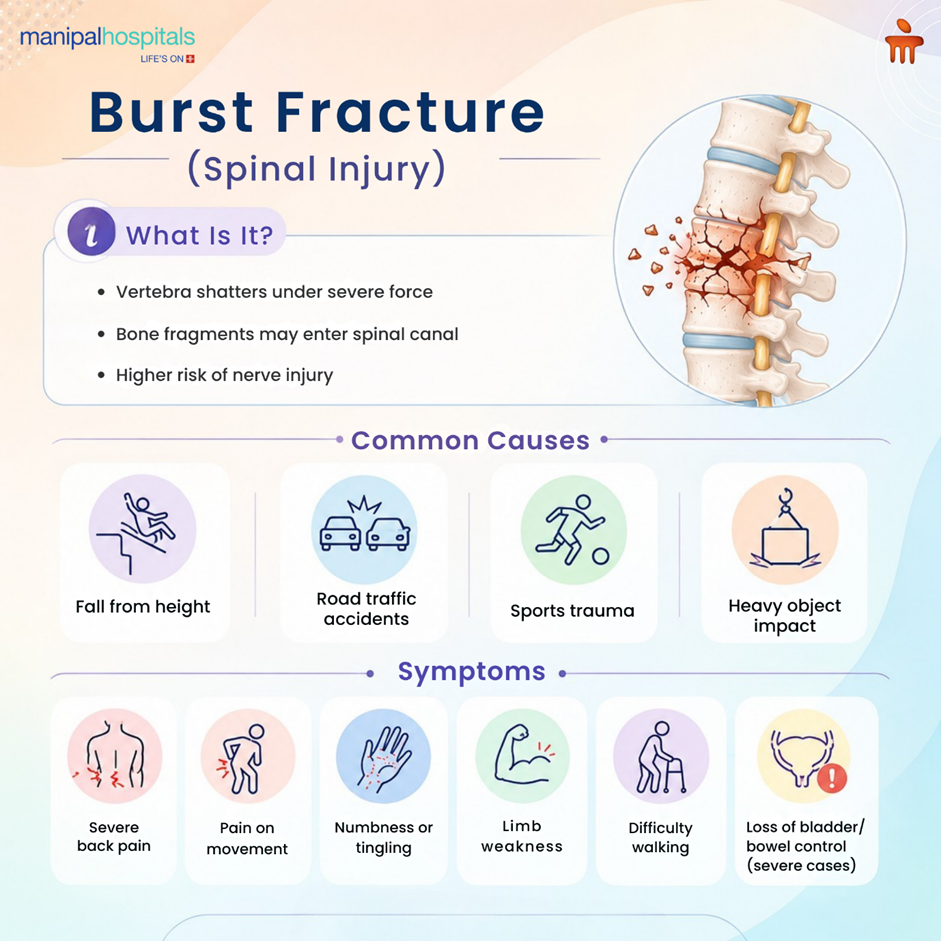
A burst fracture is a type of spinal injury where a vertebra, one of the bones that stack up to form the spinal column, shatters under extreme pressure. The bone breaks into multiple pieces, and some of those fragments can push out into the surrounding area. In many cases, pieces of bone may intrude into the spinal canal where the spinal cord and nerve roots sit.
This separates a burst fracture from a simpler compression fracture. A compression fracture typically involves the front part of the vertebra collapsing while the back part stays intact, and bone fragments do not usually spread into the spinal canal. "Burst compression fracture" is a term sometimes used because the injury does involve a crushing of the vertebra, but the key difference is the disruption of both the front and back portions of the bone. This makes a burst fracture spine injury potentially much more serious, as it carries a real risk of nerve damage or spinal cord injury. Early evaluation by a specialised orthopaedics department can help ensure accurate imaging, timely treatment, and comprehensive rehabilitation, reducing the risk of long-term complications following a burst fracture.
Burst Fracture Classification: Understanding the Types
Doctors do not view all burst fractures as the same. The burst fracture classification system helps the medical team describe the injury in a standard way, which then guides treatment decisions. While the full classification used by spine surgeons includes details from imaging, the basic categories can be explained in everyday terms.
One common way to think about it is:
-
Stable burst fracture: The vertebra is broken, but the bone fragments have not moved far out of place. The spine can still carry weight reasonably well, and there is no sign of nerve compression or injury. These are often managed without surgery.
-
Unstable burst fracture: Here, the bone is broken, and fragments have entered the spinal canal, or the spine has developed an abnormal angulation (kyphosis). Or there is damage to the ligaments that hold the spine together. Instability means the spine cannot reliably bear weight or protect the nerves without help. These injuries often require surgical stabilisation.
Within these broad groups, surgeons also consider whether the fracture involves the vertebral body alone or extends into the back structures of the vertebra and how much the spinal canal is narrowed by bone fragments. The burst fracture classification is a tool for communication, not a label to fear. Its purpose is to match your specific injury to the treatment path that is most likely to lead to healing.
How These Injuries Happen
Most burst fractures are caused by high-energy trauma. Common scenarios include:
-
Falling from a height and landing on the feet or buttocks
-
Serious motor vehicle collisions
-
Sports injuries with a direct impact, such as a tackle that transmits force up the spine
-
Being struck by a heavy object
The mechanism is usually axial loading, a force that travels straight up and down the spine, compressing the vertebra until it fails. That is why the term "burst compression fracture" is sometimes used; the bone compresses and then bursts outward. In younger adults, the injury typically requires significant force. In older adults with weaker bones due to osteoporosis, even a low-energy fall can cause a burst fracture, though simple compression fractures are far more common in that group.
Symptoms of a Burst Fracture
The symptoms depend on the location of the injury along the spine and whether nerves or the spinal cord are involved. Pain is the most immediate and universal symptom.
Common signs include:
-
Severe, sharp back pain at the level of the fracture that worsens with any movement
-
Pain that may radiate down the arms or legs, depending on whether the fracture is in the neck, upper back, or lower back
-
Numbness, tingling, or weakness in the limbs if nerve roots or the spinal cord are compressed
-
Loss of bladder or bowel control in severe cases where the spinal cord is significantly affected
-
Difficulty walking or standing up straight
It is important to know that not every burst fracture causes obvious nerve problems immediately. Some people are able to walk after the injury, but if the fracture is unstable, movement can make things worse. This is why anyone with a significant fall or accident and severe back pain needs an urgent evaluation, even if they can move their legs at first.
Diagnosis: How Doctors Confirm a Burst Fracture
When a burst fracture is suspected, the first step is a careful physical examination along with a neurological check to see if nerves are working properly. Imaging is essential and usually proceeds in stages:
-
X-rays: These show the bony alignment and can reveal a vertebra that has lost height. They can suggest a burst fracture but cannot show the details of the bone fragments inside the spinal canal.
-
CT scan: This imaging technique provides a detailed, three-dimensional view of the bone. It is the best tool to see the fracture pattern, how many pieces the vertebra has broken into, and whether fragments have entered the spinal canal.
-
MRI: This imaging technique looks at soft tissues, the spinal cord, nerves, discs, and ligaments. It is especially useful if there are any neurological symptoms to check for direct compression of nerves.
Together, these images allow the spine surgeon to determine the burst fracture classification and decide whether the injury is stable or unstable.
Treatment Options for a Burst Fracture
Treatment falls into two main paths: non-operative (conservative) management and surgery. The choice depends on stability, nerve involvement, and your overall health.
Non-operative treatment may be possible when:
-
The fracture is judged to be stable
-
Bone fragments are not significantly narrowing the spinal canal
-
There is no nerve damage
-
The spine does not have a dangerous amount of deformity
In these cases, treatment typically involves a period of rest followed by bracing to keep the spine in a fixed position while the bone heals. A thoracolumbar orthosis (a custom-moulded brace) is often used for fractures in the middle or lower back. The brace limits movement and allows the body's natural healing process to work. Regular X-rays are taken to check that the bone is not collapsing further. Physiotherapy begins after the initial healing phase to restore strength and mobility.
Surgical treatment is recommended when:
-
The fracture is unstable and cannot reliably heal without support
-
Bone fragments are pressing on the spinal cord or nerves and causing symptoms
-
There is progressive deformity, or the spine is unable to carry weight
-
The patient has neurological deficits that could improve with decompression
Surgery for a burst fracture spine injury usually involves spinal fusion with instrumentation. The surgeon removes bone fragments that are pressing on nerves (decompression) and then uses metal rods, screws, and sometimes cages to stabilise the injured segment. The goal is to restore alignment, protect the nerves, and provide immediate stability so the patient can begin moving and rehabilitating sooner than if they were in a brace alone.
Recovery and Long-Term Outlook
Recovery from a burst fracture is a gradual process. After non-operative treatment, it can take three to four months for the bone to heal, with a return to full activities sometimes taking six months or more. Rehabilitation focuses on building up core strength, improving posture, and learning safe movement patterns to protect the spine.
After surgery, many people are up and walking within a day or two with support. The surgical hardware provides immediate stability, but bone healing still takes months. Physical therapy is a central part of recovery, helping to regain flexibility and strength while avoiding strain on the healing area.
The long-term outlook depends on several factors:
-
The severity of the initial injury
-
Whether there was nerve damage
-
How well the patient follows rehabilitation
Many people return to work and active lifestyles, though some may have restrictions on heavy lifting or high-impact activities. Those with neurological injuries may need ongoing therapy, but improvements can continue for a year or more.
Conclusion
A burst fracture is a significant injury, but it is not one without a path forward. Understanding the difference between a burst compression fracture and a simple break and recognising the importance of timely treatment helps you navigate this challenging time with clarity. If you or a loved one has suffered a spinal injury, seek expert evaluation without delay. Book a consultation with the expert orthopaedic surgeons at Manipal Hospital Yelahanka, Bangalore, today for expert spine fracture treatment in Yelahanka, Bangalore.
FAQ's
Yes, if the fracture is stable, there is no nerve compression, and the bone fragments have not moved dangerously into the spinal canal. These fractures can heal with bracing and rest. Your surgeon will monitor the healing with regular imaging to ensure the spine does not collapse further.
Most people can start walking with assistance within a day or two of surgery. The bone itself takes three to four months to fuse. Returning to desk-based work may be possible within a few weeks, but physically demanding jobs and sports often require six months or more of gradual rehabilitation.
A burst fracture is a more severe form of compression fracture. In a simple compression fracture, only the front part of the vertebra collapses. In a burst fracture, the vertebra shatters and bone fragments can spread in all directions, sometimes entering the spinal canal. The risk of nerve injury is higher.
An untreated unstable burst fracture can lead to progressive spinal deformity, chronic pain, and potential nerve or spinal cord damage if bone fragments continue to press on nerves. It is important to get an evaluation after any significant fall or accident with back pain.
It depends on the severity of the injury and how you recover. Many people return to recreational sports after full healing and rehabilitation. High-impact activities or contact sports may need to be avoided depending on your surgeon's advice. A gradual, supervised return is essential to protect the spine.
Share this article on: