10 Min Read
Discovering that you or a loved one has an enlarged heart, known clinically as cardiomegaly, can be a profoundly unsettling moment. For many, the diagnosis comes to light incidentally during a routine chest X-ray for an unrelated cough, or perhaps following an echocardiogram ordered to investigate sudden shortness of breath or persistent fatigue. It is completely natural for the mind to immediately jump to heavy questions about long-term survival, daily limitations, and the fundamental stability of your health.
However, a diagnosis of cardiomegaly is not a single, unchangeable medical verdict. It is an essential clinical warning sign indicating that your cardiovascular system is working under abnormal stress. With modern diagnostic mapping, targeted medical therapies, and structured lifestyle adjustments, many patients successfully manage the underlying issues, halt the progression of structural changes, and maintain an excellent quality of life.
This blog will provide clinical insights from experts at a top cardiology hospital in Yelahanka, exploring the factors influencing survival timelines, structural causes, and the realistic treatment paths available to patients today.
Synopsis
Understanding Cardiomegaly: Dilatation vs. Hypertrophy
An enlarged heart is not a disease in itself, but rather a structural manifestation of an underlying medical condition. When the heart muscle is forced to work against high resistance or handle an abnormal volume of blood over a long period, it adapts structurally. Physicians categorise cardiomegaly into two primary anatomical types:
- Dilated Cardiomyopathy (Dilatation): In this presentation, the muscle walls of the heart chambers, most commonly the left ventricle, stretch out and become abnormally thin. As the chamber widens to accommodate more fluid, the muscle loses its elasticity and can no longer contract with enough force to pump blood efficiently throughout the body.
- Hypertrophic Cardiomyopathy (Hypertrophy): Here, the muscular walls of the heart become abnormally thick and rigid. This thickening usually occurs because the heart is constantly forcing blood against high systemic resistance, such as chronic high blood pressure. Over time, the thickened muscle becomes stiff, reducing the amount of blood the chamber can hold and fill with during each rest cycle.
Severity Assessment: Is Having an Enlarged Heart Serious?
When patients ask, is having an enlarged heart serious, the short answer is yes, it requires diligent, expert medical evaluation. While it is rarely an immediate, acute emergency on its own, it signifies that the heart’s natural reserve capacity is being challenged.
The seriousness of the condition is evaluated based on its functional impact on your daily life and your heart’s pumping efficiency, which is measured as the Ejection Fraction (EF). A normal EF ranges between 50% and 70%. When structural enlargement causes the EF to drop below 40%, the heart enters a state of heart failure, meaning it struggles to deliver oxygen-rich blood to vital organs.
If left unmonitored and untreated, a chronically enlarged heart can lead to severe medical complications, including progressive congestive heart failure, abnormal heart rhythms (arrhythmias) like atrial fibrillation, blood clots forming within the sluggish heart chambers, and unexpected cardiac arrest. Therefore, catching the condition early and identifying the structural root cause is vital to preventing irreversible damage.
Common Root Drivers: Enlarged Heart Causes
To effectively manage or treat an enlarged cardiac structure, clinicians must first pinpoint the precise mechanism driving the structural change. The list of potential enlarged heart causes is broad, spanning systemic lifestyle diseases, structural genetic factors, and environmental insults.
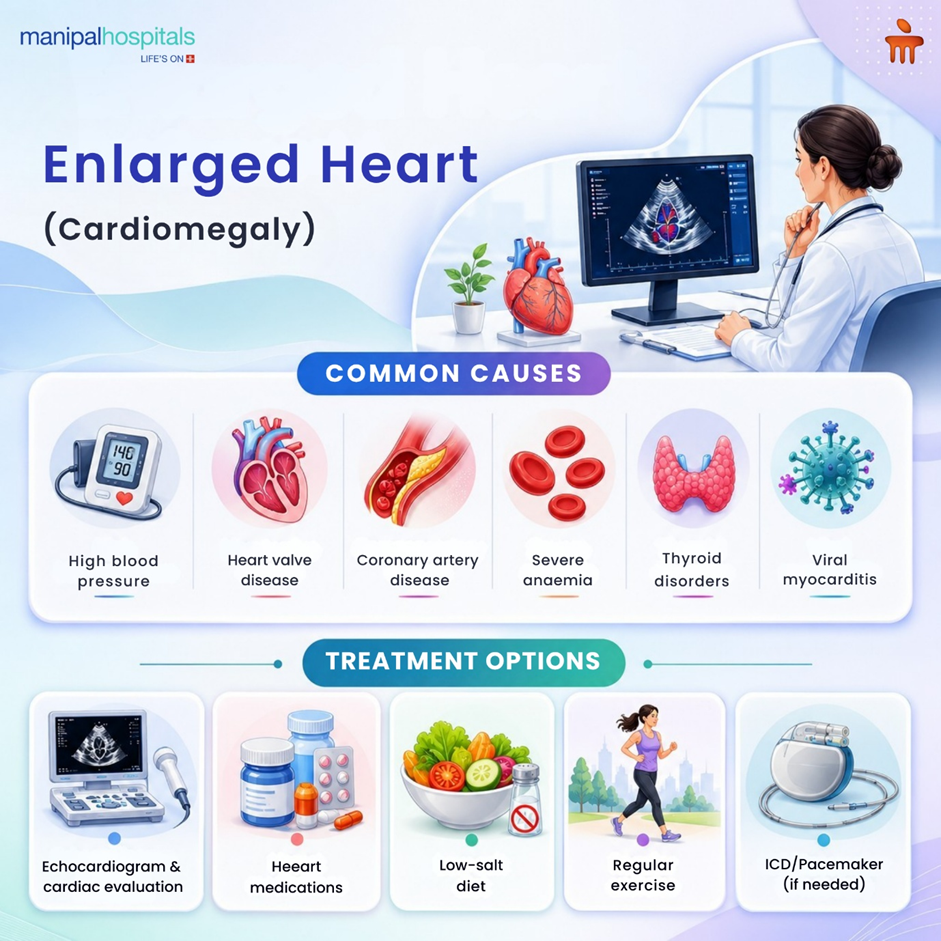
- Chronic Hypertension (High Blood Pressure): This is the leading cause of cardiac hypertrophy. When systemic blood pressure remains consistently high (above 130/80 mmHg), the left ventricle must exert excessive force to pump blood into the aorta. Like any muscle under continuous heavy load, the heart wall thickens over time.
- Coronary Artery Disease (CAD): Narrowed or blocked arteries restrict the steady supply of oxygen-rich blood to the heart muscle itself. If a patient has suffered a silent or overt heart attack, dead scar tissue replaces functional muscle tissue, forcing the remaining healthy muscle to stretch and enlarge to compensate.
- Valvular Heart Disease: The heart relies on four specialised valves to maintain a strict, one-way flow of blood. If a valve becomes narrow (stenosis) or leaks backwards (regurgitation), the heart chambers must work significantly harder to move the same volume of fluid, resulting in progressive dilatation.
- Severe Chronic Anaemia: When the blood lacks an adequate supply of oxygen-carrying red blood cells, the heart is forced to pump at a significantly accelerated pace for months or years to meet the body's baseline oxygen demands, leading to volume overload and enlargement.
- Thyroid Disorders: Both an overactive thyroid gland (hyperthyroidism) and an underactive thyroid (hypothyroidism) alter cardiac output, systemic vascular resistance, and heart rate, which can gradually induce structural changes in the myocardium.
- Viral Myocarditis: Certain viral infections can directly infiltrate the heart muscle tissue, causing widespread inflammation. This acute inflammation can weaken the structural integrity of the heart walls, leading to rapid, post-viral dilated cardiomyopathy.
Life Expectancy: How Long Can Someone Live with an Enlarged Heart?
The core concern for almost every diagnosed individual is: how long can someone live with an enlarged heart? There is no single, fixed survival timeline because longevity depends heavily on the specific cause of the enlargement, your age at diagnosis, your heart's current pumping efficiency, and your response to medical treatment:
|
Patient Risk Category |
Common Clinical Indicators |
Long-Term Prognosis Outlook |
|
Mild / Well-Controlled |
Normal or near-normal ejection fraction (above 50%); enlargement caused by early-stage hypertension that responds well to blood pressure medication. |
Excellent: Life expectancy can closely mirror that of a healthy individual of the same age, provided blood pressure is strictly managed. |
|
Moderate / Compensated |
Moderately reduced ejection fraction (35% to 45%); manageable symptoms of fatigue or occasional breathlessness during physical exertion. |
Favourable: With consistent use of modern heart failure medications, many patients remain stable for decades without significant progression. |
|
Severe / Advanced |
Severely low ejection fraction (below 30%); persistent shortness of breath even while resting; frequent hospitalisations for fluid retention. |
Guarded: Requires advanced medical therapies, device implantations, or specialised surgical intervention to extend life expectancy. |
Ultimately, structural changes caused by temporary, reversible conditions (like a transient thyroid issue or a treatable infection) carry a much better long-term survival outlook than chronic, progressive genetic conditions that go unmanaged for years.
Structural Reversibility: Can an Enlarged Heart Go Back to Normal?
A major milestone in cardiovascular medicine is the discovery of "reverse remodelling." So, can an enlarged heart go back to normal? The answer is that significant structural improvement is entirely possible if the condition is treated early enough.
When the underlying stressor is removed or carefully managed, the stretched or thickened heart muscle fibres can gradually shrink and return toward their original shape and size. For instance, if the enlargement was driven entirely by severe high blood pressure, keeping that pressure consistently in a safe, normal range can cause the thickened ventricular walls to thin out over several months.
Similarly, if a leaking heart valve is repaired or replaced before permanent muscle damage occurs, the dilated chambers can steadily reduce in size. However, if the heart tissue has already progressed to advanced, dense fibrous scarring, complete structural reversal becomes much more difficult, and the clinical focus shifts toward stabilising the heart to prevent further enlargement.Early assessment by an experienced cardiology department ensures accurate diagnosis, ongoing monitoring, and personalised treatment strategies that can help preserve heart function and reduce the risk of further enlargement.
Clinical Management: The Step-by-Step Treatment Journey
The management of an enlarged heart requires a structured, multi-step clinical approach that combines accurate diagnosis with personalised medical optimisation.
1. Advanced Baseline Testing and Diagnostic Mapping (Weeks 1-2)
Your cardiologist will order an echocardiogram, a cardiac MRI or an angiogram to measure the exact size of the chambers, calculate the ejection fraction, check the valves and look for blockages in the coronary arteries.
2. Guideline-Directed Medical Therapy (GDMT)
You’ll begin a tailored regimen of medications to lighten the heart’s load. This generally includes ACE inhibitors or ARNs to open up the blood vessels, beta blockers to slow the heart rate and reduce the heart's need for oxygen and diuretics to help remove excess fluid from the lungs and tissues.
3. Systemic Lifestyle Changes
You will be on a low-sodium diet to keep the volume load on your heart down and to prevent fluid retention. Your doctor will help you add a daily walk or other low-impact exercise to your routine to get your circulation in better shape.
4. Advanced Device or Surgical Procedure
If medications alone are unable to manage your heart rhythm or pumping efficiency, your specialist may recommend the implantation of an ICD (implantable cardioverter-defibrillator) to protect against dangerous arrhythmias or a biventricular pacemaker to resynchronise your heart's contractions.
Conclusion
An enlarged heart is a serious condition that needs careful medical attention, but it is a challenge that can be effectively managed with modern medicine. Your long-term survival and daily well-being depend not on the initial diagnosis, but on how early you intervene and how consistently you follow your treatment plan.
If you are looking for specialised enlarged heart treatment in Yelahanka, Bangalore, Manipal Hospital Yelahanka is a trusted destination for comprehensive cardiac care. Recognised as one of the top cardiology hospitals in Yelahanka, we provide world-class facilities and personalised treatment plans to help patients achieve the best possible outcomes.
FAQ's
Light to moderate aerobic exercise is very beneficial in most cases as it improves your overall circulation and decreases the workload on your heart. But avoid heavy lifting and high-intensity workouts that can lead to sudden spikes in blood pressure.” Always get your cardiologist’s personal advice on exercise clearance before starting any new routine.
Yes. If the enlargement is due to coronary artery disease, or the heart muscle has become so thick that it needs more oxygen than your coronary arteries can supply, you may feel chest pain or pressure (angina), especially with physical activity or stress. If you experience any new or worsening chest pain, seek medical attention immediately.
An enlarged heart is a physical change in the size or thickness of the heart muscle structure. Heart failure, by contrast, is a functional disease in which the heart muscle is too weak or too stiff to pump blood effectively. An enlarged heart often results in heart failure, but the structure can become enlarged before heart failure actually develops.
Most patients with a well-controlled condition will be advised by cardiologists to get a follow-up echocardiogram every 6 to 12 months. This lets your care team keep track of your chamber sizes, determine any changes in your ejection fraction, and assess how well your heart muscle is responding to your treatment plan.
Eating too much sodium, ultra-processed foods, and unhealthy fats directly leads to chronic high blood pressure and plaque build-up in your arteries. Over time, these conditions force the heart to pump against high resistance, a major driver of cardiac enlargement. Eating a heart-healthy diet is one of the main ways to manage the condition.
Share this article on: