6 Min Read
If you have ever spent a long afternoon hunched over a laptop, driving through heavy traffic, or lifting heavy boxes, you probably know exactly what that deep, stubborn ache between your shoulder blades feels like. While the lower back and neck seem to get all the attention in conversations about spinal health, middle back pain can completely derail your day. It makes sitting uncomfortable, twisting to look behind you painful, and even taking a deep breath feels strangely restricted.
Because the middle section of the spine is physically connected to the rib cage, it is inherently more rigid and stable than either the neck or the lower back. When pain develops in this stable zone, it often stems from distinct mechanical issues, structural changes, or muscle strains. Understanding the specific factors that trigger this discomfort can reduce the frustration of dealing with an undiagnosed ache and help you select an effective management path.
Through this blog, we provide you with clinical insights from spine care experts from one of the best spine care hospitals in Yelahanka, Bangalore, exploring its primary symptoms, underlying anatomical causes, and the clinical treatment options available in modern spine care.
Synopsis
Anatomy of the Middle Back
The middle back is built around twelve spinal bones, or vertebrae, labelled T1 through T12. This section of the spine, known as the thoracic spine, is much more rigid than your neck or lower back. Each of these vertebrae connects directly to a pair of ribs, creating a protective cage for your heart and lungs. While this framework provides excellent structural stability, it also means your middle back has a limited capacity to twist or bend.
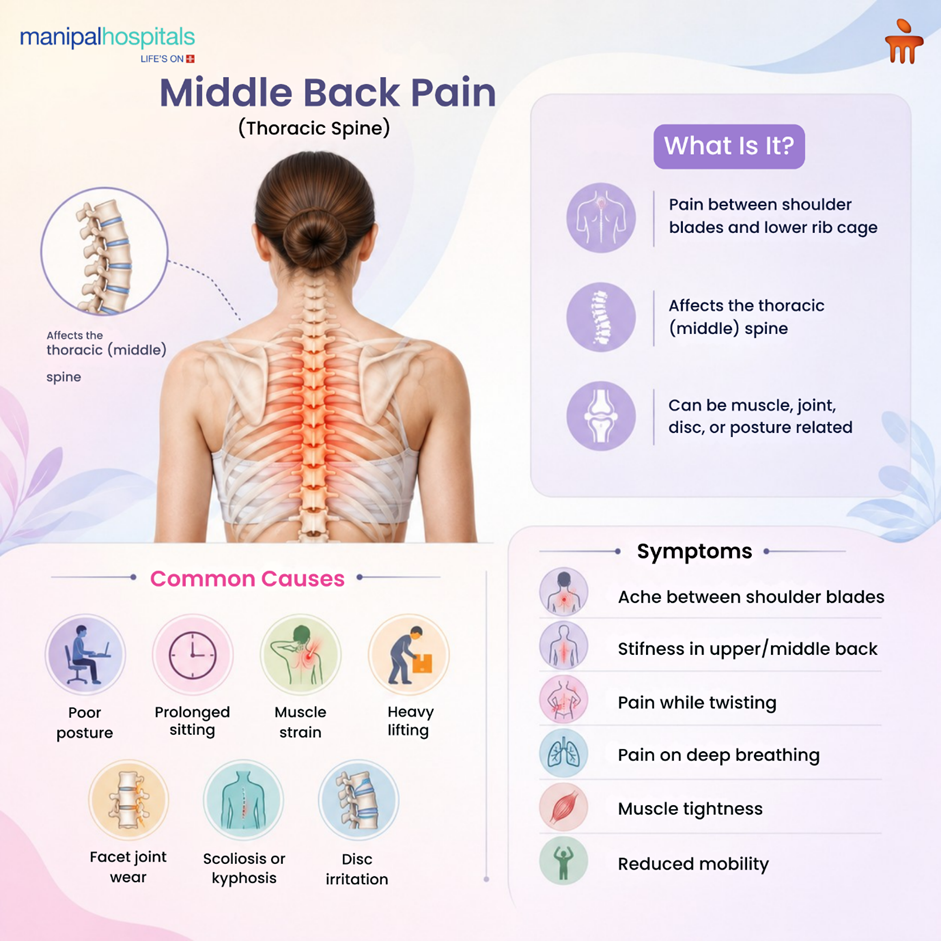
Because these bones move so little, the surrounding muscles, tendons, and ligaments end up bearing a lot of physical pressure. Most cases of middle back pain do not actually come from ruptured or slipped discs. Instead, the problem usually stems from simple mechanical strain in the deep muscle layers or irritation within the small facet joints that connect the vertebrae. If your posture drops and your shoulders round forward, you place immediate strain on these joints, which is why sitting for hours at a time causes so much discomfort.
Distinguishing Upper and Middle Discomfort
It helps to pinpoint exactly where you feel the ache, as different locations point toward different issues. People often find it hard to tell the difference between upper-middle back pain and lower thoracic issues.
Pain in the upper section usually involves the muscles that support your shoulder blades and neck, like the rhomboids and trapezius. This is typically brought on by repetitive arm movements, slouching, or staring down at a phone screen. Pain lower down in the middle back is usually linked directly to turning your torso, sitting for long stretches without proper lumbar support, or mechanical issues affecting the ribs themselves. Telling your doctor exactly where it hurts makes finding the right fix much faster.
Common Middle Back Pain Reasons and Causes
Finding the right relief requires looking at your daily habits alongside your physical anatomy. Because the ribs hold the thoracic spine quite rigid, it reacts poorly to specific types of daily strain.
-
Postural Overload: This is one of the most frequent causes of middle back pain. Sitting slouched over a laptop, leaning forward while driving, or cradling a phone drops your head forward. Your upper back muscles have to pull constantly against gravity to keep you upright. Over time, this constant stretching cuts down local blood flow and causes a deep, burning ache.
-
Muscular Strain: Lifting heavy loads without using your legs, sudden twisting movements during household work, or starting a new workout without warming up can cause small tears in the muscle fibres. The muscles between your spine and shoulder blades are easily strained when they are forced to work while cold or weak.
-
Facet Joint Wear: As you get older, the cartilage that cushions the tiny joints between your vertebrae can thin out. This leads to osteoarthritis, where the lack of natural lubrication causes friction between the bones. This joint wear causes localised stiffness that is usually most noticeable when you first get out of bed.
-
Structural Curvatures: Alignment issues like scoliosis (a sideways curve) or kyphosis (an exaggerated forward rounding) place uneven pressure on your back. The muscles on one side of the spine must work twice as hard to keep you balanced, causing a chronic ache that lasts until the alignment is addressed.
Structural Comparison
Because different structural triggers require different management strategies, it is helpful to look at how these common conditions contrast in a clinical setting to help you identify your symptoms.
|
Type of Issue |
Common Trigger |
What the Pain Feels Like |
Focus for Relief |
|
Postural Strai |
Slouching forward at a computer desk |
A dull, burning ache that gets worse by evening |
Ergonomic adjustments and regular stretching |
|
Muscle Tear |
Heavy lifting or sudden twisting |
Sharp, sudden pain when moving your arms |
Temporary rest, cold packs, and gentle movement |
|
Facet Joint Wear |
Natural ageing and cartilage loss |
Localised stiffness that eases slightly as you move |
Keeping active and targeted physical therapy |
|
Disc Irritation |
Direct trauma or long-term wear |
Sharp pain that travels along a rib to the front |
Nerve management and specific exercises |
The Treatment Plan: Step-by-Step Recovery
When a simple ache does not resolve with a few days of rest and mild stretching, following a structured medical pathway helps isolate the problem and implement an effective middle back pain treatment plan.
1. Clinical Examination: Initial assessment.
A specialist examines your spinal alignment, feels for muscle spasms, and checks your range of motion. You will discuss your daily routine, desk layout, and what specific movements make the pain worse.
2. Diagnostic Scans: These will be done within 1 to 2 days.
If the pain does not go away after a few days, an X-ray is used to check your bone structure and look for joint wear. If nerve irritation is suspected, an MRI provides a clear view of your discs and ligaments.
3. Active Physical Therapy: Weeks 1 to 6.
Your initial treatment focuses on lowering irritation with heat packs or short-term medication. A physiotherapist then guides you through exercises to stretch tight chest muscles and strengthen your upper back.
4. Ergonomic Management: Long-term routine.
You modify your daily workspace by raising your screens to eye level, using a chair with excellent support, and taking regular breaks to stand up. This stops the mechanical strain from returning.
When to Seek Immediate Medical Attention
While most thoracic pain comes from a simple muscle strain, this part of the spine runs close to several vital organs. You should see a doctor immediately if your back pain starts suddenly alongside chest tightness, difficulty breathing, a high fever, or unexpected weakness or numbness in your legs. An orthopaedics department can provide expert assessment and personalised treatment for persistent or severe middle back pain.
Conclusion
Middle back discomfort is common, but it responds well to straightforward changes in how you move and sit. Fixing your desk layout, taking regular breaks, and strengthening your core and upper back will relieve the pressure on your thoracic spine.
If your back does not improve with simple rest and if you are seeking back pain treatment in Yelahanka, Bangalore, consult our experienced spine care experts at Manipal Hospital Yelahanka, Bangalore. They ensure you get the practical medical support and diagnostic clarity needed to protect your spine and move comfortably again.
FAQ's
Yes. When you are stressed, you tend to tense your neck, shoulders, and back muscles without realising it. Holding this tension for hours cuts down local blood circulation, which creates painful muscle knots and a deep ache between your shoulder blades.
Your ribs are physically joined to your thoracic vertebrae, so your entire rib cage expands every time you inhale. If you have a strained back muscle or an irritated joint where a rib meets your spine, that breathing movement pulls on the tender tissue, causing a sharp twinge.
Yes, walking is an excellent way to keep your back healthy. It coaxes blood back into your spinal muscles to help them heal, and it keeps your joints moving without putting a heavy impact on your skeleton. Focus on walking on flat ground and keeping your gaze forward.
Raise your computer monitor so the top third of the screen sits at eye level, which stops you from tilting your head down. Keep your mouse and keyboard close enough that your elbows stay bent at a 90-degree angle by your sides so you do not have to reach forward.
A minor muscle strain generally heals within two to four weeks if you avoid heavy lifting and do some light stretching. If the pain stays the same after a month, or if it keeps disappearing and coming back, you should have a doctor look at it to see if there is another cause.
Share this article on: