8 Min Read
At first, the shoulder may only hurt during certain movements. Pain during everyday tasks is often one of the first signs people notice. Lifting bags, reaching for clothes, or turning onto one side in bed may start to feel uncomfortable. Many people ignore these changes for months, expecting the pain to improve on its own. In some cases, though, a rotator cuff tear may cause ongoing shoulder pain.
The shoulder is one of the body’s most flexible joints. It supports everyday movements like lifting, rotating, pushing, pulling, and carrying. Because it is used so often, it can become strained or injured over time. After the age of 40, this tear becomes a common cause of ongoing shoulder pain in adults. This condition can affect athletes, office workers, gym goers, and even homemakers.
In this blog, a top orthopaedic surgeon in Yelahanka, Bangalore, explains what a rotator cuff tear involves, why it happens, and the main symptoms to look out for. It also outlines the different treatment paths, what the recovery process looks like, and the specific signs that mean you should see a specialist. Conditions affecting the bones, joints, muscles, and tendons are commonly evaluated and managed through the Orthopaedics Department.
Synopsis
- What Is a Rotator Cuff Tear?
- Why Does a Rotator Cuff Tear Cause Shoulder Pain?
- Rotator Cuff Tear Causes
- Rotator Cuff Tear Symptoms: What Should You Notice
- Types of Rotator Cuff Tears
- How Doctors Diagnose and Treat a Rotator Cuff Tear
- Non-Surgical Rotator Cuff Tear Treatment
- When Injections May Be Recommended
- Arthroscopic Shoulder Surgery: Smaller Cuts, Faster Recovery
- Recovery After Rotator Cuff Treatment
- When Should You See a Specialist
- Conclusion
What Is a Rotator Cuff Tear?
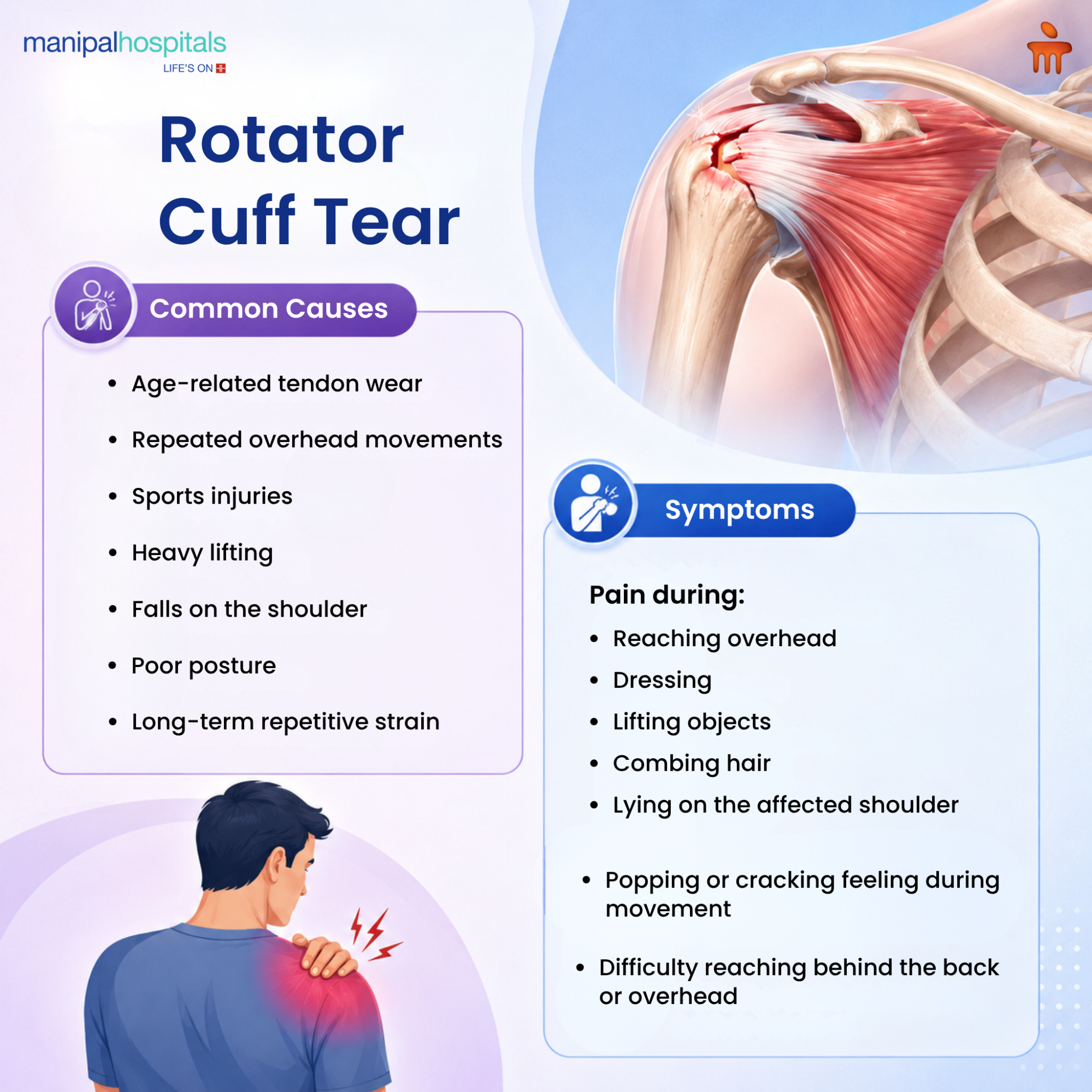
The shoulder has a group of four muscles and tendons that work together to keep the joint steady during movement. They enable arm movement and make everyday tasks such as reaching, lifting, and turning easier. A rotator cuff tear happens when one of the shoulder tendons is damaged. Sometimes the injury follows a fall or a sudden strain; other times it builds up slowly from wear and tear.
Why Does a Rotator Cuff Tear Cause Shoulder Pain?
Rotator cuff tears have some common causes. Some people get tears after sudden trauma, some from years of slow tendon degeneration.
Common rotator cuff tear causes include the following:
-
Ageing-related tendon degeneration
-
Repetitive overhead activity
-
Sports injuries
-
Heavy lifting
-
Falls on the shoulder
-
Bad posture
-
Work-related repetitive strain
-
Long-term inflammation
The blood supply to shoulder tendons naturally decreases with age, which slows healing and makes tendon damage more likely.
Rotator Cuff Tear Causes
A rotator cuff tear can happen after a sudden injury, but it can also build up slowly over time as the shoulder tendons wear down. When this happens, even normal arm movement may start to hurt.
Common causes include:
-
Repeated overhead movement at work or during sports
-
Heavy lifting or sudden strain on the shoulder
-
Falls or direct injury to the shoulder
-
Poor posture over a long period
-
Natural wear and tear with age
-
Repeated shoulder strain during daily activities
As people get older, the tendons in the shoulder also receive less blood supply, which can make them weaker, heal more slowly, and tear more easily.
Rotator Cuff Tear Symptoms: What Should You Notice
Many patients dismiss early symptoms as just “normal shoulder strain.” But early detection of warning signs often translates into easier treatment and a quicker recovery.
Common Rotator Cuff Tear Symptoms
1. Pain While Lifting the Arm
One of the earliest signs is pain during the following activities:
-
Reaching overhead
-
Lifting objects
-
Dressing
-
Combing hair
Patients often describe a sharp or catching pain.
2. Shoulder Pain at Night
Many people have trouble sleeping with this condition. Pain may worsen:
-
While lying on the affected shoulder
-
During the night
-
Early in the morning
Night pain is one of the most common complaints.
3. Shoulder Weakness: Weakness of the shoulder may be observed during everyday tasks such as overhead lifting, carrying things, or handling objects.
4. Clicking or Cracking Sensations: Some patients feel a grinding feeling, a clicking sensation, and a popping feeling during movement of the shoulder.
5. Reduced Shoulder Movement: This condition may restrict motion above rotation, reaching behind the back. Without treatment, stiffness can build up over time.
Types of Rotator Cuff Tears
The rotator cuff tear will differ depending on the severity of the injury as well as how the tear has developed. The type of tear can help guide the most appropriate treatment.
|
Type of Tear |
What Happens |
Severity |
|
Partial |
The tendon is damaged or frayed but still attached. |
Mild to moderate |
|
Full-Thickness |
The tendon is completely torn or detached from the bone. |
More severe |
|
Acute |
A tear caused by a sudden fall or a heavy lift. |
Often painful |
|
Degenerative |
Wear and tear that happens slowly over many years. |
Common after 40 |
How Doctors Diagnose and Treat a Rotator Cuff Tear
Doctors usually begin with an examination of the shoulder to assess where it hurts, how far you can move it, and how strong the arm is; they may then request imaging, such as an X‑ray or MRI, to confirm the diagnosis and gauge the tear’s severity. Doctors usually begin with a detailed shoulder examination and may recommend imaging tests to confirm the diagnosis. Similar specialised investigations are also used in orthopaedic conditions that may require procedures such as a bone biopsy.
-
An MRI scan is commonly used to evaluate tendon damage, tear size, inflammation, and muscle injury.
-
Ultrasound helps assess tendon movement in real time.
-
X-rays may identify arthritis, bone spurs, or other joint changes, although tendon tears are not directly visible on X-rays.
Non-Surgical Rotator Cuff Tear Treatment
Many rotator cuff tears can be managed without surgery. Common treatment approaches may include:
-
Rest and activity modification: Helps reduce strain on the injured shoulder
-
Physiotherapy: Improves shoulder strength, flexibility, and movement
-
Anti-inflammatory medicines: May help reduce pain and swelling
-
Posture correction and strengthening exercises: Support shoulder stability and recovery
-
Ice application: Can help relieve pain and inflammation
Regular rehabilitation exercises are an important part of recovery and help improve shoulder function over time.
When Injections May Be Recommended
Some people continue to have shoulder pain even after trying rest, exercises, and medicines for a while. When the pain starts affecting daily movement or sleep, an injection may be suggested to provide relief. Steroid injections are known to have an anti-inflammatory effect on the body, which in turn may help in alleviating pain and making movements less painful temporarily. Nevertheless, steroid injections are prescribed with caution and rarely, as they may cause tendon weakness.
Arthroscopic Shoulder Surgery: Smaller Cuts, Faster Recovery
When shoulder pain and weakness continue for a long time, an operation may be considered to fix the torn tendon. This procedure is usually done through a few small openings instead of one large cut.
During arthroscopic surgery:
-
Small instruments and a camera are inserted through tiny cuts around the shoulder
-
Damaged tendons are repaired
-
Inflamed tissue may be cleaned
-
Bone spurs may also be removed if needed
Some benefits of arthroscopic surgery may include:
-
Smaller scars
-
Less tissue damage
-
Reduced pain after surgery
-
Quicker rehabilitation and recovery
Recovery After Rotator Cuff Treatment
Rotator cuff tears are categorised by how much the tendon is damaged and how the injury started. This classification helps doctors decide if the shoulder needs surgery or if physiotherapy is enough. The typical recovery timeline is highlighted below:
|
Recovery Stage |
Approximate Time |
|
Pain Improvement |
A few weeks |
|
Better mobility |
6–12 weeks |
|
Strength Restoration |
3–6 months |
|
Full Recovery |
Up to 1 year |
When Should You See a Specialist
It is important to consult a doctor if shoulder pain does not improve or begins affecting daily activities and arm movement. Seek medical advice if you experience:
-
Shoulder pain lasting several weeks
-
Difficulty lifting the arm
-
Weakness in the shoulder
-
Pain while sleeping, especially on the affected side
-
Limited shoulder movement
-
Clicking or grinding sensations in the shoulder
-
Worsening pain after an injury
Conclusion
A small twinge in the shoulder is easy to ignore, but those early changes can matter. Recognising the signs and understanding the common causes can help people seek treatment before the problem gets worse. For many patients, rotator cuff tear treatment in Yelahanka can provide excellent outcomes using physiotherapy, medications, injections, or minimally invasive surgery.
Our experienced orthopaedic specialists at Manipal Hospital Yelahanka, Bangalore, provide comprehensive shoulder analysis, orthopaedic treatment, arthroscopy of the shoulders, and customised rehabilitation programmes for our patients. We are committed to helping you recover so you can move freely and with less pain and discomfort.
FAQ's
Yes. Shoulder injuries often cause pain and stiffness at night that is aggravated by resting directly on the shoulder, which can increase pressure and inflammation of the tendon.
Overhead exercises with heavy weights can cause tendon damage. It’s safer to do light, supervised rehabilitation exercises until shoulder strength and movement improve properly.
Yes. Poor posture can alter the shoulder alignment and increase the stress on the tendon, which can build up over time to develop chronic shoulder pain and tendon irritation.
Yeah. As we age, our tendons get weaker naturally, and degenerative tears are more common, particularly after age 40, and especially in people who are physically active or do repetitive work.
No. Shoulder pain can also be caused by arthritis, bursitis, frozen shoulder, nerve irritation, and muscle strain. A thorough examination will reveal the exact cause.
Share this article on: