7 Min Read
Preparing for the arrival of a newborn is a journey filled with milestones, from setting up the nursery to imagining that very first cry in the delivery room. The moment of birth represents a monumental physical transition for a baby. In a matter of seconds, a newborn must shift from receiving all its oxygen through the maternal placenta to expanding its lungs and breathing room air for the first time. While this intricate biological shift usually occurs seamlessly, there are instances where a baby faces a delay and requires immediate, hands-on help from the delivery team to establish steady breathing.
If your medical team mentions that your baby experienced a breathing delay at birth, it is completely natural to feel overwhelmed and look for clear answers. This blog will explore what happens when a newborn's initial breathing is interrupted, look closely at the underlying physical reasons behind the event, and outline the advanced medical therapies used to protect a child's long-term health and development.
Synopsis
What is Birth Asphyxia?
To understand the baseline birth asphyxia definition, it helps to look at what happens to a baby's lungs during delivery. While inside the womb, a baby's lungs are filled with fluid and do not breathe air; oxygen is continuously delivered from the mother's bloodstream through the placenta and umbilical cord. At birth, the physical pressure of delivery helps clear this fluid so the lungs can expand. If this transition is blocked, interrupted, or delayed, the baby enters a state of birth asphyxia.
In everyday medical terms, this condition means a baby's tissues are temporarily not getting enough oxygen, and blood flow to vital organs drops. Doctors refer to low oxygen as hypoxia and reduced blood flow to tissues as ischemia. If this state lasts for more than a few minutes, it can cause a temporary chemical build-up of acid in the baby's blood, a state called metabolic acidosis, which puts stress on fragile developing cells.
How Do Doctors Identify Baby Asphyxia?
To identify this condition objectively, pediatricians look at clear, measurable data right after delivery. First, they check the Apgar score at one minute and five minutes after birth. This quick test evaluates five parameters: heart rate, breathing effort, muscle tone, reflexes, and skin colour. A score below 7 means the baby needs some level of medical support. If a serious delay is suspected, doctors also test a small blood sample drawn from the umbilical cord. artery right after delivery. A blood pH level falling below 7.0 or a high base deficit confirms that a significant oxygen drop occurred.
Common Causes of Birth Asphyxia
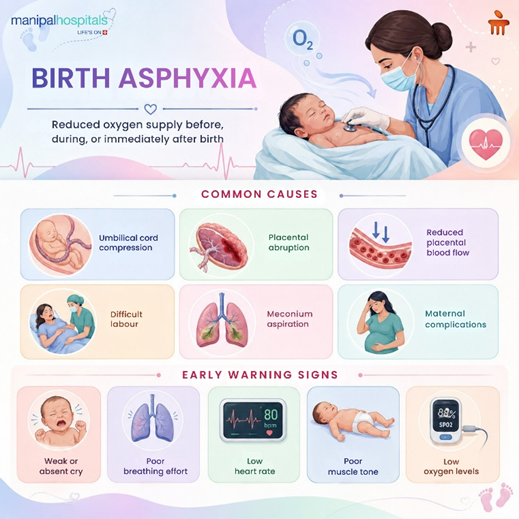
An oxygen shortage can happen right before labour peaks or during the actual delivery process. The most common causes of birth asphyxia involve temporary issues with the blood supply, the placenta, or the mechanical process of birth:
-
Umbilical Cord Issues: The cord is the baby's primary oxygen pipeline. If it gets compressed during contractions, or if it slips down into the birth canal ahead of the baby (cord prolapse), the blood line can be pinched closed. Sometimes the cord wraps tightly around the baby's neck (a nuchal cord) or develops a physical knot, restricting oxygen flow as the baby moves down.
-
Placenta Problems: The placenta anchors the baby to the womb. If it detaches from the uterine wall too early during labour (placental abruption), the oxygen supply is cut off instantly. Chronic issues like placental insufficiency, where the placenta struggles to transfer nutrients efficiently due to long-standing maternal high blood pressure, can also cause oxygen levels to drop gradually before delivery.
-
Sudden Blood Pressure Drops: If a mother's blood pressure drops quickly, which can happen due to sudden bleeding or as an unexpected reaction to epidural anaesthesia, less blood reaches the placenta. Conditions like pre-eclampsia can also constrict the blood vessels supplying the womb.
-
Difficult or Slow Deliveries: If a labour becomes obstructed, the constant pressure of contractions can exhaust the baby's natural oxygen reserves. This is common in cases of shoulder dystocia, where the baby's head emerges, but the shoulders become physically wedged behind the mother's pelvic bone, causing a critical delay.
-
Inhaling Meconium: If a baby experiences stress during a difficult delivery, they may pass their first stool (meconium) into the amniotic fluid before birth. If the struggling baby gasps and breathes this thick, sticky fluid into their airways, it blocks the lungs and makes it very difficult to absorb oxygen after birth.
How the Body Responds to Low Oxygen
When oxygen levels drop, a newborn's body naturally tries to protect its most vital organs by redirecting blood flow away from non-essential tissues and sending it directly to the brain and heart. The table below outlines how different internal systems manage this shift and how medical teams monitor their recovery:
|
Impacted Organ System |
Immediate Physical Response |
How Medical Teams Monitor It |
|
Central Nervous System |
Cellular stress and localised tissue swelling (oedema) due to altered oxygen delivery. |
Amplitude-integrated EEG (aEEG) to track brain waves and cranial ultrasound scans. |
|
Renal System (Kidneys) |
Temporary reduction in the blood filtration rate as blood flow is diverted elsewhere. |
Tracking exact hourly urine output volumes and running blood tests for serum creatinine. |
|
Cardiovascular System |
Mild strain on the heart muscle wall and temporary blood pressure fluctuations. |
Continuous arterial blood pressure monitoring and targeted neonatal echocardiograms. |
|
Pulmonary System (Lungs) |
Elevated pressure in the blood vessels of the lungs, making it harder for them to clear fluid. |
Continuous oxygen saturation monitors (pulse oximetry) and routine blood gas tests. |
The Medical Management of Birth Asphyxia
When a newborn does not breathe immediately, the delivery room team acts without a second's delay. The clinical management of birth asphyxia is a highly coordinated, time-sensitive emergency protocol designed to restore normal oxygen levels and protect the baby's organs.
1. Immediate Airway Stabilisation (First 60 Seconds)
The medical team swiftly puts the newborn under a radiant warmer to prevent the baby from getting cold. They use a gentle suction catheter to clear the mouth and nose of any amniotic fluid or trapped meconium. They dry the baby firmly with a warm towel to stimulate breathing. If the baby still doesn’t cry or get a healthy heart rate, the team uses a small mask device to gently blow small puffs of air into the lungs.
2. Advanced respiratory support (the first few minutes)
If the baby’s heart rate remains low despite mask ventilation, a specialist will place a small tube directly into the windpipe (intubation). This tube is attached to a mechanical ventilator in the Neonatal Intensive Care Unit (NICU) to do the physical work of breathing and stabilise oxygen levels in the blood.
3. Targeted Temperature Management (Initiated within 6 hours)
For babies who show signs of moderate to severe oxygen stress, doctors begin the definitive phase of treatment for birth asphyxia with therapeutic hypothermia. The baby is placed on a cooling mattress filled with fluid, which reduces the core temperature of the body from 37°C to 33.5°C. The baby stays at this precise temperature for 72 hours. This cooling slows cellular activity, reduces brain swelling, and prevents secondary tissue injury. After 3 days, the mattress slowly warms the baby to normal temperature.
4. Intravenous Stabilisation (Ongoing Monitoring)
While the baby rests, neonatologists use specific intravenous medications to support individual organs. If brain irritation triggers seizures, they give anticonvulsants like phenobarbital or levetiracetam to calm the electrical activity. If blood pressure wavers, they provide infusions of dopamine or dobutamine to keep blood moving steadily to the kidneys and liver. Fluids are also carefully restricted and calculated to give the kidneys a chance to recover fully.
Conclusion
Hearing that a newborn needed emergency breathing support at delivery is an incredibly stressful experience for any family, but modern neonatal intensive care has transformed how this condition is managed. Early intervention, specialised cooling mattresses, and continuous monitoring help most babies recover well and move past the initial delay. For expert birth asphyxia treatment in Varthur Road, Bangalore, you can consult the specialist neonatal intensive care team at Manipal Hospitals, Varthur Road.
FAQ's
No. Many newborns experience a brief delay in breathing for thirty seconds or a minute due to temporary drowsiness from maternal pain relief or a quick compression of the cord. If the delivery team provides immediate suction and a few seconds of mask ventilation, the vast majority of babies expand their lungs, recover completely, and face no lasting issues.
Birth asphyxia is a systemic lack of oxygen and blood flow that can happen to any baby right at the time of delivery, potentially affecting multiple organ systems. Premature lung disease, or respiratory distress syndrome, is a localised condition seen in babies born before their due date, caused simply by a lack of a natural surfactant coating that keeps the air sacs open.
No. Clinical research shows that the specialised cooling blanket must be started within the first 6 hours of a baby's life to be effective. This early window is critical because cooling the body before secondary cellular swelling peaks helps protect brain cells from long-term changes.
The medical team tracks kidney health by measuring the exact volume of urine the baby passes every hour and running daily blood tests to check metabolic markers. They monitor serum creatinine and blood urea nitrogen levels; as the kidneys recover their normal filtering capacity, these chemical numbers steadily drop back down to standard newborn baselines.
Yes. During regular prenatal check-ups, obstetricians use fetal Doppler ultrasound scans to measure the blood flow through the umbilical cord and track the baby's growth markers. If they identify conditions like pre-eclampsia, a low volume of amniotic fluid, or a drop in placental blood flow, they can plan a controlled delivery with a neonatal team present in the room to manage risks immediately
Share this article on: