9 Min Read
There is a specific kind of sinking feeling that often comes when you get a phone call from your doctor’s office saying your recent Pap smear results were "inconclusive" or "abnormal." You may start wondering what the results mean and whether something serious could be affecting your health. Usually, the next step your doctor suggests is a colposcopy. A colposcopy is actually an incredibly helpful tool that gives your medical team a high-definition view of your cervical health.
A colposcopy allows doctors to examine the cervix in greater detail and identify any abnormal cell changes. This blog will look at why a colposcopy procedure is recommended, how it differs from a regular exam, and what you can expect in terms of physical sensation. Understanding the process clearly can help reduce anxiety and make the experience feel more manageable.
Synopsis
What Is a Colposcopy?
A colposcopy is a diagnostic procedure used to closely examine the cervix, vagina, and vulva. Many patients are asked to get a colposcopy test after a Pap smear, or an HPV report needs more clarity. It helps the doctor check if the cells are normal or if there are early changes that need attention.
The doctor uses a colposcope, which is a light with a magnifying lens. It stays outside the body the whole time. Nothing extra is inserted apart from the usual speculum used in a pelvic exam. During a colposcopy, the doctor carefully checks the cervix, the walls of the vagina, and the outer area.
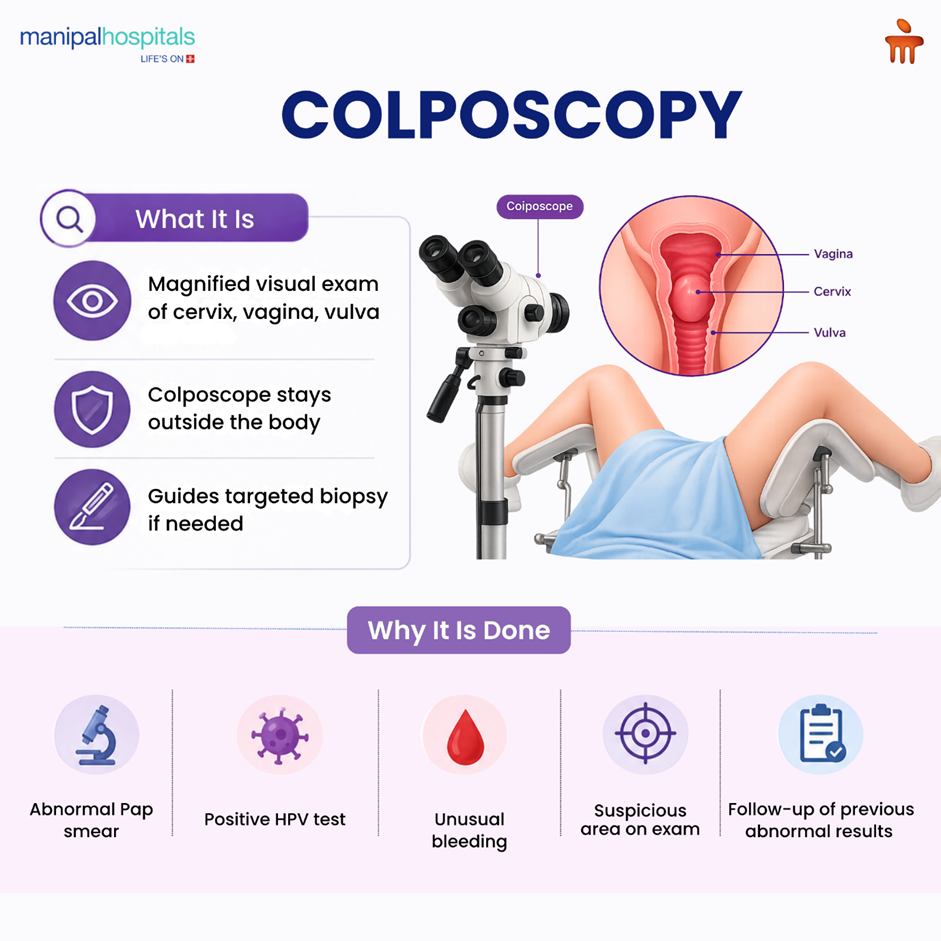
To make certain areas stand out, a liquid like diluted vinegar is applied. You may feel a slight stinging for a few seconds. Sometimes another solution is used if needed. The test itself does not involve any cuts. If the doctor notices a patch that looks different, a small sample may be taken from that exact spot to send it for lab testing. The colposcopy helps them decide where to take that sample from.
Why Is a Colposcopy Test Done?
A colposcopy test is done when a screening report does not look completely normal, and the doctor wants to see the area more clearly. It gives a direct view of the cervix instead of relying only on lab results. Most patients are sent for this after a Pap smear shows cell changes or when an HPV test comes back positive.
Doctors commonly recommend a colposcopy after abnormal Pap smear or HPV test results.
-
Your Pap smear shows changes in cervical cells
-
A high-risk type of HPV is detected
-
There is bleeding after intercourse or between periods
-
The doctor notices a patch or area that looks different during an exam
-
A previous biopsy showed changes and needs review
An abnormal report does not mean cancer. Many HPV-related cell changes resolve naturally without treatment. The purpose of a colposcopy is to check how those cells actually look and decide if they need treatment or just follow-up. In some cases, the test is repeated over time to watch the same area. This helps track whether the cells are returning to normal or showing further changes.
Preparing for a Colposcopy Procedure
Getting ready for a colposcopy procedure does not need much effort, but a few simple steps can make the test smoother and more comfortable. Most of the preparation is about keeping the area clear so the doctor gets a proper view.
It is important to tell your doctor if you are pregnant or think you might be. The test can still be done, but the approach may be slightly adjusted. Feeling anxious before the procedure is common and completely understandable. Understanding the procedure beforehand often helps reduce anxiety.
Here is some general advice before the test:
-
Avoid intercourse for at least 24 to 48 hours before the test
-
Do not use tampons, vaginal creams, or medicines at the same time period
-
Try to schedule the appointment when you are not on your period
-
You can eat your regular meals before coming in; there is no need to fast
-
Wear loose and comfortable clothing for the visit
-
If advised, you may take a mild pain relief tablet like paracetamol before the procedure
Colposcopy Procedure: Step-by-Step
A colposcopy procedure is done in a sequence that feels quite similar to a routine pelvic exam, though the doctor spends more time looking closely at the cervix. The full colposcopy does not take long, often around 10 to 20 minutes. A large part of that time goes into careful observation rather than any active step.
Also, remember that nothing from the colposcope enters the body. A biopsy is only done when there is a clear reason to take a closer look at a specific area.
Here is how it is done:
-
You lie back on the examination table, with your legs supported, just like during a Pap smear
-
A speculum is placed gently so the cervix can be seen. There is a feeling of pressure, but it settles once you relax
-
The colposcope is brought closer to the opening of the vagina. It stays outside and is used only to get a clearer, enlarged view
-
A liquid similar to diluted vinegar is applied over the cervix. It can sting a little for a few seconds, then the feeling fades
-
As the solution spreads, certain areas begin to stand out. Some patches may turn pale or white, which helps the doctor focus on them
-
At times, another solution is used to check the same area again from a different angle of visibility
-
If a spot looks different enough to need testing, a very small piece of tissue is taken from that exact area
-
In some cases, a sample may also be taken from just inside the cervical opening if that part needs to be checked
Is a Colposcopy Painful?
This is usually the first question patients ask before a colposcopy test. The procedure is not considered painful, though you may notice a few unfamiliar sensations while it is being done. What you can expect is when an experienced obstetrics and gynaecology specialist at Manipal Hospital, Sarjapur Road, can guide patients through the procedure with personalised care and reassurance:
-
The speculum can feel a bit uncomfortable when it is placed, more like pressure than pain
-
Once it is in position, that feeling usually settles and becomes easier to tolerate
-
When the liquid is applied, there can be a slight burning or stinging for a few seconds
-
After that, there is not much sensation while the doctor continues to look closely
If a biopsy is needed during the colposcopy procedure, you may notice a quick change:
-
A small pinch or cramp when the sample is taken
-
It comes on suddenly and passes just as quickly
-
Some people feel a dull cramp for a short while after
People experience it differently. Being tense can make everything feel stronger than it actually is, so staying as relaxed as possible does help.
After the Procedure
Once the colposcopy procedure is over, most people feel steady enough to sit up and walk out within a few minutes. What happens next is usually mild and settles on its own, but it helps to know what is normal in the first few days.
-
You can go back to your usual routine the same day if no tissue sample was taken, including work and light activity
-
If a sample was taken, light spotting may continue for a few days and can vary from faint staining to slightly more noticeable bleeding
-
A dark brown or almost black discharge may appear; this comes from the liquid applied to control bleeding at the biopsy site and is expected
-
Mild lower abdominal cramps can come and go, often similar to a light period cramp and usually do not last long
-
Using pads instead of tampons is advised for a few days to avoid irritation at the site
-
Intercourse is best avoided until any bleeding or discharge has completely stopped so the area can heal properly
-
Heavy workouts or strain can increase spotting, so it is better to keep activity light if bleeding is still present
-
Most of these symptoms ease gradually over a few days without needing medication or special care
Risks and Safety of Colposcopy
A colposcopy procedure is simple, and problems are not common, but a few things can still show up, mainly when a sample has been taken. Some risks include:
-
Light bleeding can continue for a few days after a biopsy, sometimes a little more than spotting
-
Mild cramping in the lower abdomen can be felt, similar to a dull period pain
-
A small risk of infection is present, especially if the area does not heal cleanly
-
Watch for signs like foul-smelling discharge, fever, or pain that is getting worse instead of settling
-
In rare cases, bleeding may be heavier and not slow down, which would need a doctor to check it
Conclusion
A colposcopy is a straightforward procedure that is generally well tolerated by most patients. With guidance from experienced obstetrics and gynaecology specialists near Sarjapur Road, the steps are simple, and most people go through them with only mild discomfort that settles quickly. What matters more is the ability to catch early cell changes and act at the right time.
At Manipal Hospitals Sarjapur Road, patients receive careful evaluation, clear guidance, and supportive follow-up throughout the process with access to specialised obstetrics and gynaecology care at Manipal Hospitals Sarjapur Road. Patients looking for a colposcopy procedure in Sarjapur Road can talk to our experts about the procedure and their concerns.
FAQ's
If the doctor only performed a visual check, they can usually tell you what they saw immediately. However, if a biopsy was taken during the colposcopy procedure, it typically takes five to seven business days for the lab to process the tissue and provide a final report.
Yes. Since general anaesthesia is not used for a colposcopy, you will be fully awake and alert. Most women feel perfectly fine to drive themselves to and from the appointment.
No. Most abnormal results show "dysplasia," which are precancerous changes. These are very treatable. If these cells are found during your colposcopy procedure in Sarjapur Road, your doctor will discuss simple ways to remove them before they ever have a chance to become serious.
Yes, a colposcopy test is safe during pregnancy. It is very important to monitor any abnormal cells even while pregnant. However, doctors are usually more cautious about taking a biopsy during pregnancy unless it is absolutely necessary.
The acetic acid (vinegar) causes abnormal cells to absorb more water and turn white. This "aceto-white" change is what helps the doctor pinpoint exactly where to look during the colposcopy.
Share this article on:


.webp "Common Gynaecological Problems Women Ignore: A Clinical Guide")