9 Min Read
A normal heartbeat is something most people take for granted. It’s because under typical circumstances, the heart expands and contracts consistently throughout the day, ensuring that oxygen and vital nutrients reach every organ. However, when the internal electrical system responsible for managing this rhythm encounters an interruption, the body notices the impact almost immediately. You might experience a sudden wave of dizziness while standing up from a chair, feel unusually exhausted after climbing a short flight of stairs, or notice an irregular fluttering sensation in your chest.
When the heart beats too slowly or is not well coordinated, daily life can be very unpredictable. In some situations, a small implantable medical device is frequently recommended to restore a regular rhythm for these electrical disturbances. Understanding who needs a pacemaker and how modern cardiac care treats these conditions can ease the unknowns and help you get a better idea of your treatment options. In this blog, we will discuss the specific medical reasons for an irregular rhythm and how this medical intervention supports long-term health.
Synopsis
What is a pacemaker?
To understand why a pacemaker is used, it’s useful to look at how the heart naturally controls the rhythm. The heart has an electrical system built in. The process starts in the upper right chamber at the sinoatrial node, which produces regular electrical signals. These electrical signals travel through the heart muscle and tell it to contract and pump blood efficiently.
If this route is blocked, damaged, or delayed by illness, ageing or injury, the heart struggles to maintain a steady rate. So, if these natural signals don't work, what does a pacemaker do? The device serves as a constant and sensitive surveillance system. It tracks your normal heart rate every second. If your heart is beating on its own at a healthy, normal rate, the device just observes and does nothing. It works when your natural heart rate falls below a certain level or when there is a dangerous pause between your beats. It produces tiny electrical pulses that go to the heart muscle and make it beat at a safe speed. This constant monitoring is the reason why your brain and other vital organs receive a steady supply of blood.
How Does a Pacemaker Work?
Modern pacemakers are small, lightweight electronic devices that are typically placed just under the skin below the collarbone during a straightforward, minimally invasive surgical procedure.
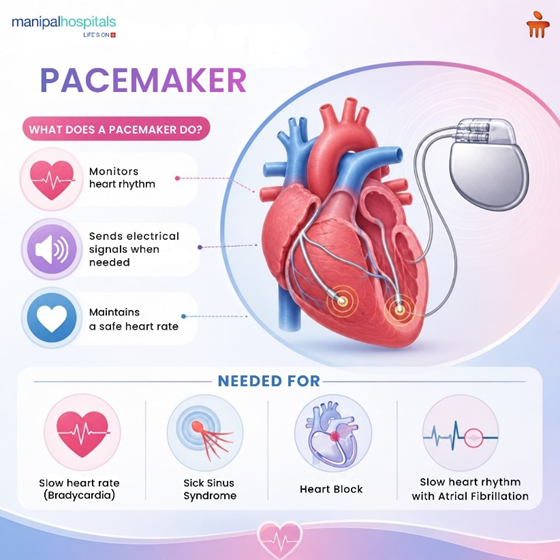
To understand how does a pacemaker work, it helps to examine its two primary components:
-
The Pulse Generator: This small metal case houses a long-lasting lithium battery and electronic circuitry. The internal computer reads the heart's natural electrical activity and determines when to provide assistance.
-
The Leads: These are thin, insulated medical wires that are guided through a vein directly into specific chambers of the heart.
The tips of these leads are attached to the inner wall of the heart. They perform two continuous functions: they detect the heart's native electrical signals and transmit them back to the pulse generator, and they deliver the necessary electrical pacing pulses back to the heart muscle when required. Advanced models also feature specialised sensors that detect physical movement or breathing rates. If you begin walking quickly or exercising, the device automatically increases your heart rate to meet your body's changing physical demands.
What Heart Conditions Require a Pacemaker?
Cardiologists will consider a range of diagnostic tests, physical exams, and patient symptoms before recommending a device. Patients experiencing signs of an abnormal heart rhythm can consult the Cardiology Department for a comprehensive evaluation and personalised treatment recommendations.Diagnostic tests such as an ECG help assess the heart's electrical activity and identify rhythm abnormalities that may require treatment.Specific electrical problems that define heart conditions requiring a pacemaker include:
1. Abnormally slow heart rate
Bradycardia is when your heart rate falls below 60 beats per minute when you’re awake. A slow heart rate is normal and healthy for competitive athletes or while in deep sleep. Pathological bradycardia is when the heart cannot physically pump enough blood to supply normal daytime activities. Its deficiency results in chronic weakness, chronic dizziness, breathlessness, and sudden fainting.
2. Sick sinus syndrome (SSS)
This condition is a direct failure of the sinoatrial node, the heart’s natural pacemaker. The node may fire signals at too slow a rate or may cease firing altogether for several seconds at a time. It may jump back and forth erratically between an abnormally slow rate and a rapid, chaotic rhythm. This discrepancy causes sudden falls in blood pressure and unanticipated attacks of physical weakness.
3. Atrioventricular Block (Heart Block)
Heart block is a delay or complete block of the electrical signals that travel from the upper chambers of the heart (atria) to the lower pumping chambers (ventricles). Third-degree or complete heart block means there are no electrical signals being sent between the upper and lower sections. The lower chambers are allowed to beat at their internal back-up rate, which is usually too slow and erratic to keep the body going safely.
4. Slow ventricular response atrial fibrillation
Atrial fibrillation is a common arrhythmia that occurs when the upper chambers of the heart beat rapidly and irregularly. Sometimes the medications required to control this rapid upper rhythm can cause the main lower pumping chambers to beat too slowly. A pacemaker is usually placed along with the medical therapy so the entire lower heart rate stays safe and steady.
Common Arrhythmias and Device Management
Because different electrical defects require unique clinical approaches, medical teams alter the device setup based on the patient's specific heart rhythm pattern.
|
Heart Condition |
Underlying Electrical Issue |
Main Physical Symptom |
Typical Device Setup |
|
Sinus Node Malfunction |
The natural pacing cells produce slow or irregular signals |
Fatigue, lightheadedness, brief pauses in rhythm |
Single-chamber or dual-chamber pacemaker |
|
Complete Heart Block |
Total interruption of signals between upper and lower chambers |
Sudden fainting, severe weakness, chest discomfort |
Dual-chamber pacemaker to keep chambers synchronised |
|
Tachy-Brady Syndrome |
The heart fluctuates between rapid and very slow rates |
Alternating heart racing and sudden dizziness |
Pacemaker used alongside rhythm-controlling medication |
What to Expect During and After the Procedure
While the prospect of a cardiac procedure can cause anxiety, pacemaker implantation is a highly standardised and routine medical intervention.
The Implantation Procedure
The procedure takes place in a specialised cardiac catheterisation laboratory. Instead of general anaesthesia, most patients receive a local anaesthetic to numb the skin near the collarbone, along with a mild sedative to keep them relaxed and comfortable throughout the process. The specialist makes a small incision, guides the thin leads through a vein into the heart using real-time X-ray imaging, and fastens them to the heart wall. The leads are then attached to the pulse generator, which is placed in a small pocket created just beneath the skin. The incision is closed using medical sutures or surgical glue. The entire process is usually completed in one to two hours.
The Recovery Phase
Most people will be observed overnight in the hospital and discharged the following day. During the first weeks of recovery, specific precautions have to be taken to allow the incision to heal completely and the wires to stabilise:
-
Limited arm movement: Raise the arm on the side of the device to shoulder level for four to six weeks to keep the leads from moving out of position.
-
Incision Care: Until your medical team says it is okay to wash the area as you normally would, keep the area around the incision clean and dry.
-
Physical Activity Restrictions: During the initial healing phase, avoid lifting items heavier than five kilograms and strenuous physical activity with the upper body.
Living with a Pacemaker: Practical Realities
Learning to live with an implanted device involves some small adjustments, but your daily routine won’t be significantly affected.
Common household items: Today’s appliances such as microwave ovens, vacuum cleaners, televisions and kitchen blenders are perfectly safe. Your device can’t be affected by their electrical fields.
However, special precautions apply to high voltage equipment and some medical environments:
-
Mobiles: Do not bring your mobile phone closer than 15 cm (6 inches) to your pacemaker. Use the phone on the ear opposite the device, and do not store it in a breast pocket.
-
Security Systems: Airport security scanners are safe to walk through, but you should notify security personnel that you have an implanted device. They may walk you around the scanner or do a manual search as the metal casing may set off the alarm.
-
Medical Procedures: Always inform all healthcare providers about your device. While standard digital X-rays and CT scans are safe, conventional MRI scans use intense magnetic fields that can alter pacemaker settings. Many modern devices are designed to be safe during an MRI, but they must be temporarily adjusted by a technician immediately before and after the scan.
Conclusion
An irregular or slow heart rhythm can make everyday activities feel exhausting, but modern cardiac care offers reliable, long-term options to manage these issues. A pacemaker does not replace the natural function of your heart; it serves as an essential backup system that steps in only when your body needs it. Consult the cardiology specialists at Manipal Hospital for a detailed evaluation and dedicated pacemaker treatment in Salem to protect your cardiac health and improve your overall quality of life.
FAQ's
A standard pacemaker battery typically lasts between 5 and 15 years, depending on how frequently the device needs to actively pace your heart. The battery does not deplete suddenly. Your medical team monitors the battery life during routine check-ups months in advance. When the power runs low, the pulse generator is replaced during a minor outpatient procedure.
No. A pacemaker is distinct from an implantable cardioverter-defibrillator (ICD). An ICD delivers a noticeable shock to correct rapid, dangerous heart rhythms. A pacemaker, however, delivers incredibly small, low-voltage pulses to manage a slow heart rate, and these impulses cannot be felt by the patient.
Yes. Once your surgical incision has fully closed and your doctor confirms that the leads are stable, you can return to most recreational sports, including walking, swimming, and cycling. However, full-contact sports such as football or martial arts should be avoided permanently to prevent direct impact to the chest area.
Pacemakers generally require regular assessments every 3 to 6 months. Many contemporary systems include a home monitoring unit that transmits data from your home directly to your medical clinic wirelessly, minimising the need for frequent in-person hospital appointments.
Share this article on:


__Its_Type_and_Benefits.webp "what-is-ecg-types-benefits")