8 Min Read
When you go for tests because of an unexplained lump, an ongoing change in your skin, or unusual blood test results, a doctor might suggest a tissue evaluation. Hearing that you need this type of medical test can make you feel anxious and leave you with many questions. However, it is a routine and foundational part of medical care that brings clear answers when imaging scans or general lab tests do not give a final conclusion.
A recommendation for this test does not mean you have a severe condition like cancer. Doctors use it to check a wide range of health issues, including long-term inflammation, non-cancerous growths, and everyday tissue changes. This blog explains the test's purpose, common methods medical teams use, and what to expect before, during, and after your appointment.
Synopsis
What is a Biopsy?
A biopsy is a medical procedure in which a small sample of tissue, cells, or fluid is removed from a specific area of the body so it can be examined under a microscope by a pathologist. While blood tests show systemic markers and scans provide pictures of organs, this test is unique because it allows doctors to look directly at the cellular structure of the tissue itself.
Why Biopsy Test Is Done: Key Clinical Reasons
Medical specialists request this diagnostic evaluation for several reasons across different specialties, including gastroenterology, dermatology, and oncology. The decision is made whenever a precise cellular identity is required to choose the correct path of care.
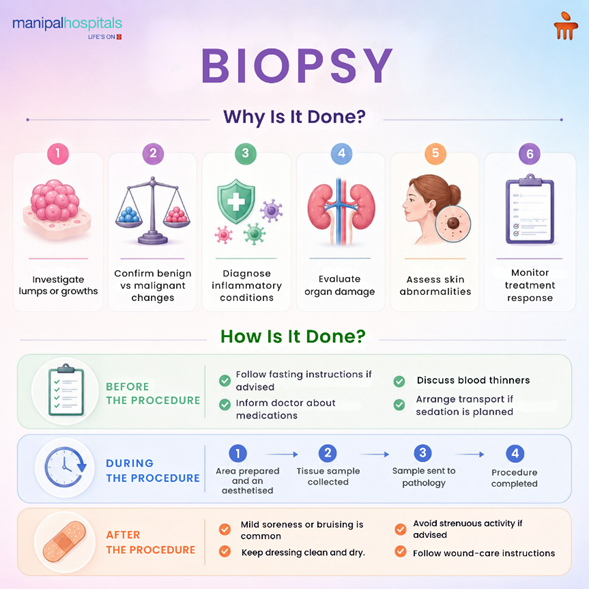
Investigating Abnormal Lumps or Growths: If a physical exam or an ultrasound reveals an unusual mass—such as a breast lump, an enlarged lymph node, or a thyroid nodule—a tissue sample determines whether the growth is non-cancerous (benign) or cancerous (malignant).
-
Evaluating Internal Organ Function: For chronic conditions affecting organs like the liver, kidneys, or gastrointestinal tract, a sample helps assess the extent of scarring (fibrosis), inflammation, or functional tissue damage.
-
Diagnosing Inflammatory or Autoimmune Diseases: Conditions like celiac disease or inflammatory bowel disease alter the lining of the digestive tract in specific ways. A cellular analysis confirms these specific changes.
-
Assessing Skin Abnormalities: Moles or skin lesions that change shape, size, or colour are sampled to rule out skin disorders or malignancies.
-
Monitoring Treatment Effectiveness: For individuals already undergoing treatment for a specific condition, subsequent tissue samples help doctors see if a tumour is shrinking or if the tissue is returning to its healthy state.
How the Procedure Is Performed
Patients naturally want to know exactly how is a biopsy done before they arrive for their appointment. The method your medical team chooses depends entirely on where the tissue is, how deep the area is inside your body, and your general health. Modern medical techniques ensure that these procedures are highly focused and cause very little discomfort. The primary methods include:
Needle Biopsy
This is the most common and least invasive approach. The doctor uses a thin, hollow needle to take cells or a small core of tissue from a lump just under the skin or deep inside an organ. To make sure the needle goes to the exact spot, the doctor often uses ultrasound or CT imaging to guide it. A local anaesthetic numbs the area completely, so you feel a bit of pressure rather than sharp pain.
Endoscopic Biopsy
This method looks at internal linings, like the stomach, colon, or lungs. A thin, flexible tube with a light and a camera (an endoscope) goes through a natural opening, such as your mouth or rectum. Small tools pass through the tube to collect a tiny scraping or snippet from the inner lining. Sedation is routinely used to keep you relaxed and comfortable.
Skin or Punch Biopsy
For surface issues, a specialist uses a small circular tool to remove a tiny, deep sample of the skin layers, very similar to a small hole punch. The area is fully numbed beforehand, and the site might need one or two small stitches to heal cleanly.
Surgical Biopsy
When an abnormality sits deep inside your abdomen or chest and cannot be reached safely with a needle, a surgical approach is used. An incisional approach removes a small piece of the mass, while an excisional approach takes out the whole lump. This takes place in an operating theatre using general or regional anesthesia to keep you entirely pain-free.
Biopsy Types and Their Diagnostic Focus
The choice of method directly matches the organ or system under investigation. The table below outlines standard procedures and how they help doctors make accurate clinical decisions:
|
Procedure Category |
Common Area Evaluated |
Diagnostic Focus |
Type of Anaesthesia |
|
Fine Needle Aspiration |
Thyroid nodules, lymph nodes, fluid-filled cysts |
Separating fluid accumulation from solid cell masses |
Local anaesthetic |
|
Core Needle Entry |
Breast tissue, deep muscle masses, liver tissue |
Retrieving a solid cylinder of tissue to view cell structure |
Local anaesthetic with guidance |
|
Endoscopic Snip |
Stomach lining, oesophagus, colon wall |
Finding areas of chronic inflammation, ulcers, or early growths |
Conscious sedation |
|
Excisional Removal |
Suspicious skin moles, enlarged superficial nodes |
Full removal of a lesion to check the outer edges |
Local or general anaesthesia |
|
Bone Marrow Aspiration |
Hip bone interior marrow space |
Evaluating blood cell production and marrow health |
Local anaesthetic with sedation |
What to Expect During and After the Evaluation
Preparation and recovery vary depending on the type of procedure you have, but the overall steps follow a standard path designed around patient safety.
Before the Procedure
Your medical team will give you clear guidelines during your consultation. If you are having an endoscopic or surgical procedure, you may need to fast without food or drink for several hours beforehand. It is important to tell your doctor about all current medicines, especially blood thinners or aspirin, as you might need to stop taking them for a few days to avoid bruising or bleeding at the sample site.
After the Procedure and Recovery
-
For minor needle or skin evaluations, you can typically go home straight away and get back to light daily activities.
-
If you received sedation or general anaesthesia, you will rest in a recovery room for a few hours until the medicine wears off, and you will need a family member or friend to drive you home.
-
Mild soreness, light bruising, or a bit of discomfort around the site is completely normal for a few days.
Your medical team will show you how to keep the dressing clean and dry. It is important to avoid heavy lifting or hard exercise for the specific days advised by your clinician so the tissue can heal properly.
Receiving Your Results
The collected sample goes immediately to a pathology laboratory, where it is processed, stained, and looked at under a microscope. The pathologist writes down their findings in a detailed report for your doctor. This process usually takes between three to seven working days, depending on whether the lab needs to run special chemical stains. Your doctor will then see you for a follow-up appointment to explain the results and talk about any next steps.
Conclusion
A biopsy is a precise and reliable diagnostic step that takes away the guesswork. By showing exactly what is happening at a cellular level, it helps your medical team build a safe and effective plan tailored to your health. If you have an ongoing health concern, a new skin change, or an inconclusive scan, getting a professional evaluation is the best way to move forward. For clear diagnostics and supportive care, contact our specialists to arrange a standard biopsy procedure in Salem at Manipal Hospital.
FAQ's
No. There is no evidence to show that taking a needle sample or removing a piece of tissue causes abnormal cells to spread to other areas of your body. Doctors use careful, precise techniques and protective pathways to keep the sample contained safely during collection.
The process is designed to prevent pain. Local anaesthetics completely numb the skin and the tissue underneath, so most patients feel only a sensation of dull pressure or tugging. For deeper checks, conscious sedation or general anesthesia ensures you remain comfortable.
You should keep the area clean and dry for the first 24 to 48 hours, or exactly as your nursing team tells you. Avoid taking hot baths or going swimming until the skin closes up completely. If you see sudden redness, warmth, or fluid leaking, contact your clinic for advice.
An endoscopy is an observational check where a doctor uses a camera on a flexible tube to look at the internal lining of an organ. A biopsy is the physical removal of a small tissue sample. Doctors very often do both together, taking a small sample during an endoscopy if they see an unusual area.
While basic cell checks can happen quickly, some tissue samples need extra steps in the lab. This includes softening bone samples or using special chemical dyes to identify specific proteins. These laboratory steps ensure your final diagnosis is completely accurate.
Share this article on: