6 Min Read
A slipped disc, medically referred to as a herniated disc, is a common cause of back and neck pain that affects adults of all ages, particularly those between 30 and 50 years. While many people use the term “slipped disc,” the condition actually involves the soft cushion (disc) between spinal bones bulging or rupturing out of its normal position and pressing on nearby nerves. Understanding the causes, symptoms and treatment options — including when neurosurgery becomes necessary can help you take informed steps towards recovery.
At Manipal Hospital Jaipur, our multidisciplinary team, including senior neurosurgeons and physiotherapists, provides personalised care for slipped disc and herniated disc conditions.
Synopsis
- What Is a Slipped Disc / Herniated Disc?
- Symptoms of Herniated Disc / Slipped Disc
- Diagnosing a Slipped Disc
- Non-Surgical Treatment Options
- When Is Herniated Disc Surgery Needed?
- Herniated Disc Surgery Options
- Recovery Time After Herniated Disc Treatment
- Exercises for Herniated Disc: Key Guidelines
- Prevention: Tips to Protect Your Spine
- Why Choose Manipal Hospital Jaipur for Slipped Disc Care
What Is a Slipped Disc / Herniated Disc?
The spine consists of vertebrae separated by discs made of a tough outer ring (annulus fibrosus) and a gel-like centre (nucleus pulposus). A slipped disc occurs when the nucleus pushes through a tear in the annulus. This can irritate or compress spinal nerves, leading to pain, numbness and weakness.
Common types include:
-
Lumbar disc herniation – affecting the lower back
-
Cervical disc herniation – affecting the neck
Both types can be painful and debilitating, but treatment outcomes are generally good with early diagnosis and appropriate care.
Causes of Slipped Disc
A herniated disc doesn’t “slip” in the literal sense. Common causes include:
1. Age-related Disc Degeneration - As we age, spinal discs lose water content and elasticity, making them more prone to tears and herniation.
2. Improper Lifting - Lifting heavy objects without proper posture can strain the spine and cause a disc to bulge.
3. Sudden Injury - A fall, accident or sudden twist can trigger a disc herniation.
4. Repetitive Strain - Jobs or activities involving frequent bending, twisting or lifting increase risk.
5. Genetic Predisposition - Some individuals have a genetic tendency towards weaker disc structure.
6. Obesity - Excess body weight adds stress to spinal discs, especially in the lumbar region.
7. Smoking - Smoking impairs blood supply to discs, accelerating degeneration.
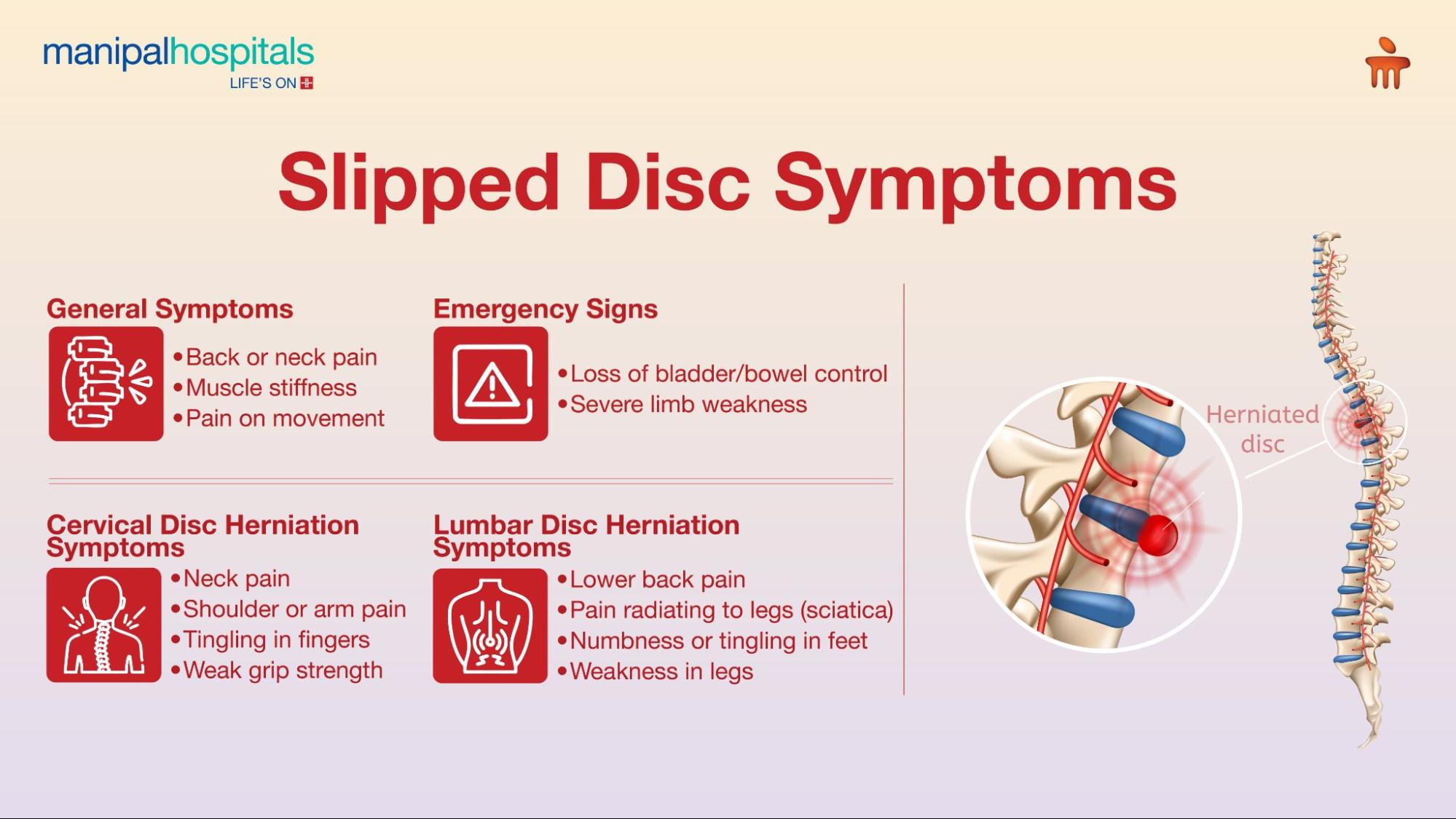
Symptoms of Herniated Disc / Slipped Disc
Symptoms vary depending on the location and severity of the disc herniation.
General Symptoms
-
Localised back or neck pain
-
Pain that worsens with movement
-
Muscle stiffness and spasms
Lumbar Disc Herniation Symptoms
-
Sharp pain in lower back
-
Pain radiating to buttocks, legs or feet (sciatica)
-
Numbness or tingling in legs
-
Weakness in lower limbs
Cervical Disc Herniation Symptoms
-
Neck pain
-
Pain radiating to the shoulders, arms or hands
-
Numbness or tingling in the upper limbs
-
Weak grip strength
Severe Symptoms (Urgent Care Needed)
-
Loss of bladder or bowel control
-
Severe weakness
-
Progressive numbness
These may indicate serious nerve compression and require immediate medical evaluation.
Diagnosing a Slipped Disc
A comprehensive assessment usually includes:
-
Medical history & physical examination
-
Neurological testing to check nerve function
-
Imaging such as:
-
X-ray – rules out fractures
-
MRI – best for visualising disc herniation
-
CT scan – detailed cross-section images
-
Early diagnosis leads to better treatment outcomes.
Non-Surgical Treatment Options
Most people with a slipped disc improve with conservative treatment. These include:
1. Rest & Activity Modification - Short periods of rest followed by a gradual return to activity help tissues heal without stiffness.
2. Pain Relief Medication - NSAIDs, muscle relaxants or nerve pain medications may be prescribed to reduce inflammation and discomfort.
3. Physical Therapy - Exercises for a herniated disc aim to:
-
Strengthen core muscles
-
Enhance flexibility
-
Improve posture
-
Reduce nerve compression
Examples of exercises for a herniated disc may include pelvic tilts, knee-to-chest stretches, McKenzie extensions and gentle mobilisation.
4. Heat & Cold Therapy - Cold packs reduce inflammation in early stages, while heat improves blood flow and relaxes muscles.
5. Epidural Steroid Injections - In selected cases, steroid injections around the affected nerve root provide relief from pain and inflammation.
When Is Herniated Disc Surgery Needed?
Most patients respond to conservative management within 4–12 weeks. However, neurosurgical evaluation becomes essential when:
-
Persistent pain despite optimal medical therapy
-
Progressive neurological weakness
-
Severe nerve compression visible on MRI
-
Cauda equina syndrome (loss of bowel/bladder control)
-
Recurrent herniation affecting quality of life
At Manipal Hospital Jaipur, herniated disc surgery is recommended only when clearly indicated after comprehensive evaluation and multidisciplinary discussion.
Herniated Disc Surgery Options
When conservative treatment fails, the following surgical interventions may be considered:
1. Microdiscectomy - A minimally invasive procedure to remove the portion of the disc compressing the nerve. This is the most common surgery for lumbar herniated discs.
2. Laminectomy & Foraminotomy - Removal of a small portion of bone or ligament to relieve nerve pressure.
3. Disc Replacement - Artificial disc replacement may be an option in selected cervical disc herniation cases.
4. Spinal Fusion - In cases with instability, fusion of vertebrae provides long-term stability.
Surgical approaches are tailored based on the location, severity and overall health of the patient.
Recovery Time After Herniated Disc Treatment
Recovery time varies:
Non-Surgical Recovery
-
Most patients notice improvement within 4–6 weeks
-
Full recovery may take 3 months or more
-
Physiotherapy plays a key role
Post-Surgical Recovery
-
Microdiscectomy patients may resume light activity within 1–2 weeks
-
Full tissue healing and return to normal activity may take 6–12 weeks
-
Regular follow-ups and guided rehabilitation are essential
Adhering to prescribed exercises and lifestyle modifications speeds up healing.
Exercises for Herniated Disc: Key Guidelines
When performing exercises:
-
Start with gentle movements
-
Avoid bending forward sharply
-
Focus on core strengthening
-
Gradually increase intensity
-
Work under a physiotherapist's supervision
Examples include:
-
Cat-cow stretch
-
Bridges
-
Pelvic tilts
-
Prone extensions
These exercises support spinal stability and help prevent recurrence.
Prevention: Tips to Protect Your Spine
-
Maintain good posture when sitting, standing and lifting
-
Use ergonomic chairs and workstations
-
Keep a healthy weight
-
Strengthen core muscles regularly
-
Avoid smoking
-
Take breaks during long drives or desk work
Healthy lifestyle habits significantly reduce the risk of a herniated disc.
Why Choose Manipal Hospital Jaipur for Slipped Disc Care
At Manipal Hospital Jaipur, we offer:
-
Expert neurosurgeons specialised in herniated disc surgery
-
Individualised care plans
-
Advanced imaging and minimally invasive surgical techniques
-
Dedicated physiotherapy and rehabilitation support
-
Patient-centred follow-up and education
Whether you need non-surgical care, herniated disc surgery or guided recovery support, our team ensures safe and effective treatment.
Learn More: Back Pain You Should Not Ignore
FAQ's
A bulging disc extends symmetrically without rupture, while a slipped/herniated disc has a tear allowing inner material to press on nerves.
Yes, many slipped discs improve with conservative care, including rest, medication and physiotherapy.
Non-surgical recovery usually takes weeks to months; post-surgical recovery may take 6–12 weeks.
Yes, when performed correctly under guidance. Tailored exercises reduce pain and improve strength.
Surgery is considered if pain persists despite treatment, or if there’s progressive weakness or loss of bladder control.
Share this article on: