7 Min Read
It happens when you stand up after sitting for a while, when you reach down to pick something up, or when you simply roll your shoulders after a long day at the desk. A sudden pop, snap, or crackle that makes you pause. For a moment, you wonder if something just went wrong inside your body. Joints make noise and almost everyone hears a cracking sound in joints at some point in life. For most people, the sound is harmless, but the mind often races to worst-case scenarios: arthritis, worn bones, or a torn ligament.
The truth is more nuanced. While many joint sounds are just part of moving through the world, some deserve closer attention. This blog discusses clinical insights from experts from a top orthopaedic hospital in Doddaballapur, Bengaluru, that help you understand the common reasons for cracking sounds in joints, and most importantly, when it is time to seek help.
Synopsis
The Anatomy of a Cracking Joint
To understand the primary reason for cracking sound in joints, it helps to look at how a mobile joint is built. Most of our moving joints, like your knuckles, knees, and shoulders, are synovial joints. They are enclosed within a protective tissue capsule filled with a thick, lubricating fluid called synovial fluid.
As shown in the illustration, when a joint moves or stretches, the physical space between the bones expands, causing the pressure inside the joint capsule to drop. This sudden drop in pressure pulls dissolved gases (such as nitrogen and carbon dioxide) out of the synovial fluid, rapidly forming tiny micro-bubbles. When these bubbles merge or collapse quickly, it produces the classic "crack" sound you hear. This entirely harmless physical process is known as cavitation, and it takes around 20 minutes for the gases to fully re-dissolve before the joint can be popped again.
Other common reasons for cracking sounds in joints include:
-
Ligaments and Tendons Shifting: As you change position, a tendon’s path may shift slightly, causing it to snap safely back over a bony prominence. This is incredibly common in the hips and ankles.
-
Natural Cartilage Variations: Slight, harmless structural irregularities in the smooth cartilage surfaces can cause a clicking sound as they slide across each other during a deep squat or stretch.
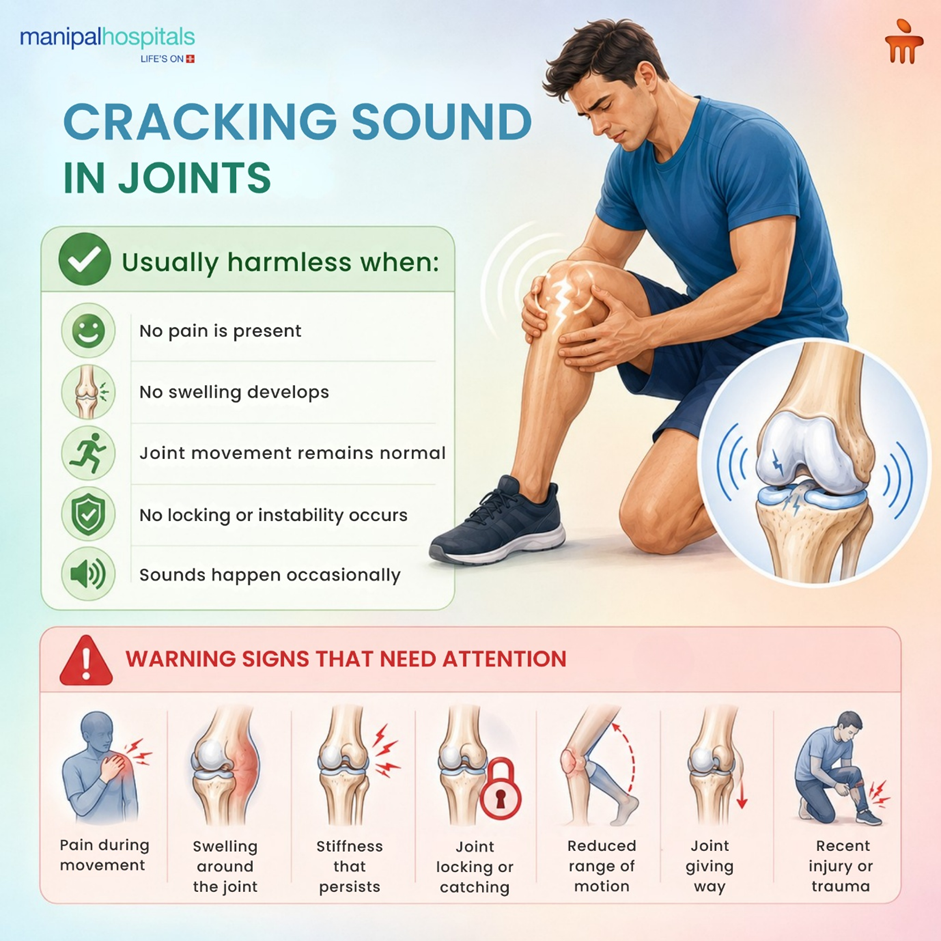
When Does a Cracking Sound Become a Concern?
If your joints pop frequently but there is absolutely no pain, swelling, or discomfort involved, you generally have nothing to worry about. However, the medical context changes entirely when the sound is paired with physical distress.
The table can help you differentiate between harmless joint sounds and signs that indicate an underlying structural issue:
|
Symptom Presentation |
Potential Source |
Recommended Action |
|
Occasional pop, completely painless |
Standard gas bubble release (cavitation) or normal tendon movement |
No medical intervention required; stay active |
|
Constant grinding, crunching, or grating (Crepitus) |
Cartilage wear and tear, rough surfaces, or early joint degeneration |
Schedule a routine evaluation with an orthopaedic specialist |
|
Sudden pop accompanied by sharp pain or immediate swelling |
Acute structural injury, such as a ligament or meniscus tear |
Rest and elevate the joint; seek a timely clinical assessment |
|
Pop followed by the joint physically locking or giving out |
A structural blockage, loose cartilage fragment, or severe instability |
Seek professional orthopaedic evaluation |
Some specific conditions that may explain why a cracking sound in joints becomes symptomatic include:
-
Osteoarthritis: Wear and tear thins the cartilage, making joint surfaces rough. The resulting friction causes grinding or crunching sounds, often with morning stiffness and aching.
-
Meniscus tears: In the knee, a torn piece of cartilage can flip in and out of the joint, causing a click or catch along with pain on the inner or outer side.
-
Patellofemoral pain syndrome: The kneecap tracks unevenly over the thighbone, leading to grinding, popping, and discomfort especially when climbing stairs.
-
Shoulder impingement or labral tears: The shoulder’s ball-and-socket joint is surrounded by a rim of cartilage called the labrum. A tear here can cause clicking, catching, and deep ache.
-
Loose bodies: Small fragments of bone or cartilage can break off and float in the joint, causing unpredictable locking and cracking.
Why a Careful Diagnosis Matters?
When you see an orthopaedic specialist, they will do more than just listen to the sound. The diagnosis starts with a thorough history: what triggers the noise, when it started, whether there was an injury, and how your symptoms behave throughout the day. The physical examination includes feeling the joint, testing your range of motion, and performing specific manoeuvres that isolate different structures. Based on these findings, imaging such as X-rays, ultrasound, or an MRI may be recommended.
This methodical approach is important because why cracking sound in joints happens in a young athlete is often very different from why it happens in a grandmother with osteoarthritic knees. The treatment that follows, be it exercises, injections, or surgery, will depend entirely on getting this diagnosis right.
Small Daily Habits That Support Quiet, Happy Joints
If your joint noises are accompanied by a dull ache or stiffness, protecting your cartilage and strengthening the surrounding structures becomes your primary goal. A proactive approach focused on movement can keep your joints functioning smoothly.
-
Movement is Medicine: Synovial joints do not have a direct blood supply. They rely entirely on regular movement to pump lubricating fluid throughout the joint cavity, delivering vital nutrients to the cartilage and clearing out metabolic waste.
-
Stay hydrated: Well-hydrated cartilage and synovial fluid maintain better cushioning and glide.
-
Strengthen the supporting cast: Strong thigh muscles protect the knee; strong rotator cuff and scapular muscles protect the shoulder; strong glutes support the hip.
-
Listen to your body: If a movement consistently produces a painful crack, modify it and seek advice rather than pushing through.
Key strategies for long-term joint care include:
-
Targeted Strengthening: Building up the muscles around a noisy joint (like strengthening the quadriceps to support the kneecap) acts as a natural shock absorber, reducing uneven friction.
-
Low-Impact Conditioning: Activities like cycling, swimming, and swimming pool exercises keep your joints moving through their full range of motion without the heavy impact loads of running on hard asphalt.
-
Stretching and Mobility Work: Consistent daily stretching prevents tendons and muscles from becoming overly tight, reducing the likelihood of them snapping loudly over bony areas.
Conclusion
The next time you hear a cracking sound in joints, you can pause, notice if there is pain or swelling, and then make a calm choice. Understanding why cracking sounds in joints happen lets you separate everyday physiology from potential problems. And if something does not feel right, expert and compassionate joint treatment in Doddaballapur is within reach at Manipal Hospitals.
Our experienced orthopaedic specialists at Manipal Hospital Doddaballapur, provide comprehensive evaluation and personalized care to help you move with confidence. Take care of your joints now, so they continue to carry you comfortably through all the moments of life, silently, or with a harmless crackle that you no longer fear.
FAQ's
No, multiple studies have found no link between habitual knuckle cracking and the development of osteoarthritis. The sound is caused by gas bubbles in the synovial fluid, not by grinding bones or damaged cartilage. However, aggressive or painful cracking could theoretically strain ligaments over time, so moderation and gentleness remain wise.
Yes, especially if there is no pain, swelling, or limitation. The kneecap glides within a groove, and minor shifts in alignment, muscle tightness, or changes in pressure can generate noise. If the crack is painless and your knees feel stable, it is usually nothing to worry about.
Tendons snapping over bony landmarks is another very frequent cause. Tightness in the muscles connected to those tendons can make the snapping more prominent. Gentle stretching and strengthening often reduce this type of noise, especially around the hips and shoulders.
You should seek an orthopaedic consultation if the cracking is accompanied by pain, swelling, locking, a sensation of the joint giving way, or if it started suddenly after an injury. It’s always safer to evaluate a noisy joint that also “feels wrong” rather than waiting for the problem to possibly worsen.
In many cases, yes. Strengthening the muscles that support a joint improves alignment and reduces abnormal tendon snapping or friction. Physiotherapy is often the first line of treatment for noisy joints, especially when there is no internal structural damage. A qualified physiotherapist can assess your movement patterns and design a programme to quiet the noise and improve function.
Share this article on: