7 Min Read
You go to bed exhausted, yet your mind stays wide awake. You drag yourself through the afternoon with a heaviness that coffee cannot lift. Perhaps your work schedule has shifted, or you spent one too many nights scrolling, and now your body feels like it belongs to a different time zone altogether. It is easy to blame stress, age, or a bad mattress, but often the real culprit is an invisible conductor inside you that has lost its rhythm.
That conductor is your circadian rhythm, the internal 24-hour clock that orchestrates nearly every biological process, from when you feel alert to when your cells repair themselves. When it runs smoothly, you wake naturally, feel hungry at predictable times, and slip into deep sleep with ease. When it is thrown off, the effects ripple far beyond a few tired mornings.
Understanding the mechanisms behind your circadian rhythms is the first step toward improving sleep quality, restoring energy levels, and supporting long-term neurological health. Specialists at the best neurology hospital in Doddaballapur often evaluate sleep-wake disturbances to identify underlying neurological or lifestyle-related factors that may be affecting overall well-being.
Synopsis
- What is a circadian rhythm?
- How the Biological Clock Works: The Master Clock and Its Messengers
- Circadian Rhythm Is Controlled by Light, Genes, and Lifestyle Cues
- When the Rhythm Breaks: Circadian Rhythm Disruption
- Signs That Your Circadian Rhythm May Be Out of Sync
- How to Fix Circadian Rhythm: Practical, Evidence-Based Steps
- Conclusion
What is a circadian rhythm?
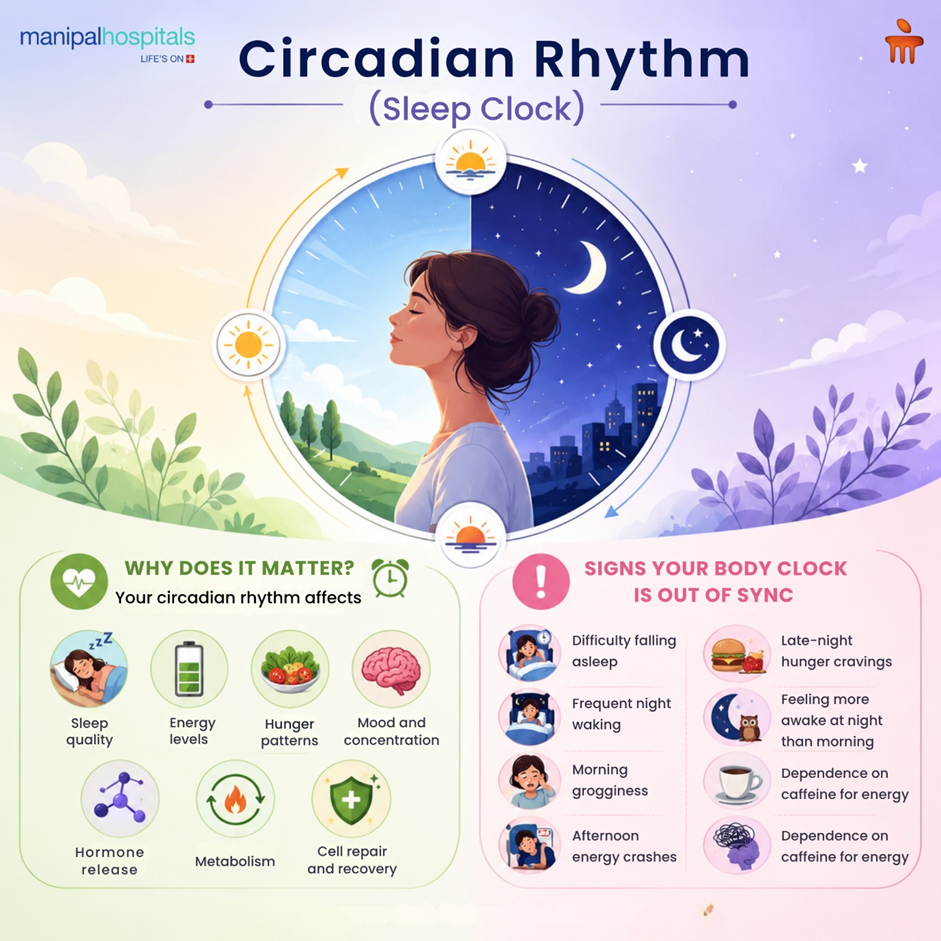
The circadian rhythm is a natural, internal process that follows a 24-hour cycle. The term comes from the Latin words "circa" (around) and "diem" (day), describing the daily physical, mental, and behavioral changes that respond primarily to light and darkness.
While it is most visible in our sleep-wake patterns, this internal clock regulates several essential biological processes:
-
Hormone Release: It controls the timing of cortisol (which promotes alertness in the morning) and melatonin (which signals the body to prepare for sleep at night).
-
Body Temperature: Core temperature peaks in the late afternoon and drops to its lowest point in the early morning.
-
Metabolism and Digestion: Metabolic rates and digestive enzymes fluctuate based on the time of day, preparing the body to process food during waking hours.
-
Cell Repair: Essential maintenance, including DNA repair and cell regeneration, occurs primarily during specific phases of rest.
How the Biological Clock Works: The Master Clock and Its Messengers
The phrases "biological clock" and "circadian rhythms" are sometimes used interchangeably, but it is helpful to separate the machinery from the rhythms it creates. The central “biological clock” resides in a tiny cluster of neurons in the brain called the suprachiasmatic nucleus (SCN), located in the hypothalamus just above the optic chiasm. The SCN contains around 20,000 cells, each capable of generating its own near-24-hour rhythm. Together, they form a synchronised pacemaker that acts as the body’s master timekeeper.
Left in complete darkness, most humans exhibit a cycle slightly longer than 24 hours, typically around 24.2 hours. Without daily correction, the rhythm would drift, delaying sleep onset a little more each day. That daily resetting is where environmental cues, called zeitgebers (time-givers), are important.
Circadian Rhythm Is Controlled by Light, Genes, and Lifestyle Cues
The circadian rhythm is controlled by light. When light, especially blue-wavelength light, hits specialised cells in the retina, signals travel directly to the SCN, telling it that it is daytime. This light input suppresses melatonin production and raises cortisol, promoting alertness. As evening falls and light dims, the pineal gland releases melatonin, body temperature drops, and sleep-readiness builds.
Yet circadian rhythm is controlled by more than light alone. A set of “clock genes” (including CLOCK, BMAL1, PER, and CRY) drive the molecular machinery inside every cell. These genes produce proteins that accumulate over roughly 24 hours and then degrade, creating an auto-regulatory feedback loop that constitutes the biological tick. Variations in these genes can make some people naturally morning larks while others are night owls.
Other zeitgebers fine-tune the rhythm:
-
Meal timing: The liver and gut clocks respond strongly to when you eat. Consistently eating late at night can shift peripheral clocks out of sync with the brain clock.
-
Physical activity: Exercise at consistent times reinforces muscular and metabolic rhythms, while late-night intense workouts can delay melatonin onset.
-
Social interaction and routine: Regular sleep-wake schedules, even on weekends, stabilise the SCN.
When these cues are aligned, the circadian rhythm hums in harmony. When they conflict, such as exposure to bright screens at midnight while the brain expects darkness, the rhythm begins to fracture.
When the Rhythm Breaks: Circadian Rhythm Disruption
Modern life is not kind to our internal clocks. Circadian rhythm disruption occurs when there is a mismatch between the internal biological clock and the external environment. This misalignment can be acute, like a single night of shift work, or chronic, like years of staying up late and sleeping in on weekends.
Common causes of circadian rhythm disruption include:
-
Shift work or rotating schedules
-
Frequent travel across time zones (jet lag)
-
Inconsistent sleep-wake timings
-
Excessive screen time before bed
-
Lack of morning light exposure
-
Ageing, as the SCN naturally loses some precision
When the rhythm is disrupted, you may not only feel tired. Over time, circadian rhythm disruption has been linked to an increased risk of metabolic disorders like obesity and type 2 diabetes; cardiovascular problems; mood disorders, including depression and anxiety; digestive issues; and impaired immune function.
Signs That Your Circadian Rhythm May Be Out of Sync
Sometimes the symptoms are subtle, and you may have blamed them on stress or a busy schedule. Watch for these indicators that your circadian rhythm needs attention:
-
Difficulty falling asleep at a reasonable hour
-
Waking frequently during the night
-
Severe morning grogginess that lasts for hours
-
Energy crashes at unusual times of day
-
Craving junk food late at night
-
Feeling more alert in the evening than in the morning
-
Digestive complaints like bloating or irregular bowel movements
-
Relying on caffeine or sleeping pills to function
If several of these sound familiar, your biological clock might be out of tune. The good news is that the clock can be reset.
How to Fix Circadian Rhythm: Practical, Evidence-Based Steps
Adjusting a biological clock takes time; your body cannot reset its schedule instantly. If your sleep patterns are out of alignment, you can use specific daily habits to prompt your internal clock to shift back into place.
-
Keep your wake-up time consistent - Wake up at the same hour every day, even on weekends. This regularity provides your body with a reliable daily anchor point. Sleeping in on days off often delays your clock, making the following week more difficult to start.
-
Get daylight early in the day. Spend 15 to 20 minutes outside in natural sunlight within half an hour of waking up. If you must wake up before sunrise or lack access to natural light, using a 10,000-lux light therapy box can provide a similar biological signal.
-
Dim your environment in the evening. Two hours before you plan to sleep, turn off bright overhead lights and use low-wattage lamps instead. It is also practical to limit screen use or wear blue-light-blocking lenses during this period to avoid suppressing sleep hormones.
-
Eat meals at regular intervals. Having breakfast shortly after rising and finishing your final meal at least three hours before sleeping stabilises the metabolic clocks in your digestive organs, which coordinate closely with your brain.
-
Watch the timing of your workouts. Physical activity in the morning or afternoon reinforces daytime alertness. Try to complete intense exercise at least two hours before you intend to sleep so your heart rate and core temperature can normalise.
-
Build a winding-down routine. Reading a physical book, light stretching, or taking a warm bath can signal to your system that it is time to rest. The natural drop in body temperature that occurs after a warm bath helps induce drowsiness.
-
Be mindful of caffeine and alcohol. Consuming caffeine after 2:00 PM interferes with the chemicals that make you feel tired. While alcohol might cause initial drowsiness, it tends to disrupt and fragment your sleep patterns later in the night.
-
Keep your bedroom cool. Your core temperature needs to drop slightly to initiate sleep. Setting your room temperature between 18°C and 22°C assists this natural process.
Conclusion
Your body functions best when your daily habits align with the natural rhythms of day and night. If persistent fatigue or sleep disturbances are affecting your quality of life, making simple adjustments to your sleep environment and routine is often the first step toward improvement. However, if symptoms continue despite these changes, seeking expert medical evaluation is important. At Manipal Hospital Doddaballapur, the best nephrology hospital in Doddaballapur, Bangalore, patients have access to comprehensive care and specialist consultations to identify underlying health concerns and develop personalised treatment plans that support overall well-being.
FAQ's
Caffeine blocks adenosine, the chemical that builds up in your brain throughout the day to create sleep pressure. While it does not change your clock genes directly, it masks your fatigue and delays the time you feel tired, which can push your entire sleep cycle later. It is best to avoid caffeine for at least 8 to 10 hours before bed.
Not in a way that helps your rhythm. Sleeping late on Saturday and Sunday creates a shift that confuses the master clock in your brain. This makes waking up early on Monday morning significantly harder. Keeping a steady schedule all week is far more effective than trying to compensate on your days off.
Melatonin works as a biological signal to tell your brain that it is nighttime, rather than acting as a direct sedative. It can be useful for overcoming jet lag or correcting a shifted schedule, but it is best used as a temporary tool under a doctor's guidance rather than a long-term solution for poor sleep habits.
Yes, it naturally shifts over time. Older adults frequently experience an advanced sleep phase, meaning they naturally feel tired earlier in the evening and wake up earlier in the morning. Recognising this shift can help you adjust your daily routines without feeling like something is wrong.
For most individuals, sticking to a strict light and sleep schedule for two to three weeks is long enough to see a clear improvement. Your internal systems need this time to stabilise and coordinate with your new habits.
Share this article on:


.webp "Dr. Srinivas Raju | Top Neurologist in Doddaballapur, Bangalore | Manipal Hospitals")