7 Min Read
Many patients enquire about scoliosis's meaning when they notice a change in posture or spine shape. Scoliosis is a condition where the spine curves sideways instead of staying straight when seen from the back. This curve is not the same as the natural front-to-back bend of the spine.
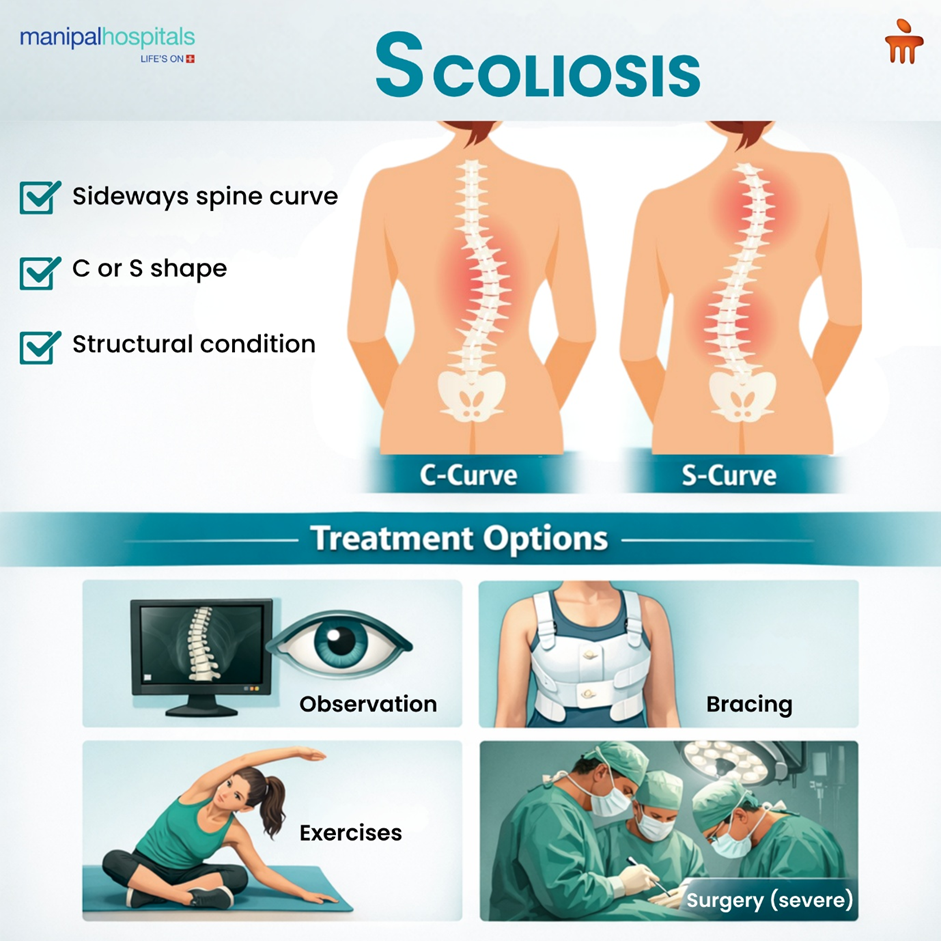
The spine may form a C-shaped or S-shaped curve. The condition is often picked up during childhood or teenage years, especially during periods of rapid growth.
In many cases, the curve remains mild and does not cause major problems. In some people, it can slowly increase and may need medical care. In this blog, a top orthopaedic specialist in Doddaballapur, Bangalore, discusses everything you need to know about scoliosis, including why it happens, what signs to look for, and how doctors check it.
Synopsis
What is scoliosis?
Scoliosis is a sideways curve of the spine, and the scoliosis definition is based on how much the spine bends and rotates. This can change the way the shoulders, ribs, or hips look.
The condition is described as a structural change in the spine, not just poor posture. The curve can vary in size. Some are small and stable. Others may increase over time. Doctors often classify it as mild, moderate, or severe based on the angle of the curve.
Types of Scoliosis
-
Idiopathic scoliosis: This is the most common type. The exact cause is not known. It is often seen in children and teenagers during growth.
-
Congenital scoliosis: This type is present from birth. It happens when the spine does not form properly before birth.
-
Neuromuscular scoliosis: This occurs due to nerve or muscle conditions such as cerebral palsy. Muscle imbalance affects how the spine is supported.
Causes of Scoliosis
Understanding scoliosis causes helps explain why the spine curves in some people.
-
Unknown cause or idiopathic scoliosis is what most cases fall under. No clear reason is found. It is often seen during childhood or adolescence, especially during rapid growth.
-
Abnormal spine development before birth, as in the case of congenital scoliosis. The bones of the spine do not form in the usual way. This condition leads to a curve that becomes more visible as the child grows.
-
Muscle or nerve conditions, such as cerebral palsy, can lead to neuromuscular scoliosis by affecting muscle control and support of the spine.
-
Age-related changes in the spine in adults. Also called degenerative scoliosis, it causes wear and tear of discs and joints, which can lead to gradual curvature of the spine.
-
Family history is also a contributing factor, and a genetic link is seen in some cases. Having a close family member with scoliosis can increase the chances for others.
-
Rapid growth during adolescence. The curve may appear or progress during growth spurts when the spine is developing quickly.
Symptoms of Scoliosis
Recognising scoliosis symptoms early can help in timely evaluation and care.
-
Early Signs: In many cases, the condition starts without clear discomfort. The curve may be small and not easily noticed. Children, in particular, may not report any symptoms at this stage.
-
Uneven Shoulders or Hips: One shoulder may appear higher than the other, and the hips may also look uneven. Clothes may not sit evenly on the body.
-
Prominent Rib Cage on One Side: One side of the rib cage may stick out more, especially when bending forward. This happens because the spine also rotates slightly along with the curve.
-
Body Leaning to One Side: The body may look slightly tilted, and the head may not align properly with the pelvis.
-
Back Pain: Pain is more common in adults. Children often do not feel pain even if a curve is present.
-
Muscle Imbalance: Muscles on one side of the back may feel tighter or more noticeable than the other.
-
Breathing Difficulty in Severe Cases: In severe cases, changes in chest shape may affect lung space and cause breathing difficulty.
How Scoliosis Is Diagnosed
Quite often, scoliosis cases are found during school health checks or routine visits in early teenage years. Sometimes parents notice uneven shoulders or a change in posture first.
-
Physical Examination: The first step is a close look at the back. The doctor checks shoulder height, hip level, and how the spine sits in the midline. Even small differences, like one shoulder blade sticking out slightly, can give a clue.
-
Posture Assessment: The patient is asked to stand straight and relaxed. The doctor looks from the front, side, and back. Attention is given to how the head lines up with the pelvis and whether the body shifts to one side.
-
Adams Forward Bend Test: The patient bends forward with arms hanging down. In this position, any rib hump or uneven contour stands out more. It helps show curves that aren't obvious when standing straight.
-
Imaging with X-ray: If a curve is suspected, an X-ray is done. It shows the spine clearly and allows the doctor to measure the curve angle, called the Cobb angle. Less than 10 degrees is not scoliosis; 10 to 24 degrees is mild; 25 to 39 degrees is moderate; and more than 40 degrees is considered severe.
Scoliosis Treatment Options
Treatment is planned based on the person’s age, the size of the curve, and whether the spine is still growing.
-
Observation for mild curves: If the curve is small and not progressing, treatment may not be needed. Regular follow-ups with clinical checks and occasional X-rays help track any change.
-
Bracing in growing children: A brace may be advised when the curve is moderate, and the child is still growing. It does not correct the curve but helps stop it from getting worse. The brace usually needs to be worn for several hours each day.
-
Physical therapy and exercises: Exercises can help improve posture, balance, and back strength, though they do not correct the curve.
-
Surgical treatment for severe cases: Surgery is considered when the curve is large or progressing. The goal is to straighten and stabilise the spine using rods and screws. This helps prevent further progression and may improve alignment.
-
Management in adults: Treatment mainly focuses on relieving pain and keeping you active. It may include medications, guided exercises, and simple lifestyle changes.
Conclusion
Scoliosis is a condition where the spine curves sideways, and it can vary from mild to more noticeable forms. Many adults have small curves that remain stable and do not affect daily life. Some cases may progress, especially during growth years, and may need closer follow-up. Early evaluation helps identify changes at the right time and enables the doctor to decide whether any treatment is needed. If you notice uneven shoulders or posture changes or have concerns, it is better to get it checked.
For expert care and guidance on scoliosis treatment in Doddaballapur, you can consult our orthopaedic specialists at Manipal Hospital Doddaballapur.
FAQ's
A spine is considered scoliotic when there is a sideways curve seen on an X-ray, typically measured using the Cobb angle. A curve of 10 degrees or more is diagnosed as scoliosis.
Scoliosis does not reverse on its own. Small curves may remain stable without treatment. In growing children, some curves can increase, so regular monitoring is needed.
Early signs include uneven shoulders, one hip appearing higher, or clothes not fitting evenly. A slight rib prominence when bending forward can also be an early clue. Pain is not always present.
Treatment depends on age and curve size. Mild cases are observed, while growing children may need a brace. Severe curves may require surgery. For personalised care and scoliosis treatment in Doddaballapur, it is best to consult a specialist.
You should see a doctor if you notice posture changes, uneven shoulders, or back asymmetry. Early evaluation is important, especially in children during growth years.
Share this article on: