7 Min Read
Many people think ADHD is just about being easily distracted or overly active. In reality, it is more than that. Attention-deficit/hyperactivity disorder, often called ADHD, is a neurodevelopmental condition that affects how the brain manages attention and impulse control.
When people ask what ADHD is, the answer goes beyond behaviour. It is recognised as a medical condition, not a discipline issue. ADHD symptoms often begin in childhood and can continue into adult life. Some people mainly struggle with focus, while others may act quickly without thinking.
In this blog, we bring you clinical inputs from experienced Paediatric and Child Care Experts in Doddaballapur, Bangalore, to help you understand what ADHD is, its symptoms, causes, diagnosis, and ADHD treatment options.
Synopsis
What is ADHD?
ADHD is a neurodevelopmental condition that affects how the brain regulates attention and behaviour. It influences how a person focuses and manages daily tasks. ADHD is recognised as a medical condition and not a result of poor discipline or low effort. Changes in brain development and function affect how symptoms appear.
ADHD can interfere with daily functioning across different settings. In children, it may show up as difficulty following instructions or staying engaged in school. In adults, it may appear as trouble organising tasks, managing time, or maintaining focus at work. These difficulties are linked to how the brain processes attention and impulses, not intelligence.
The three main types of ADHD are:
-
Inattentive Type: This type mainly affects the ability to focus. A person may forget tasks, overlook details, or find it hard to stay focused on activities that need ongoing attention.
-
Hyperactive-Impulsive Type: This type shows up as restlessness and quick actions. A person may find it hard to sit still, interrupt others, or act without thinking through consequences.
-
Combined Type: This includes features of both inattention and hyperactivity-impulsivity. Many people with ADHD fall into this category. Symptoms can change over time, with hyperactivity becoming less obvious in adulthood while attention difficulties continue.
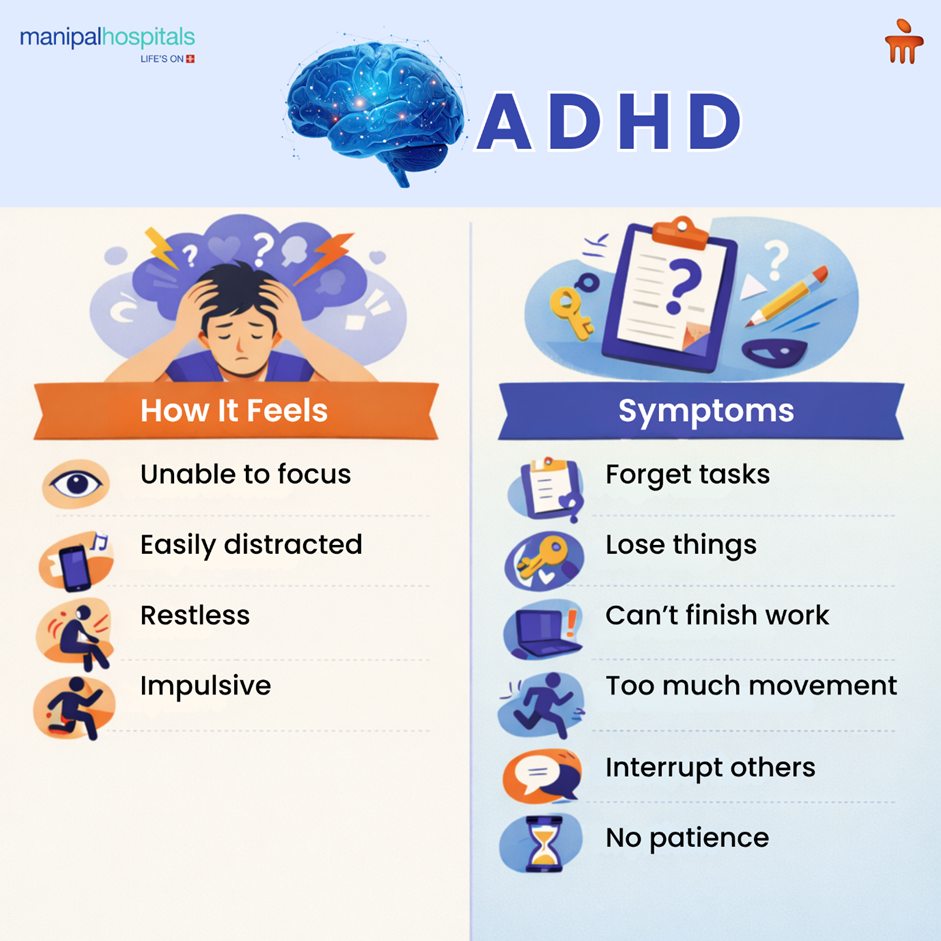
ADHD Symptoms
ADHD symptoms can look different from person to person, but experts group them into patterns. Some people mainly have trouble with attention. Others are more active or show impulsive behaviour.
Inattention symptoms
-
Difficulty staying focused on tasks, especially those that need sustained attention
-
Making frequent careless mistakes in schoolwork or routine activities
-
Forgetting daily responsibilities like homework, appointments, or chores
-
Misplacing items such as books, keys, or phones
-
Starting tasks but finding it hard to complete them without getting distracted
Hyperactivity symptoms
-
Constant movement, even in situations where stillness is expected
-
Difficulty sitting in one place for long periods
-
Talking more than others in conversations or interrupting quiet settings
-
Feeling internally restless, especially in older children and adults
Impulsivity symptoms
-
Interrupting others while they are speaking or during activities
-
Acting quickly without thinking about possible consequences
-
Difficulty waiting for their turn in conversations or group situations
How symptoms differ in children and adults
In children, symptoms are often more visible. In adults, they may appear as restlessness, poor focus, or impulsive decisions affecting daily life.
Causes of ADHD
The exact cause of ADHD is not fully known. What we understand from research is that it involves how the brain develops and functions, rather than a single trigger.
-
Genetic factors: If ADHD runs in the family, the chances are higher that the next generation can get it. Multiple genes are also involved, predominantly those that affect how brain signals are transmitted. These genetic patterns influence attention and impulse control from an early age.
-
Brain structure and function: Certain areas of the brain, like the prefrontal cortex, help with focus, planning, and self-control. In ADHD, these areas may develop differently or function less efficiently. Neurotransmitters such as dopamine, which regulate motivation and reward, do not work in the same way. That is why staying focused or delaying actions becomes difficult.
-
Prenatal and early life factors: Some factors before or around birth can increase risk. Babies born prematurely or with low birth weight show a higher association. Exposure to alcohol or smoking during pregnancy can affect early brain development. These do not directly cause ADHD but can contribute to how the brain develops.
-
Brain injury: In a small number of cases, early brain injury can lead to symptoms similar to ADHD. This is not common, but it is recognised in clinical practice.
How ADHD is Diagnosed
Diagnosing ADHD takes a step-by-step clinical evaluation. There is no single test that confirms the condition, so doctors rely on a detailed understanding of ADHD symptoms and how they affect everyday life.
-
A doctor will take a detailed medical and developmental history, including early childhood behaviour.
-
Behavioural patterns are assessed over time, not based on a single visit.
-
For children, doctors often speak with parents and teachers to understand how the child functions in different settings.
-
Symptoms should have started before the age of 12, even if they were recognised later.
-
Doctors look for symptoms in more than one setting, such as home, school, or work.
-
The symptoms must interfere with daily functioning, like learning, relationships, or job performance.
-
The symptoms should be persistent and not occasional.
-
In some cases, more than one condition may be present, and each needs separate attention.
How Is ADHD Treated?
Managing ADHD treatment usually involves a combination of approaches. The plan depends on age, symptoms, and how much daily life is affected.
-
Medications: Medications are often the first step in ADHD treatment. Stimulants are commonly used and help improve attention and reduce impulsivity by affecting brain chemicals like dopamine. Non-stimulant options may be used if stimulants are not suitable or cause side effects.
-
Behavioural therapy: Behavioural therapy helps build routine and improve daily habits. It supports better organisation, time management, and consistent behaviour. In children, it often includes guidance for both the child and caregivers.
-
Counselling/psychotherapy: Counselling helps manage emotional and social challenges. It can improve communication, reduce frustration, and support overall mental well-being.
-
Lifestyle support: Simple habits like maintaining a routine, using reminders, and staying physically active can help improve focus and reduce restlessness.
Conclusion
ADHD is a common condition, and with the right approach, it can be managed effectively. Many patients see clear improvement once symptoms are identified early and addressed in a structured way. Ignoring signs can make daily tasks, school, or work more difficult over time.
If you or your child are noticing ongoing attention or behaviour concerns, it is worth getting a proper evaluation. Timely care can make a meaningful difference in long-term functioning. For those seeking ADHD treatment in Doddaballapur, seek comprehensive, child-focused care from Paediatric and Child Care experts at Manipal Hospital Doddaballapur, where evaluation and treatment are guided by experienced specialists.
FAQ's
Early ADHD symptoms often show up as poor focus, getting distracted easily, or leaving tasks halfway. In children, you may also see constant movement or acting without thinking.
ADHD does not fully go away. What changes is how it shows up. A child who is very active may become calmer with age, but issues with attention or impulsive decisions can still continue into adult life.
ADHD is sometimes referred to as the "ADHD disease," but this term is incorrect. It is better to think of it as a brain-based condition. It affects how the brain handles attention and control. It is not about attitude or lack of effort.
ADHD treatment depends on age and symptoms. Children often need behaviour support along with guidance for parents. Adults may need medication, routine changes, and practical strategies to manage work and daily tasks.
You should see a doctor if ADHD symptoms are ongoing and starting to affect school, work, or relationships. Waiting too long can make things harder to manage. Early help makes a clear difference.
Share this article on: