7 Min Read
After birth, parents naturally pay attention to things like breathing, feeding, and whether the baby seems comfortable. However, some conditions are not immediately noticeable. Congenital heart defects are among them, as they develop before the child is born. These defects affect how the heart functions and how blood flows through it. While some do not make much difference at all and clear up by themselves, others necessitate immediate intervention by a doctor, which is precisely why early detection of a congenital heart defect is crucial.
Today, awareness about this condition has increased, and testing for congenital heart disease has become more common. In many cases, early detection occurs nowadays, thus improving patient results. This blog provides a detailed list of congenital heart defects, the steps involved in a diagnosis, and the specialised care available for infants today.
Synopsis
- What Are Congenital Heart Defects (CHDs)?
- Causes and Risk Factors
- Types of Congenital Heart Defects
- List of Congenital Heart Defects
- Signs and Symptoms in Newborns
- Importance of Early Diagnosis in Newborns
- Diagnostic Methods in Detail
- Treatment Options
- Living with Congenital Heart Defects
- Preventive Measures During Pregnancy
- When to Seek Medical Help
- Conclusion
What Are Congenital Heart Defects (CHDs)?
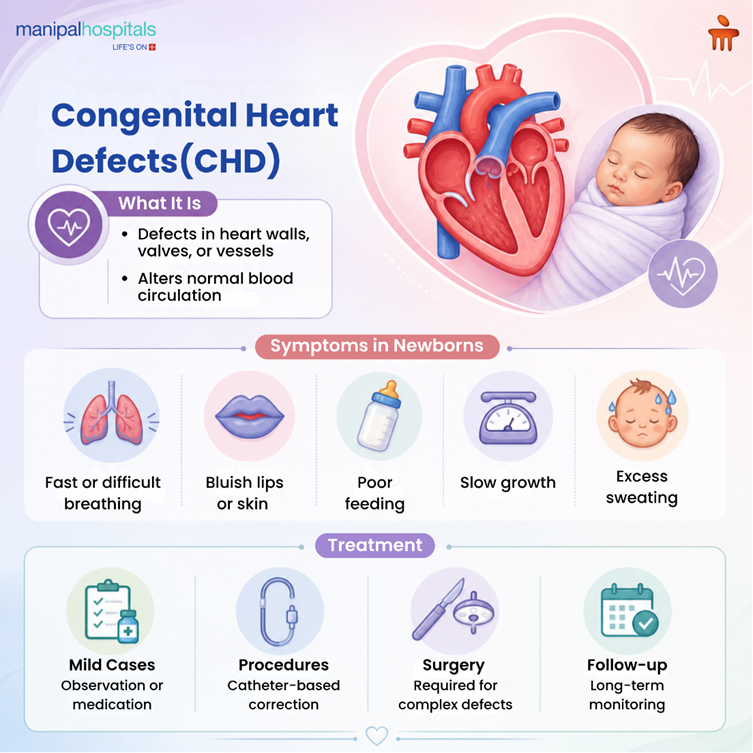
Congenital heart defects (CHDs) are structural abnormalities present at birth. They may involve the walls of the heart, the valves, or the blood vessels connected to it. Because of these changes, normal blood flow through the heart can be affected.
Not every defect behaves the same way. Some may go unnoticed for years, while others show symptoms soon after birth. The severity depends on how much the defect affects blood flow and oxygen levels in the body. Diagnosing congenital heart disease early helps doctors plan the right course of care and management.
Causes and Risk Factors
In many cases, there is no single clear cause behind CHDs. However, there are some risk factors that may increase the probability:
Genetic defects or chromosomal problems
-
A family history of heart conditions
-
Illnesses occurring during pregnancy
-
Uncontrolled cases of diabetes in the mother
-
Exposure to alcohol, smoking, or certain medications during pregnancy
It is important to mention that, regardless of these risk factors, congenital heart disease may develop. Because some cases develop without any obvious risk factors, routine screening during pregnancy and after birth remains important.
Types of Congenital Heart Defects
Doctors generally group the types of congenital heart defects based on how they affect oxygen levels and blood flow.
-
Acyanotic Defects: These are usually less severe and do not significantly reduce oxygen levels. Common examples include atrial septal defect and ventricular septal defect. Symptoms, if they appear, may take time to develop.
-
Cyanotic Defects: These conditions are more severe, and they lead to oxygen deficiency in the blood, resulting in bluish skin around the lips and body parts. The Tetralogy of Fallot is among heart problems that need immediate attention.
-
Obstructive Defects: In these cases, blood flow is partially blocked. This puts extra strain on the heart. Examples include narrowing of the aorta or pulmonary valve.
Understanding these types of congenital heart defects helps doctors decide how urgently treatment is required.
List of Congenital Heart Defects
CHDs can affect the heart in different ways depending on which structure is involved and how blood flow is altered. Doctors often group these conditions based on how they affect oxygen flow and circulation.
The below list explains more on congenital heart defects and their specifics:
|
Condition |
Category |
Description |
Severity |
|
Atrial Septal Defect |
Acyanotic |
Opening between the upper chambers |
Mild to Moderate |
|
Ventricular Septal Defect |
Acyanotic |
Opening between the lower chambers |
Moderate |
|
Patent Ductus Arteriosus |
Acyanotic |
The blood vessel fails to close |
Mild to Severe |
|
Tetralogy of Fallot |
Cyanotic |
A combination of four defects |
Severe |
|
Transposition of the Great Arteries |
Cyanotic |
Arteries switched |
Critical |
|
Coarctation of Aorta |
Obstructive |
Narrow aorta |
Moderate |
|
Pulmonary Stenosis |
Obstructive |
Valve narrowing |
Mild to Severe |
Signs and Symptoms in Newborns
Symptoms can vary, and sometimes they are subtle. Signs to watch for include:
-
Increased rate of breathing or effort involved with breathing
-
Blueness around the mouth or fingertips
-
Difficulty feeding
-
Slow growth or inadequate weight gain
-
Extreme sweating
Sometimes, congenital heart disease is diagnosed through routine examinations before any symptoms appear.
Importance of Early Diagnosis in Newborns
Early congenital heart defect diagnosis can change the course of treatment significantly. Detection at an early stage helps in planning care without any complications.
Pulse oximetry is usually one of the tests that may be done in newborn screening. Further tests are done in case of abnormalities, such as echocardiography. Early detection from top cardiologists from Bhubaneswar will help reduce risks and increase survival chances, particularly in cases of severe congenital heart disease.
Diagnostic Methods in Detail
Echocardiography
This test is often conducted on babies. It utilises sound waves to create pictures of the heart, thus making it easier to evaluate the structure and functioning of the heart.
Pulse Oximetry
This is a quick and painless screening test carried out shortly after the baby’s birth. This test detects any level of oxygen present in the blood.
Chest X-ray
A chest X-ray is sometimes recommended to evaluate the size of the heart and to check how the lungs are functioning alongside it. It provides useful supporting information.
Advanced Imaging
In some cases, advanced scans such as computerised tomography (CT) or magnetic resonance imaging (MRI) may be needed for a more detailed evaluation of the heart. These help provide clearer images when required.
Both of them contribute significantly towards the detection of any heart problem.
Treatment Options
Treatment depends on the nature of the defect and how it affects the child.
Medication
Some mild conditions are managed with medicines that support heart function.
Minimally Invasive Procedures
Certain defects can be corrected using catheter-based techniques without open surgery.
Surgery
More complex cases may require surgical repair, sometimes in early infancy.
Follow-up Care
Long-term monitoring is often necessary, even after successful treatment.
Centres offering congenital heart defect treatment in Bhubaneswar provide a combination of these approaches under specialised care.
Living with Congenital Heart Defects
Many children with congenital heart defects grow up to lead active lives. However, regular monitoring remains important.
Parents should ensure:
-
Scheduled medical visits
-
Adherence to treatment plans
-
Awareness of any new symptoms
With the right care, long-term outcomes have improved significantly over the years.
Preventive Measures During Pregnancy
Although not all congenital heart defects can be prevented, certain steps may reduce risk:
-
Regular antenatal check-ups
-
Managing chronic conditions
-
Avoiding alcohol and harmful substances
-
Taking prescribed supplements
Prenatal scans may also help identify certain conditions before birth.
When to Seek Medical Help
Immediate medical attention is necessary if a newborn shows:
-
Bluish skin or lips
-
Poor feeding
-
Unusual tiredness
Prompt congenital heart defect diagnosis ensures that treatment can begin without delay.
Conclusion
Congenital heart defects remain one of the most common birth conditions, but outcomes today are far better than in the past. Awareness, early detection, and timely care play a major role. Understanding the types of congenital heart defects and recognising early signs can help parents act quickly. With access to specialised and advanced cardiology care at Manipal Hospital Bhubaneswar, treatment has become more effective.
For those seeking reliable congenital heart defect treatment in Bhubaneswar, consulting experienced cardiologists at Manipal Hospital Bhubaneswar can help ensure comprehensive care tailored to each child’s needs.
FAQ's
CHDs are structural issues in the heart present at birth. They affect blood flow and may range from mild conditions to serious disorders, where an infant may need immediate care involving surgery.
Diagnosis involves screening tests such as pulse oximetry and echocardiography. These help detect abnormalities early and guide appropriate treatment decisions in newborns.
The main types of congenital heart defects include acyanotic, cyanotic, and obstructive categories, each affecting blood flow and oxygen levels in different ways.
Yes, many congenital heart defects can be treated with medication, procedures, or surgery. Early detection significantly improves outcomes and long-term health.
Congenital heart defect treatment in Bhubaneswar is available at specialised centres like Manipal Hospitals, where experts offer advanced diagnostics, surgical care, and long-term monitoring for children with heart conditions.
Share this article on:


.webp "ଅଙ୍ଗ ଦାନର ଗୁରୁତ୍ୱ: ମୃତ୍ୟୁ ପରେ କେଉଁ ଅଙ୍ଗ ଦାନ କରାଯାଇପାରିବ?")