7 Min Read
Daily routines, long working hours, irregular meals, and limited physical activity have quietly made liver-related problems more common than many people realise. One such condition is non alcoholic fatty liver disease, where excess fat starts building up in the liver even in people who drink little or no alcohol.
Understanding exactly what is non-alcoholic fatty liver disease is important because it often develops silently. Many people do not realise they have it until it progresses or is detected during routine tests. It can gradually lead to inflammation or liver damage if left unmanaged.
This blog provides an insight into the causes, symptoms, and treatment for non-alcoholic fatty liver disease. If you know about it early enough, there is much that can be done about it.
Synopsis
- What is Non-Alcoholic Fatty Liver Disease?
- How Liver Function is Affected?
- Non-Alcoholic Fatty Liver Disease Causes
- Types of Non-Alcoholic Fatty Liver Disease
- Symptoms and Progression
- Importance of Early Diagnosis
- How Non-Alcoholic Fatty Liver Disease is Diagnosed?
- Non-Alcoholic Fatty Liver Disease Treatment
- Living with Non-Alcoholic Fatty Liver Disease
- Prevention and Risk Reduction
- When to Seek Medical Advice?
- Conclusion
What is Non-Alcoholic Fatty Liver Disease?
Non-alcoholic fatty liver disease, or NAFLD, is when there’s too much fat build-up in the cells of your liver, and you drink little or no alcohol. The liver plays a central role in the body's metabolism. While accumulation of fat in the organ is normal, if it accumulates beyond its usual amount, the liver may gradually stop functioning efficiently.
There are 2 main types of NAFLD. The first is simple fatty liver disease, where fat is present but there is little or no inflammation. The second is non-alcoholic steatohepatitis (NASH), where fat accumulation is accompanied by inflammation and liver cell damage.
How Liver Function is Affected?
The liver has many important roles, including metabolism, detoxification, and digestion. When too much fat builds up, it can start to affect how well the liver works.
In the early stages, the liver may still function normally despite fat accumulation. Over time, however, this build-up can lead to inflammation and eventually cause scarring, known as fibrosis.
Failing to receive treatment will result in other complications, such as cirrhosis. Knowing what non-alcoholic fatty liver disease is important for appreciating its significance.
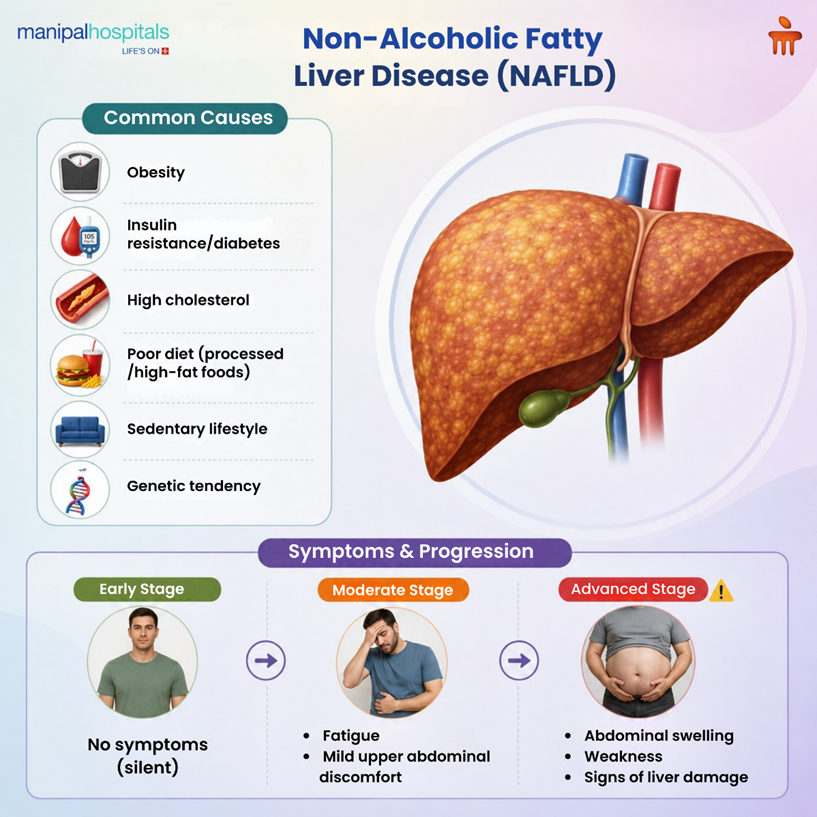
Non-Alcoholic Fatty Liver Disease Causes
This condition usually develops because of a mix of everyday factors rather than a single cause. Some of the common ones include:
-
Obesity, where extra body fat gradually builds up in the liver.
-
Insulin resistance, often linked to type 2 diabetes, which affects how the body handles sugar and fat.
-
High cholesterol, which can increase fat levels in the liver.
-
Dietary habits, especially frequent intake of processed or high-fat foods.
-
Low physical activity, which affects how the body uses and stores fat.
-
Family history or genetic tendency, where some people may be more prone than others.
In most cases, it’s not just one of these but a combination over time that leads to non-alcoholic fatty liver disease.
Types of Non-Alcoholic Fatty Liver Disease
There are two main types, each with different implications for health:
Simple Fatty Liver
This stage involves fat accumulation without inflammation or damage. It is often reversible with lifestyle changes.
Non-Alcoholic Steatohepatitis (NASH)
This is an advanced stage with inflammation and damage to liver cells. The condition can lead to fibrosis or cirrhosis when not managed properly.
Understanding the various stages makes it possible to know how to treat non alcoholic fatty liver disease.
Symptoms and Progression
The signs can change as the condition moves from early to more advanced stages. In many people, it develops slowly and may not cause clear symptoms at first.
|
Stage |
Symptoms |
Clinical Significance |
|
Early |
Often no symptoms |
Silent condition |
|
Moderate |
Fatigue, mild discomfort |
Liver stress begins |
|
Advanced |
Abdominal swelling, weakness |
Possible complications |
In many cases, non-alcoholic fatty liver disease symptoms are not noticeable in the early stage. Some people may experience mild fatigue or a general feeling of uneasiness in the upper abdomen area.
In the later stages, there can be some symptoms. But, even in the late stages, the disease may sometimes not produce any symptoms, which emphasises the importance of health checks.
Importance of Early Diagnosis
Early detection helps in better management of the problem. The doctors normally diagnose it using blood tests, scanning, and ultrasounds.
Early diagnosis of non-alcoholic fatty liver disease helps the patient manage the disease before it causes significant damage. Checking the liver enzymes and other metabolic markers may be among the common tests to evaluate this condition. Early detection makes non-alcoholic fatty liver disease treatment easy.
How Non-Alcoholic Fatty Liver Disease is Diagnosed?
Blood Tests
Blood tests are usually the first step. They give a quick idea of how the liver is working and whether enzyme levels are higher than normal. Even if you don’t feel any symptoms, these changes can still show up in reports.
Imaging Tests
Scans like ultrasound or MRI help doctors see if fat has built up in the liver. These tests are simple and don’t involve any cuts or procedures, but they give a clearer picture of what’s going on.
Liver Biopsy
In some cases, a small sample of liver tissue may be taken for closer examination. This helps check for inflammation or scarring and gives more detailed information when needed.
Together, these tests help confirm the condition and decide what steps to take next.
Non-Alcoholic Fatty Liver Disease Treatment
Treatment focuses on addressing underlying causes and preventing progression.
Lifestyle Changes
Weight management, a balanced diet, and regular exercise are key components of non-alcoholic fatty liver disease treatment.
Medical Management
In some cases, medications may be prescribed to manage associated conditions such as diabetes or high cholesterol.
Monitoring
Regular follow-up helps track progress and adjust treatment as needed.
When suggesting treatment, specialists often combine comprehensive care strategies that combine lifestyle guidance with medical supervision.
Living with Non-Alcoholic Fatty Liver Disease
Having this disease means being very attentive about your lifestyle. Minor adjustments like healthy eating habits and exercise can make a huge difference.
Doctors always recommend that their patients reduce eating processed food and stick to a healthy diet. The constant supervision will help to ensure that the condition does not get worse.
Prevention and Risk Reduction
Prevention is very important to reduce the risk of developing the condition:
-
Maintaining a healthy weight
-
Eating a balanced diet
-
Staying physically active
-
Managing blood sugar and cholesterol levels
When to Seek Medical Advice?
The following issues should lead to seeking medical guidance if they persist without any specific cause or are worsening with no apparent reason. Fatigue may appear to be insignificant, yet in some cases, it is indicative of a liver disorder. Unexpected fluctuations in weight (whether loss or gain) that happen without a change in one's way of life are other factors that cannot go unattended. Additionally, liver test results that prove to be abnormal after routine medical examinations require proper evaluation.
Consulting a leading gastroenterologist in Bhubaneswar at Manipal Hospital will help to establish whether a liver disorder is the cause of your symptoms and provide a timely diagnosis. The early detection will make it possible to prescribe appropriate NAFLD treatment according to the stage reached by the problem.
Conclusion
Non-alcoholic fatty liver disorder is a common condition, but also one that is often missed and might impact the liver’s function. Knowing what non-alcoholic fatty liver disease is and how it could be identified could assist in preventing potential problems, and consulting experienced gastrointestinal specialists near Bhubaneswar can help with timely diagnosis and appropriate treatment.
This condition is usually easy to control with the right treatment and care. If you want more information regarding fatty liver disease treatment in Bhubaneswar, you can visit Manipal Hospital Bhubaneswar for specialised gastrointestinal science care.
FAQ's
It is a condition that occurs when there is too much fat in the liver and is not related to alcohol.
Common causes include obesity, diabetes, high cholesterol, and poor lifestyle habits that contribute to fat accumulation in liver cells.
Symptoms may include fatigue, abdominal discomfort, and weakness, although many cases remain asymptomatic in early stages.
Yes. Treatment mainly focuses on weight management, exercise, diet changes, and controlling related conditions like diabetes or high cholesterol.
Fatty liver disease treatment in Bhubaneswar is available at Manipal Hospitals where our team of gastroenterologists and hepatologists offer expert diagnosis, lifestyle management, and medical care as needed.
Share this article on:


_need_Surgery__Expert_Guide_.webp "Expert guide on gallbladder polyps and treatment options")

7.png)


.webp "ଅଙ୍ଗ ଦାନର ଗୁରୁତ୍ୱ: ମୃତ୍ୟୁ ପରେ କେଉଁ ଅଙ୍ଗ ଦାନ କରାଯାଇପାରିବ?")