7 Min Read
Your shoulder is the most flexible joint in your body, allowing you to lift, swing, and rotate your arm in almost any direction. However, this incredible range of motion comes with a downside: it makes the shoulder highly vulnerable to slipping out of place. A dislocated shoulder happens when the ball at the top of your arm bone pops right out of its socket. It usually takes a hard blow to do this, like a nasty fall, a sports collision, or a car accident, leaving you with instant, severe pain and an arm you cannot move at all.
Many people mistake severe shoulder strain for a minor tweak, but a true dislocation is a medical emergency that requires immediate professional care. Trying to pop the joint back in by yourself or letting an untrained person pull your arm can cause permanent damage to the surrounding blood vessels, muscles, and nerves. Recognising the signs early and knowing exactly what to do can protect your joint health over the long term. This blog outlines the common dislocated shoulder symptoms, what immediate steps to take, and what your treatment and recovery options look like today.
Synopsis
Understanding a Dislocated Shoulder
To understand a shoulder dislocation, it helps to look at the joint's anatomy. The shoulder is a “ball-and-socket” joint, where the top of your arm bone fits into a shallow socket in your shoulder blade. Because the socket is so shallow, a cuff of tough tissue called the labrum, along with surrounding ligaments, acts like a seal to hold the bone securely in place.
When a strong force affects the joint, these supporting tissues may stretch or tear, allowing the bone to move out of alignment. Most dislocations are "anterior," meaning the arm bone pushes forward and down. Once the bone pops out, the surrounding muscles instantly lock up and spasm to protect the joint. This clamps the arm in an awkward, highly painful position.
Key Dislocated Shoulder Symptoms to Watch For
A dislocation is usually very obvious right after the injury happens. If you or someone else takes a hard fall, look out for these prominent dislocated shoulder symptoms:
-
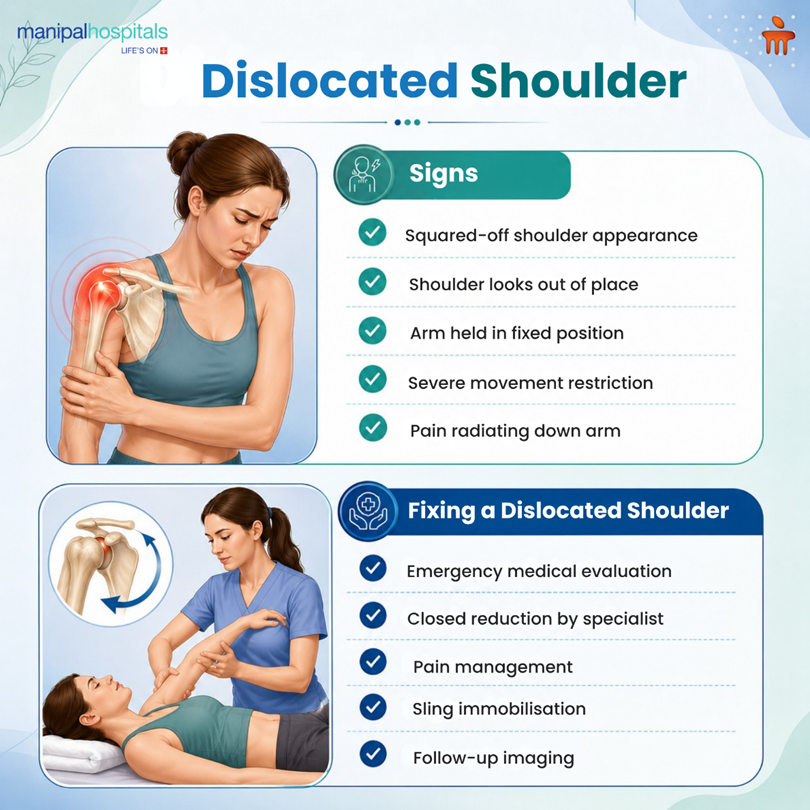
Visibly Deformed Shape: The shoulder looks squared-off, flat, or bulged rather than rounded. You might notice a distinct bump under the skin where the bone has shifted forward.
-
Intense, Immediate Pain: The pain is severe and constant, often radiating down the arm into the hand.
-
Inability to Move: The joint locks up completely, making it impossible to lift or rotate your arm even an inch.
-
Swelling and Bruising: The area around the joint swells up rapidly, and deep bruising appears over the next few hours.
-
Numbness or Tingling: If the displaced bone presses against local nerves, you might feel a “pins and needles” sensation or weakness travelling down to your fingers.
Daily Hazards and Causes
Shoulder injuries don't typically happen without a significant impact. It is usually a sudden, forceful event that compromises the joint:
|
Cause |
How it Happens |
Effect on the Shoulder |
|
Sports Injuries |
High-impact contact in football or rugby, or awkward falls during gymnastics and skiing. |
Forces the arm bone out of its socket through sudden, twisting tension. |
|
Accidents & Falls |
Landing hard directly on your shoulder, or extending your arm fully to break a trip or fall. |
Transfers the entire body weight directly into the joint, overriding the ligaments. |
|
Severe Trauma |
Sudden, violent forces such as car accidents or sudden pulling motions on the arm. |
Causes complete displacement of the bone, frequently tearing surrounding tissues. |
|
Joint Laxity |
Naturally loose ligaments or a history of previous shoulder dislocations. |
This condition lowers the threshold of force needed to slip the bone out of alignment. |
How Do Doctors Diagnose a Dislocated Shoulder?
When you arrive at our OPD, a specialist will act quickly to evaluate the joint and make sure it is safe to proceed with treatment:
-
Physical Examination: The doctor carefully inspects the shape of your shoulder, checks for skin numbness, and gently feels your wrist pulse to ensure blood circulation is healthy.
-
Digital X-rays: This is the most crucial tool. X-rays confirm exactly which direction the bone moved and, more importantly, check if there are any tiny bone fractures around the socket.
-
MRI Scans: If the doctor suspects deep internal soft tissue damage, an MRI helps look closely at whether the labrum or rotator cuff tendons have been badly torn.
How to Fix a Shoulder Dislocation?
The core focus of treatment is to safely return the arm bone to its rightful position and give the stretched tissues time to heal. There are specific, structured methods used depending on how cleanly the bone slipped out and whether the joint stays stable afterwards.
-
Closed Reduction: - This is the standard way to reset the joint. A doctor uses careful hand movements to guide the bone back into its cup. Medicine is given first to relax tight muscles so the bone slips back into place smoothly.
-
Sling Immobilisation: - Once the joint is back in place, the immediate pain drops significantly. However, the ligaments are still stretched and weak. Your arm will be placed in a medical sling for a few weeks to keep it completely still, giving the tissues a quiet environment to scar down and heal.
-
Targeted Physical Therapy: - After the sling comes off, the shoulder will feel stiff and weak. A therapist walks you through gentle exercises to restore your range of movement and rebuild the strength of your “rotator cuff” muscles, which act as a natural brace to keep the joint stable.
-
Shoulder Dislocation Surgery - While a standard reset works for most first-time injuries, surgery becomes necessary in specific situations. If a significant impact has caused severe tearing in the ligaments, labrum, or tendons, a specialist may recommend a surgical repair to reattach the tissues.
Shoulder dislocation surgery is also highly recommended for individuals who suffer from recurrent instability, meaning the shoulder keeps popping out during minor everyday activities. Modern techniques usually allow the procedure to be done via keyhole surgery (arthroscopy), which keeps incisions small and helps structure a more reliable recovery path.
When to Seek Medical Help?
Because a dislocation involves joint displacement and potential nerve stress, knowing when to head straight to an emergency room is essential.
-
When to Get Emergency Care: Seek immediate medical care the second an injury occurs. Never wait out a suspected dislocation to see if it improves on its own, as prolonged displacement can compromise long-term nerve function and blood supply.
-
Urgent Red Flags: Never try to push the bone back in at home. Go straight to emergency care if the hand turns cold or pale, the arm loses all feeling, or there is an open wound near the joint.
Conclusion
Knowing how to fix a dislocated shoulder always starts with prompt, professional medical alignment rather than guesswork. While the initial injury can be incredibly painful and disruptive, getting the joint put back in place quickly by a professional gives the surrounding tissues the best possible chance to recover cleanly.
Taking your rehabilitation seriously with targeted exercises helps rebuild joint stability and prevents the injury from happening again later. From the best orthopaedic hospital in Bhubaneswar and consulting the best orthopaedics doctors in Bhubaneswar at Manipal Hospitals can also help ensure accurate treatment, proper rehabilitation, and long-term shoulder stability.
If you are looking for highly dependable shoulder dislocation treatment in Bhubaneswar, consulting an experienced orthopaedic specialist at Bhubaneswar Manipal Hospitals ensures you receive a precise diagnosis, safe joint alignment, and a proper recovery plan to get your arm back to full strength safely.
FAQ's
No, you should never attempt this procedure. Pulling or twisting the arm without medical training can trap nerves, tear blood vessels, or fracture the bone, causing much worse long-term damage than the original dislocation.
No. A subluxation means the arm bone partially slips out of the socket and pops back in on its own. A full dislocation means the bone is completely out of the socket and stays out until a doctor resets it.
While the bone is reset in minutes, the stretched ligaments take time to heal. Most people can return to light daily activities in a few weeks, but full recovery and a return to sports usually take 3 to 6 months of physical therapy.
When a shoulder dislocates, the supporting ligaments are stretched out or torn. If they heal loosely, the joint remains unstable, making it much easier for the bone to slip out again during minor everyday movements.
Not always. First-time dislocations are usually managed with a non-surgical reset and physical therapy. However, if the ligaments are severely torn or if the shoulder keeps dislocating repeatedly, surgery may be needed to tighten the tissues and stabilise the joint.
Share this article on:


.webp "ଅଙ୍ଗ ଦାନର ଗୁରୁତ୍ୱ: ମୃତ୍ୟୁ ପରେ କେଉଁ ଅଙ୍ଗ ଦାନ କରାଯାଇପାରିବ?")