7 Min Read
Most of us don’t think much about a sore throat. It comes and goes, usually because of an infection or a change in weather. But sometimes, symptoms that seem minor at first can point to something more serious. Throat cancer is one such condition where early signs are easy to overlook.
In many cases, throat cancer symptoms begin quietly. A slight change in voice or a persistent irritation might not raise concern at first. That is one reason early throat cancer is often overlooked, as the symptoms do not always feel alarming in the beginning.
As the condition progresses, these symptoms become more noticeable. Understanding the reasons for throat cancer and how symptoms change over time can help you recognise when to seek medical advice early. This blog explains this progression in a simple and practical way.
Synopsis
What is Throat Cancer?
Throat cancer refers to abnormal cell growth in the throat region, including the voice box and surrounding structures. These cells grow uncontrollably and can interfere with speaking, breathing, and swallowing.
There isn’t just one form of throat cancer. It depends on where the abnormal cells begin. Some affect the upper throat, while others involve the vocal cords. Regardless of location, early throat cancer usually starts in a small, localised area.
At that stage, symptoms may not be obvious. As the tumour grows, it begins to affect nearby tissues. This is when throat cancer symptoms become clearer and more persistent.
Reasons for Throat Cancer
Throat cancer is often linked to certain lifestyle and health-related factors. Smoking and chewing tobacco are among the biggest risk factors, as they expose the throat to harmful chemicals over time.
Alcohol consumption is another important risk factor, especially when combined with tobacco use, as this significantly increases the risk compared to either factor alone.
Infection with human papillomavirus (HPV) is also a known risk factor linked to many cases of throat cancer. Other lifestyle and environmental factors may also contribute, but in some cases, no clear cause can be identified.
Types of Throat Cancer
Throat cancer can develop in different parts of the throat, and the type depends on where it begins.
-
Pharyngeal Cancer: This type develops in the pharynx, which is the part of the throat behind the nose and mouth. It can affect different sections depending on where it begins.
-
Laryngeal Cancer: This type involves the voice box. Changes in voice are often one of the earliest throat cancer symptoms associated with this type.
-
Oropharyngeal Cancer: This type affects the middle region of the throat, including the tonsils. It is increasingly associated with viral infections.
Understanding the types of throat cancer helps explain why symptoms may differ from one person to another.
Symptom Progression Over Time
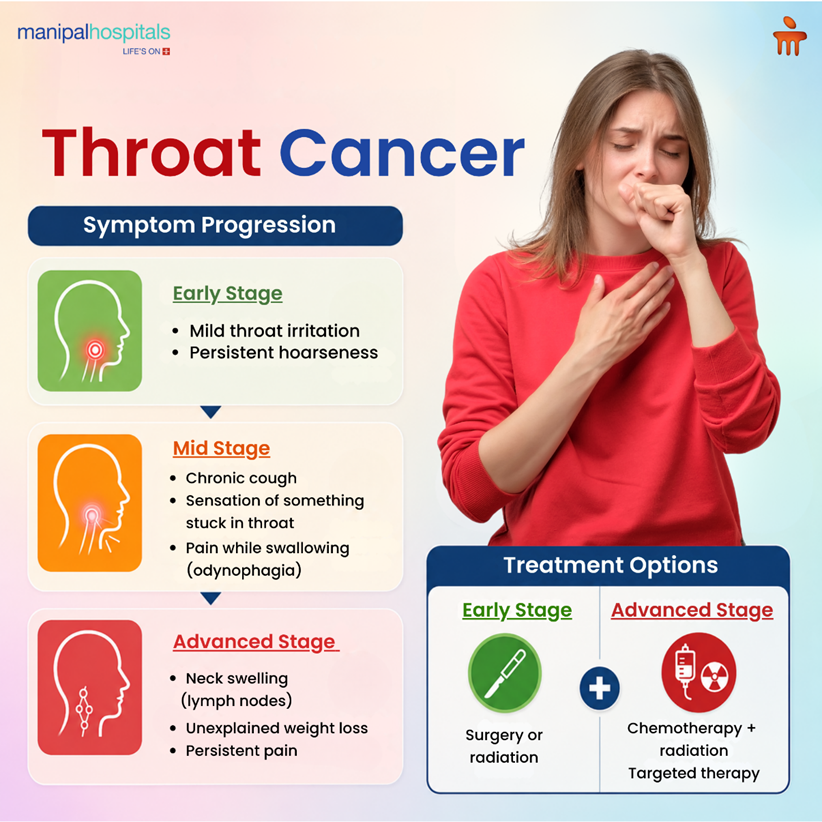
Initially, the symptoms of throat cancer will appear to be those of a typical throat infection. A patient may neglect a constant hoarseness or slight irritation. With time, swallowing food becomes painful. Some people develop a persistent cough or feel like something is stuck in the throat.
|
Stage |
Symptoms |
Clinical Insight |
|
Early |
Mild irritation, hoarseness |
Localised growth |
|
Mid-stage |
Pain while swallowing, cough |
Increasing size |
|
Advanced |
Neck swelling, weight loss |
Possible spread |
Common Throat Cancer Symptoms
Signs may vary depending on where the tumour is located, but some of the more commonly reported throat cancer symptoms include:
-
Persistent sore throat
-
Hoarseness that does not improve
-
Difficulty swallowing
-
Lump in the neck
-
Ear pain without infection
In early throat cancer, these signs may not seem serious. However, persistence is the key warning sign.
Importance of Early Detection
Detecting early throat cancer can make treatment simpler and more effective. When identified at an early stage, intervention can often be less aggressive.
Most often, diagnosis begins with a clinical examination. If anything is found to be unusual, more tests need to be performed. Early detection of throat cancer symptoms will give the patient a greater chance of being successfully treated.
Diagnostic Methods
-
Clinical Examination -In the first stage of examination, the doctor thoroughly examines the neck area, checking for any changes that are visible or palpable.
-
Endoscopy - The process involves passing a thin, flexible tube with a light attached down the throat to get a better look at the internal structures and see if there are any abnormal growths.
-
Imaging - Several types of scans may be performed in order to establish the location of the tumour and its size.
-
Biopsy - A tiny piece of tissue is taken from the area involved and looked at under a microscope to be certain that cancer cells are present.
All the above-mentioned tests help in determining the exact nature of the disease, and doctors can use their results to determine the best method of treating throat cancer.
Treatment Options for Throat Cancer
The treatment will be based on how far the cancer has spread and where it is located. The doctors generally determine the method after evaluating all the factors related to the cancer.
-
Surgery - Surgery is often recommended when the tumour is found early and is limited to one area. The goal is to remove the affected tissue while preserving as much normal function as possible.
-
Radiation Therapy - Radiation therapy uses high-energy rays to destroy cancer cells. It may be used on its own or along with surgery to lower the risk of the cancer returning.
-
Chemotherapy - Chemotherapy is the utilisation of drugs to kill cancer cells. It is often advised in more advanced stages or when the disease has spread beyond its original site.
-
Targeted Therapy - Targeted therapy aims at particular molecules that play a role in the development of cancer, making it more effective. Throat cancer centres in Bhubaneswar usually adopt both treatments depending on their patient’s circumstances.
Prevention and Risk Reduction
Though all cases cannot be prevented, some measures can be taken to minimise risks:
-
Avoid smoking and chewing tobacco products.
-
Limit the intake of alcohol.
-
Pay attention to good dental hygiene.
-
Get vaccinated if recommended.
Reducing exposure to known risk factors can lower the chances of developing throat cancer.
When to Seek Medical Advice?
It is very important not to delay seeking medical help if you have symptoms of throat cancer that last longer than two weeks. You might assume that such symptoms will disappear after some time, but this is not the case since there might be another problem that needs to be addressed. Difficulties with swallowing, a change in your voice, and unexplained weight loss are minor symptoms that could indicate another health issue. Failure to see your doctor can mean that your throat cancer diagnosis will be delayed. By seeking medical help early enough and accessing specialised cancer care at Manipal Hospital Bhubaneswar, the appropriate treatment can be started promptly.
Conclusion
Throat cancer often begins with symptoms that seem minor at first. Over time, these signs become more pronounced. Understanding the reasons for throat cancer and recognising early changes can make a significant difference.
With timely care and the right medical support, outcomes have improved considerably. For those seeking expert guidance and advanced throat cancer treatment in Bhubaneswar, consult oncology specialists at Manipal Hospital Bhubaneswar for personalised oncology care.
FAQ's
Early throat cancer may cause mild symptoms such as hoarseness, a sore throat, or slight difficulty swallowing that persists longer than usual.
The most common reasons for throat cancer include tobacco use, alcohol consumption, and HPV infection, along with environmental and lifestyle factors.
Throat cancer symptoms often start mildly and gradually worsen, leading to pain, swallowing difficulty, and noticeable physical changes in advanced stages.
Yes, throat cancer treatment can be effective, especially when diagnosed early. Options include surgery, radiation, chemotherapy, and targeted therapies
Manipal Hospitals offers advanced throat cancer treatment in Bhubaneswar in our Comprehensive Care Centre, which involves advanced diagnostics, personalised treatment plans, and ongoing care.
Share this article on:


.webp "ଅଙ୍ଗ ଦାନର ଗୁରୁତ୍ୱ: ମୃତ୍ୟୁ ପରେ କେଉଁ ଅଙ୍ଗ ଦାନ କରାଯାଇପାରିବ?")