7 Min Read
During early childhood, children learn how to coordinate their movements, balance, and explore their environment. However, in the case of children with spastic cerebral palsy, muscle tightness can cause mobility issues, which may interfere with this crucial development process.
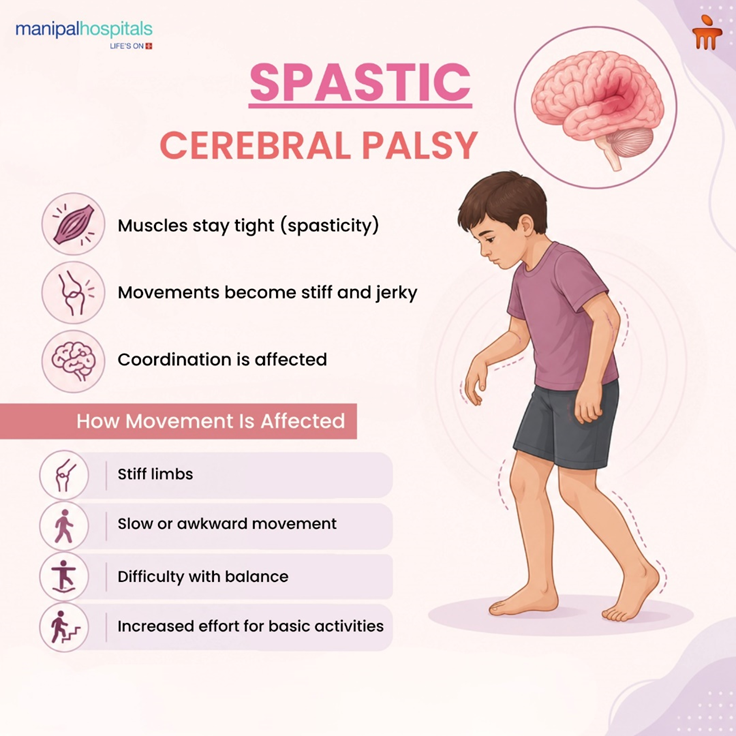
In spastic cerebral palsy, the muscles remain in a state of contraction rather than relaxation at all times. As a result, simple movements like sitting, standing, and walking become extremely difficult. As a result, parents may notice delayed milestones or stiffness when handling their child.
Early identification of its symptoms can make a real difference, because support started at the right time often improves outcomes. While the condition cannot be reversed, the right therapy can improve movement and make daily activities easier over time.
Synopsis
What is spastic cerebral palsy?
Spastic cerebral palsy is characterised as a neurological condition involving damage to the baby's brain that happens before, during, or immediately after birth. Due to the injury, the brain loses its ability to control body movements and muscle tone.
The main symptom of this disorder is spasticity, meaning that the muscles are tense rather than relaxed and exhibit involuntary spasms. The severity can vary widely, ranging from mild stiffness to more significant movement challenges. Identification of the signs of spastic cerebral palsy may facilitate the process of therapy and result in successful treatment.
How is movement affected?
In spastic cerebral palsy, the brain becomes incapable of sending clear messages to the muscles, resulting in restricted and staccato-like movement of the limbs. Movements are usually slow for a child due to their lack of ability to crawl, walk, or maintain balance. Sometimes, movements are overdone, and this may be characterised by muscle stiffness, resulting in excessive tiredness due to the increased effort needed.
A person's fine motor skills are also affected. Writing, holding items in their hands, or buttoning clothes are among the activities that are particularly challenging for patients to accomplish easily.
Types of Spastic Cerebral Palsy
Spastic cerebral palsy is classified based on the parts of the body affected.
Spastic Diplegia
This form mainly involves the lower limbs, so the legs are more affected than the upper body. For children suffering from this form of cerebral palsy, there is a tendency to have a stiff gait while walking. There might also be a case of toe walking by the affected individuals. It could also involve the use of aids like walkers and braces in certain situations.
Spastic Hemiplegia
This type affects one side of the body, usually involving both the arm and leg on the same side. Differences in strength and coordination may become more noticeable as the child grows. Activities like holding objects or walking may require more effort due to this imbalance.
Spastic Quadriplegia
This is the most severe form and involves all four limbs along with the trunk. Movements are highly restricted, and maintaining posture may be challenging. The children affected by this form of spastic cerebral palsy may also face more neurological difficulties.
The knowledge about the different forms of spastic cerebral palsy will help healthcare professionals formulate suitable treatment plans for their patients.
Spastic Cerebral Palsy Symptoms
The symptoms can vary from child to child, but they mainly affect muscle control and movement.
|
Symptom |
Description |
Impact |
|
Muscle stiffness |
Tight muscles |
Limited flexibility |
|
Delayed milestones |
Late sitting or walking |
Slower development |
|
Poor coordination |
Difficulty controlling movement |
Balance issues |
|
Muscle spasms |
Sudden contractions |
Interrupted motion |
|
Abnormal posture |
Unusual positioning |
Affects alignment |
Spastic cerebral palsy symptoms often become more noticeable as the child grows. Early signs may be subtle, but they can progress as movement demands increase.
Early Diagnosis and Therapy
An early diagnosis is essential so that treatment can be given as soon as possible to maximise mobility. Diagnosis of muscle tone, posture, and developmental markers is assessed by doctors.
In certain cases, physicians may conduct imaging studies to detect any abnormalities in the brain. Depending on the imaging reports, we can determine the therapy and treatment approach accordingly.
Approaches to Therapy
There are usually multiple methods employed when treating spastic cerebral palsy, focusing on motion and functionality.
-
Physiotherapy - Physiotherapy seeks to build up muscle strength, movement, and flexibility. Through continuous physiotherapy, the child will finally be able to reduce stiffness and learn how to move better.
-
Occupational Therapy - Occupational therapy is effective in helping the child learn and execute simple everyday activities like writing, dressing, and eating.
-
Speech Therapy - The condition affects the ability to speak and swallow in some children. In such cases, speech therapy has been found to be helpful.
-
Medication - The child may also be required to take medication to reduce muscle stiffness and increase comfort levels.
-
Assistive Devices - Devices such as braces, walkers, or wheelchairs may be used to support movement.
Specialists often use a combination of these approaches tailored to each child’s needs to treat the condition.
Living with Spastic Cerebral Palsy
Some children with spastic cerebral palsy may need ongoing support from parents or caregivers for daily activities. With the correct treatment regimen, most of them end up improving their ability to move around.
The participation of the family is essential in keeping up with the treatment regimen as well as making sure that improvements are made.
Even though there are numerous obstacles, many people with spastic cerebral palsy lead productive lives.
Preventing Complications
While the condition cannot be prevented, complications can be managed through:
-
Regular physiotherapy
-
Proper posture and positioning
-
Early use of assistive devices
-
Routine medical monitoring
When to Seek Medical Advice
Parents are often the first to notice small changes, and it’s better to get them checked rather than wait. You should consider seeing a best brain specialist in Bhubaneswar if you notice:
-
Delays in milestones like sitting, crawling, or walking
-
Increased stiffness in the arms or legs
-
Poor coordination or difficulty maintaining balance
-
Trouble controlling movements or unusual body postures
-
One side of the body is being used more than the other
These signs don’t always point to something serious, but it’s still worth getting them checked. In the event it is something serious, then recognising the signs early on can also allow care and support to begin at the right time. Such steps can make a real difference later.
Conclusion
For many families, managing spastic cerebral palsy becomes part of everyday life. While movement challenges can make simple activities harder, steady progress is possible with the right support. Improvements may take time, often coming in small steps, but with regular therapy and consistent care, children can become more comfortable in their movements.
What makes a difference is ongoing support, patience, and the right guidance at each stage. Every child is different, so care needs to be adapted to their specific needs. Over time, this can help build confidence and make daily activities easier to handle, and consulting experienced best neurology doctors at Manipal Hospital Bhubaneswar can support personalised long-term care.
For those seeking specialised neurology care in bhubaneshwar, for spastic cerebral palsy treatment in Bhubaneswar is available at Manipal Hospital Bhubaneswar, where treatment plans are tailored to each child.
FAQ's
Spastic cerebral palsy is a neurological condition where muscle stiffness affects movement and coordination. It is caused by damage to the developing brain, usually before, during, or shortly after birth.
Common spastic cerebral palsy symptoms include muscle stiffness, delayed milestones, poor coordination, and difficulty with movement and posture. These may become more noticeable as the child grows and movement demands increase.
Spastic cerebral palsy may have various types depending on the part of the body where the condition has developed. Accordingly, the type may be identified as diplegia, hemiplegia, or quadriplegia.
Even though the problem cannot be cured, symptoms and movement difficulties can often be managed effectively. Treatment and therapy can help the child move freely and be more functional.
Spastic cerebral palsy treatment in Bhubaneswar is available at specialised centres offering physiotherapy, rehabilitation, and neurological care.
Share this article on:


_-_Symptoms,_Causes_and_Recovery.webp "Guillain-Barré Syndrome (GBS): Symptoms, Causes & Recovery")


.webp "ଅଙ୍ଗ ଦାନର ଗୁରୁତ୍ୱ: ମୃତ୍ୟୁ ପରେ କେଉଁ ଅଙ୍ଗ ଦାନ କରାଯାଇପାରିବ?")