7 Min Read
Finding a lump in the neck can be frightening for anyone. Many people immediately worry about cancer or serious illness. However, not every neck swelling is dangerous. In many cases, the cause is a thyroid nodule, a common condition that affects millions of people worldwide. The reassuring news is that most thyroid nodules are non-cancerous and can be managed successfully with proper evaluation and treatment.
At Manipal Hospitals Baner, specialists focus on early diagnosis, advanced thyroid imaging tests, and personalised treatment plans that help patients recover confidently. With modern medical advancements, early-stage thyroid cancer now has survival rates of over 98%, making awareness and timely care extremely important.
Synopsis
- Understanding the Thyroid Gland
- A Patient Story That Many Can Relate To
- Symptoms That Should Never Be Ignored
- Causes and Risk Factors
- Importance of Thyroid Tumour Detection
- Blood Tests
- Fine Needle Aspiration (FNA) Biopsy
- Treatment Options for Thyroid Nodules
- Over 98% Survival with Early Treatment
- Why Regular Monitoring Matters
- Why Choose Manipal Hospitals Baner?
Understanding the Thyroid Gland
The thyroid is a small butterfly-shaped gland located at the front of the neck. Though small in size, it performs several vital functions in the body. It produces hormones that regulate metabolism, heart rate, body temperature, digestion, and energy levels.
When abnormal growth develops within the thyroid gland, it is known as a thyroid nodule. These nodules may be solid, fluid-filled, or mixed in nature.
Some remain tiny and unnoticed, while others become large enough to create visible swelling in the neck.
Studies suggest that nearly half of adults may develop thyroid nodules by the age of 60. Thankfully, more than 90% of these nodules are benign and do not lead to cancer.
A Patient Story That Many Can Relate To
A 42-year-old woman visited Manipal Hospitals Baner after noticing mild swelling in her neck while getting ready for work. Initially, she ignored it because there was no pain. Over the next few months, she began experiencing slight discomfort while swallowing and occasional hoarseness in her voice.
Concerned, she consulted an endocrinologist who recommended thyroid imaging tests, including an ultrasound. The scan revealed a suspicious thyroid nodule. A fine needle aspiration (FNA) biopsy confirmed early-stage papillary thyroid cancer.
Because the cancer was detected early, she underwent successful surgery and recovered completely. Today, she continues regular thyroid health monitoring and leads a healthy, active life.
Her story highlights one important message: early diagnosis saves lives.
Symptoms That Should Never Be Ignored
Most thyroid nodules do not cause symptoms initially. Many are discovered accidentally during routine health check-ups or scans performed for other conditions.
However, larger nodules or cancerous growths may produce symptoms such as:
-
A visible lump in the neck
-
Difficulty swallowing
-
Voice changes or hoarseness
-
Persistent throat discomfort
-
Neck pain
-
Breathing difficulty while lying down
-
Enlarged lymph nodes
-
Rapid growth of the swelling
Sometimes, nodules also affect hormone production, causing symptoms like:
-
Sudden weight loss
-
Excess sweating
-
Tremors
-
Palpitations
-
Increased appetite
Ignoring these symptoms can delay diagnosis and treatment.
Causes and Risk Factors
Doctors often cannot identify one exact reason behind thyroid nodules, but several factors may increase the risk.
Iodine Deficiency
The thyroid gland requires iodine to produce hormones. Low iodine intake may lead to enlargement and nodule formation.
Family History
People with a family history of thyroid disease or thyroid cancer may have a higher risk.
Radiation Exposure
Exposure to radiation during childhood significantly increases the chances of thyroid cancer later in life.
Thyroid Inflammation
Conditions like Hashimoto’s thyroiditis can trigger chronic inflammation and nodular changes.
Hormonal Changes
Women are more likely to develop thyroid nodules due to hormonal fluctuations during pregnancy and menopause.
Importance of Thyroid Tumour Detection
Early thyroid tumour detection is extremely important because thyroid cancer usually grows slowly and responds very well to treatment when diagnosed early.
At Manipal Hospitals Baner, doctors use advanced diagnostic tools to evaluate thyroid nodules accurately.
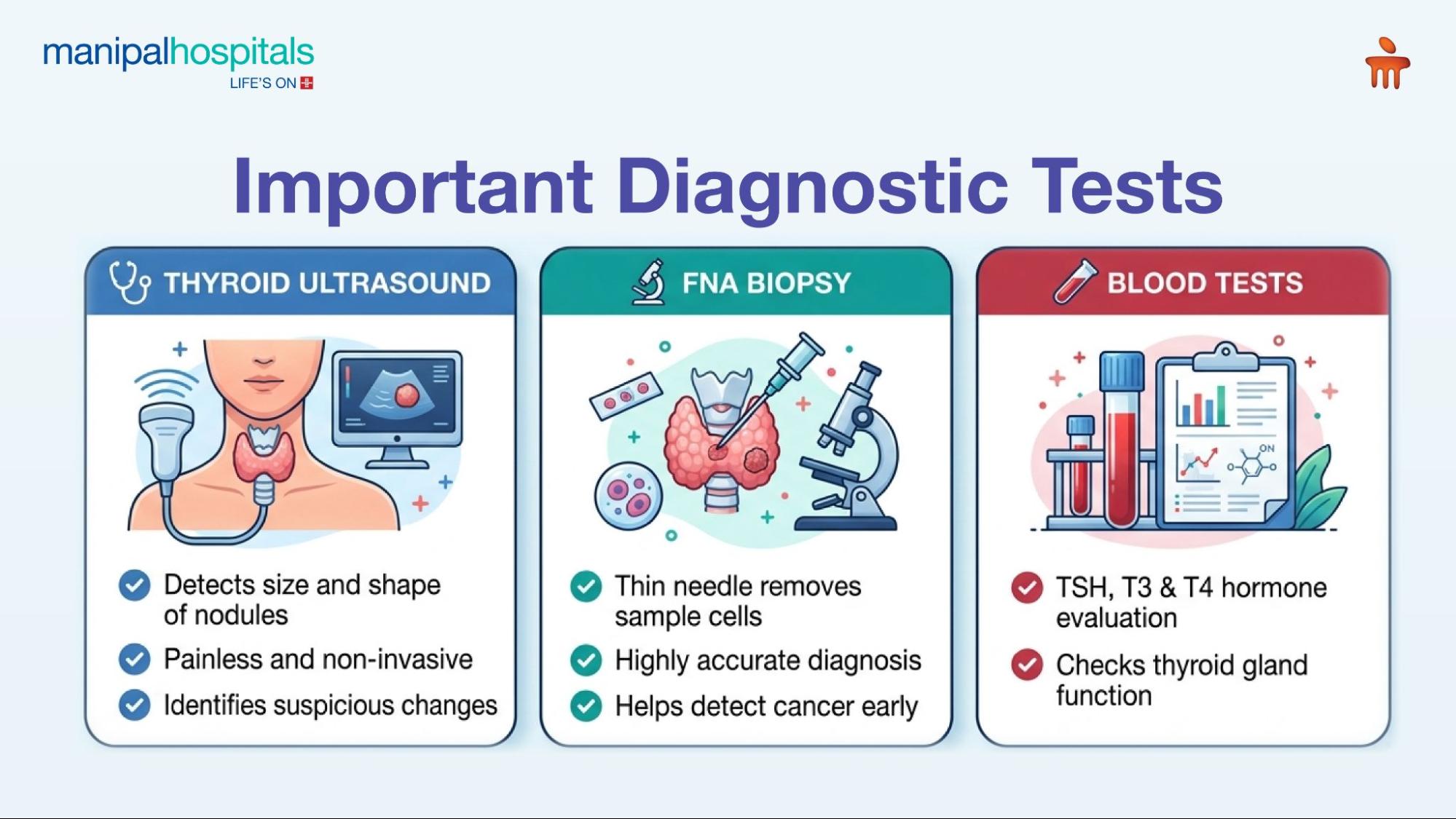
Thyroid Ultrasound
Ultrasound is one of the most important thyroid imaging tests. It helps determine:
-
Size of the nodule
-
Shape and structure
-
Presence of calcifications
-
Blood supply
-
Number of nodules
This painless test can identify even very small nodules that cannot be felt physically.
Blood Tests
Blood investigations evaluate thyroid hormone levels, including:
-
TSH
-
T3
-
T4
These tests help determine whether the thyroid gland is functioning normally.
Fine Needle Aspiration (FNA) Biopsy
If the ultrasound shows suspicious features, doctors may recommend an FNA biopsy. During this procedure, a thin needle is used to collect cells from the nodule for laboratory examination.
The procedure is quick, minimally uncomfortable, and highly accurate for diagnosing thyroid cancer.
Treatment Options for Thyroid Nodules
Treatment depends on the size, symptoms, and biopsy results.
Observation
Small benign nodules may only require regular thyroid health monitoring through periodic scans and follow-up visits.
Medication
In selected cases, thyroid hormone medication may help control growth.
Minimally Invasive Treatments
Procedures like radiofrequency ablation (RFA) can shrink benign nodules without major surgery.
Surgery
If cancer is confirmed, surgery is often the best treatment option. Surgeons may remove part or all of the thyroid gland depending on the severity of the condition.
At Manipal Hospitals, experienced endocrinologists in Baner, Pune, perform advanced thyroid surgeries with a strong focus on safety, precision, and faster recovery.
Over 98% Survival with Early Treatment
One of the most encouraging aspects of thyroid cancer is its excellent survival rate. Early-stage thyroid cancer, especially papillary thyroid cancer, has a survival rate exceeding 98%.
Most patients:
-
Recover completely
-
Return to normal life
-
Require minimal long-term treatment
-
Experience an excellent quality of life
This is why early medical evaluation should never be delayed.
Why Regular Monitoring Matters
Even after successful treatment, regular thyroid health monitoring remains important. Follow-up care helps doctors:
-
Detect recurrence early
-
Monitor hormone levels
-
Assess remaining thyroid tissue
-
Ensure long-term health
Most patients require periodic ultrasounds and blood tests as part of routine follow-up.
Why Choose Manipal Hospitals Baner?
Patients receive access to:
-
Experienced endocrinologists
-
Advanced thyroid imaging tests
-
Ultrasound-guided biopsy
-
Comprehensive thyroid cancer care
-
Personalised treatment plans
-
Long-term follow-up support
The hospital’s multidisciplinary approach ensures that every patient receives complete care under one roof.
A thyroid nodule diagnosis can feel overwhelming, but it is important to remember that most nodules are harmless and highly manageable. Advances in thyroid tumour detection, imaging technology, and modern treatment have dramatically improved outcomes for patients with thyroid disease and thyroid cancer.
If you notice swelling in the neck, difficulty swallowing, voice changes, or persistent throat discomfort, seek timely medical advice. Early diagnosis can make treatment simpler, safer, and more successful.
Consult the thyroid specialists at Manipal Hospitals Baner for expert evaluation, advanced diagnostics, and compassionate thyroid care.
Disclaimer: This article is for informational purposes only and should not replace professional medical advice, diagnosis, or treatment. Always consult a qualified healthcare provider regarding any medical concerns.
FAQ's
No. More than 90% of thyroid nodules are benign and non-cancerous.
No. Thyroid ultrasound is completely painless and non-invasive.
Some small cystic nodules may shrink naturally, but many remain stable for years.
FNA biopsy is highly accurate and correctly diagnoses most thyroid cancers.
Yes. Some nodules may produce excess thyroid hormones and lead to hyperthyroidism.
Yes. Early-stage thyroid cancer has an excellent cure rate and survival exceeding 98%.
Monitoring depends on the size and type of nodule, but follow-up ultrasounds are usually recommended every 6–12 months.
Share this article on: