7 Min Read
Let me start with something very simple: most people don’t think about their heart until it starts giving signals. A little discomfort, slight breathlessness, or sudden fatigue… and that’s when we panic. But the reality is, heart problems often build quietly over years. That’s exactly why a regular heart checkup becomes so important.
At Manipal Hospital Baner, doctors often say one thing very clearly prevention is always better than emergency treatment. And honestly, a timely heart health test can save you from major complications later.
Synopsis
Why You Shouldn’t Ignore Heart Check-Ups
Think of your heart like a machine that never switches off. It works 24/7 without a break. But with today’s lifestyle, long sitting hours, stress, outside food, and lack of exercise. It's under constant pressure.
Regular heart screening tests help you:
-
Catch problems early (before symptoms even start)
-
Understand your risk through proper risk assessment for heart disease
-
Keep conditions like BP, cholesterol, and diabetes in check
-
Avoid sudden cardiac emergencies
It’s not about being scared it’s about being aware.
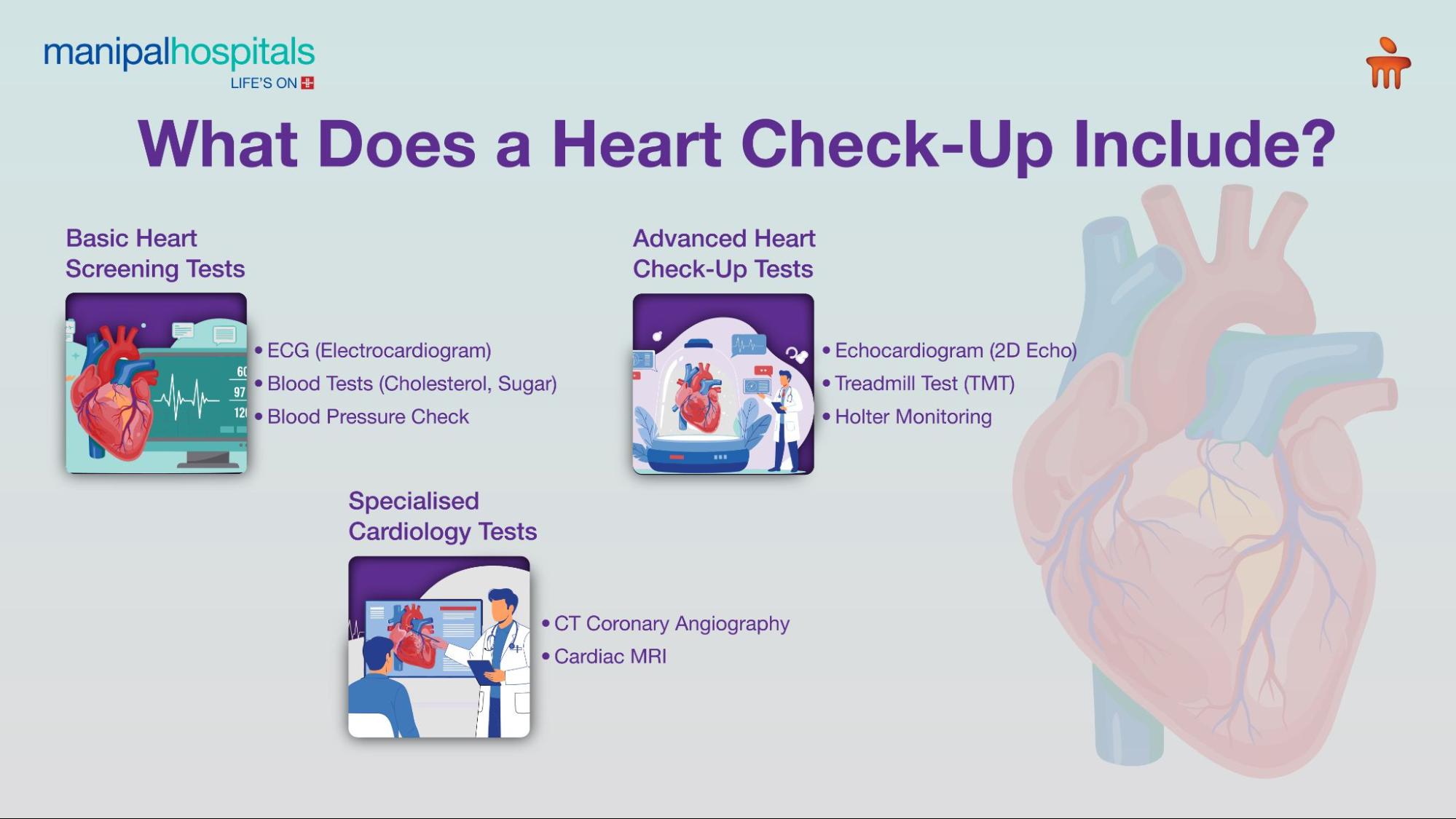
What Actually Happens in a Heart Check-Up?
Many people feel a heart checkup is complicated or only for older people. But that’s not true. It’s usually a simple combination of basic and advanced cardiology tests depending on your health.
Let me walk you through the common heart checkup tests in a very simple way.
1. ECG (Electrocardiogram)
This is usually the first step in any heart function test.
It’s quick, painless, and takes just a few minutes. Small electrodes are placed on your chest to check how your heart is beating.
Doctors use it to:
-
Detect irregular heart rhythms
-
Check if there was any past silent heart issue
-
Evaluate chest pain
This is why people often hear about ECG and echocardiograms together during a check-up.
2. Echocardiogram (2D Echo)
Now this one gives a clearer picture literally.
It’s like an ultrasound of your heart that shows the following:
-
How well your heart is pumping
-
Whether valves are working properly
-
If there’s any structural issue
Among all types of heart tests, this one gives very detailed information.
3. Treadmill Test (TMT)
This is the test people usually get nervous about but it’s quite safe.
You walk on a treadmill while your heart activity is monitored. The idea is simple: to see how your heart performs under stress.
It helps in:
-
Detecting early signs of blockage (commonly called a heart blockage test)
-
Understanding exercise tolerance
-
Identifying hidden symptoms
4. Blood Tests
A proper heart health test is incomplete without blood work.
These tests check:
-
Cholesterol levels
-
Blood sugar
-
Triglycerides
They play a major role in preventive cardiac exams because they highlight risk factors before disease develops.
5. Holter Monitoring
Sometimes, heart issues don’t show up in a 5-minute ECG.
That’s where this test helps.
You wear a small device for 24 hours that records your heart rhythm continuously. It’s useful for detecting irregular heartbeats that come and go.
6. CT Scan / Advanced Heart Tests
In some cases, doctors may suggest advanced heart screening tests like CT coronary angiography.
These are more detailed and help in:
-
Checking artery blockages
-
Early diagnosis of heart disease
So, Who Should Actually Get These Tests Done?
This is the most common question.
Honestly, you don’t need to wait for symptoms. A heart checkup is for anyone who wants to stay ahead.
-
You should definitely consider it if:
-
You are above 30–40 years old.
-
You have a stressful or sedentary lifestyle
-
You smoke or consume alcohol regularly
-
You have diabetes, BP, or high cholesterol
-
There’s a family history of heart disease
And most importantly—if you feel symptoms like chest pain, palpitations, or breathlessness, don’t delay. You may need immediate heart function tests or even a heart blockage test.
How Often Should You Do a Heart Check-Up?
There’s no one-size-fits-all answer, but a simple approach works:
-
In your 20s–30s → once every 2–3 years (if healthy)
-
30–45 years → every 1–2 years
-
45+ or high-risk → once every year
Doctors at Manipal Hospital Baner usually personalise this based on your health and lifestyle.
A Small Real-Life Story
One patient I remember is Amit, 36, working in IT.
No major complaints. Just occasional tiredness, which he ignored. His company arranged a routine heart checkup at Manipal Hospital Baner.
His treadmill test showed early warning signs. Further cardiology tests confirmed a minor blockage.
The good part? It was caught early.
With simple lifestyle changes and medication, he avoided a major heart issue. That’s the power of preventive cardiac exams.
Simple Habits That Go a Long Way
Along with regular heart checkup tests, small daily habits matter a lot:
-
Walk or exercise for at least 30 minutes
-
Eat home-cooked, balanced meals
-
Reduce stress (even 10 minutes of meditation helps)
-
Quit smoking
-
Keep BP and sugar under control
Your heart doesn’t need perfection just consistency.
If there’s one thing to take away, it’s this: don’t wait for symptoms.
A simple heart health test, including ECG and echocardiogram, can give you clarity, peace of mind, and sometimes even save your life.
At Manipal Hospital Baner, the focus is not just on treatment, but on early detection and prevention through the right types of heart tests and accurate risk assessment for heart disease.
Take that step. Book your heart checkup. Your future self will thank you.
FAQ's
A heart checkup usually includes an ECG, echocardiogram, blood tests, and sometimes a treadmill test or advanced scans.
Yes, it helps detect reduced blood flow and is often used as a heart blockage test.
No, most heart screening tests are simple, safe, and painless.
Absolutely. In fact, preventive cardiac exams are meant for early detection before symptoms appear.
It usually takes around 1–3 hours depending on the number of heart checkup tests included.
Share this article on: