8 Min Read
Is the world starting to sound muffled? or
Do you find yourself turning the TV volume up higher or constantly asking people to repeat themselves?
If this sounds familiar, you are not alone, and more importantly, you are getting older in a different way than you might think.
Adult hearing loss is incredibly common, but it is also widely misunderstood. Many people wait years before addressing it, simply because they don't recognize the early signs or assume nothing can be done.
In this blog, we are going to walk through everything you need to know. We will cover the subtle early signs of hearing loss and break down the different types, like age-related hearing loss and conductive hearing loss treatment options available.
Synopsis
Hearing Loss in Adults
When a person is partially or completely unable to hear sounds in one or both ears, it’s referred to as hearing loss. It can result from damage to the nerve pathways, ear, or the sound conduction mechanism. The severity of hearing loss ranges from mild to profound. It makes it difficult for a person to understand speech, especially if the environment is noisy.
Recognising the Early Signs of Hearing Loss
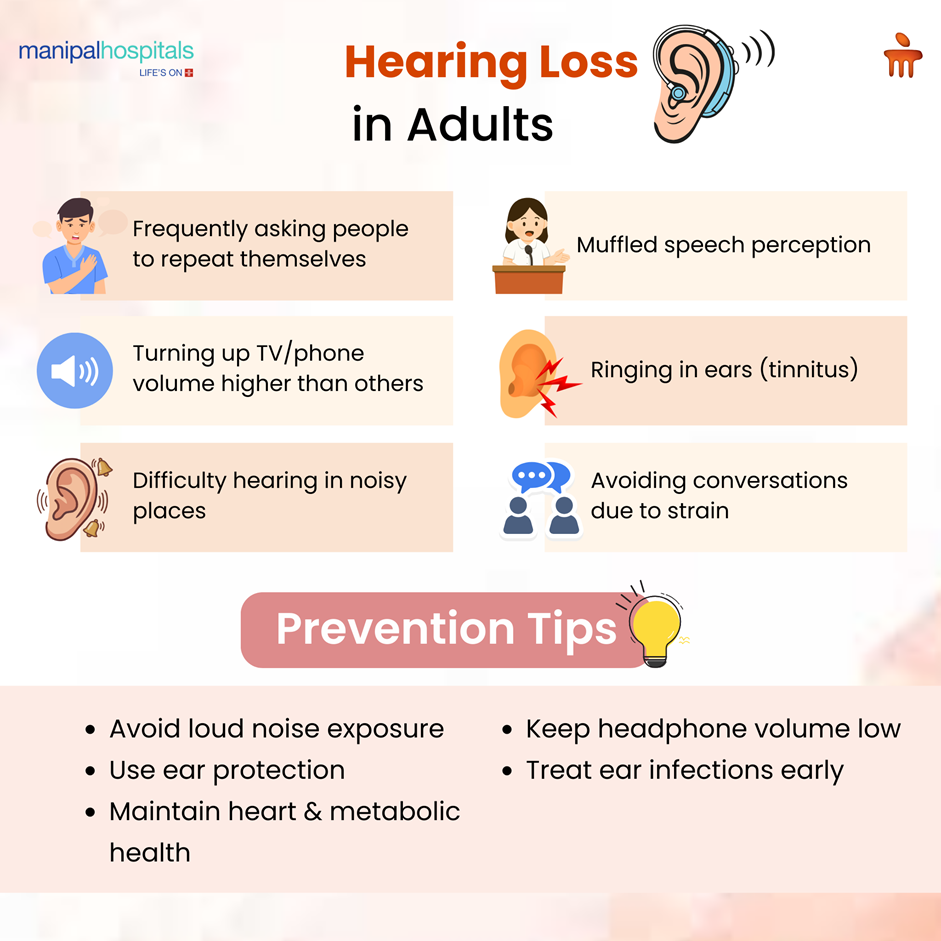
Hearing loss usually doesn't happen overnight. It creeps up so gradually that you might not notice it yourself. Often, it is family and friends who notice it first. Here are the signs you should be paying attention to:
-
Asking others to repeat, especially in background noise.
-
Turning up the TV or radio volume more than others do.
-
Difficulty following group conversations, especially with multiple talkers.
-
Trouble hearing on the phone or missing doorbells and timers.
-
Perceiving muffled speech or that people “mumble.”
-
Tinnitus: ringing, buzzing, or hissing in the ears.
-
Avoiding noisy places because they’re exhausting to follow.
If you recognise a few of these, it’s worth booking a hearing check. Early problems often have simple hearing loss treatment paths.
Main Types and Causes of Adult Hearing Loss
Not all hearing loss is the same. Understanding the type helps pick the right hearing loss treatment for your specific situation. The following are the main types:
Conductive Hearing Loss
Occurs when sound cannot reach the inner ear efficiently. Causes include earwax blockage, middle-ear infections, fluid, a perforated eardrum, or otosclerosis. Good news: many causes are reversible with conductive hearing loss treatment, such as ear cleaning, antibiotics, or minor surgery.
Sensorineural Hearing Loss
Results from damage to the inner ear (cochlea) or auditory nerve. The two main drivers are:
-
Age-related hearing loss (presbycusis): a gradual loss from ageing of hair cells in the cochlea.
-
Noise-induced hearing loss: damage from loud sounds over time or a single loud event.
Sensorineural loss is usually permanent, but modern hearing loss treatments (hearing aids, cochlear implants) restore access to sound.
Mixed Hearing Loss
A combination of conductive and sensorineural elements. Treat the reversible conductive part first, then address residual sensorineural loss.
How Is Hearing Evaluated?
If you are worried about your hearing, the first step is a proper evaluation. A clear, stepwise assessment guides your treatment. Here is what typically happens:
-
History and symptom review: when symptoms began, noise exposure, medications, and tinnitus.
-
Otoscopy: A simple inspection of the ear canal and eardrum often reveals wax or infection.
-
Pure-tone audiometry: the gold-standard hearing test measuring thresholds across frequencies.
-
Speech audiometry: tests understanding of speech in quiet and noise.
-
Tympanometry and middle-ear tests: assess middle-ear function for conductive causes.
-
Special tests: (ABR, otoacoustic emissions) or imaging when there’s asymmetric loss or neurological concerns.
Testing is painless and typically completed in an hour. Results map directly to suitable hearing loss treatment options.
Why Early Detection of Hearing Loss Matters
Think about how much of your day relies on hearing. The morning alarm, the conversation at breakfast, the traffic while driving, the meeting at work, and the laughter with friends in the evening.
Hearing is social currency: it keeps conversations flowing, safety alerts noticeable, and relationships close. Untreated hearing loss affects communication, mood, and even cognitive health. But here is what most people don't realise: untreated hearing loss affects more than just communication. Research has linked it to mood changes, increased anxiety, and even faster cognitive decline. Your brain works harder to process fragmented sound, stealing energy from memory and thinking.
But the positive news is that detecting decline early expands your options dramatically. Reversible causes can be fixed quickly; hearing aids work better when fitted earlier, and people adapt more easily. Early action makes hearing loss treatment more effective and less disruptive to daily life.
Practical, Modern Solutions: Matching Treatment to Cause
Treatment is never one-size-fits-all. Here’s how common problems are approached.
Reversible/Medical Treatments
-
Earwax Removal: Microsuction or irrigation quickly restores hearing in many cases.
-
Medical Management: Antibiotics for middle-ear infection or steroids for sudden sensorineural loss (when given early).
-
Minor Surgery: Myringotomy for persistent middle-ear effusion or stapedotomy for otosclerosis.
These conductive hearing loss treatment approaches often deliver rapid improvement.
Hearing Aids: First-Line for Sensorineural Loss
Hearing aids are the most common hearing loss treatment for adults with permanent loss. Modern devices are:
-
Small, discreet, and comfortable.
-
Highly programmable and noise-aware, improving speech intelligibility in noisy settings.
-
Available as behind-the-ear (BTE), in-the-ear (ITE), or invisible-in-canal options.
-
Often connect to phones and TVs via Bluetooth.
A proper hearing aid fitting includes verification (real-ear measures), a trial period, and follow-up. Early adoption leads to better long-term outcomes. Support and training are also a part of effective hearing loss treatment.
Assistive Listening Devices and Apps
-
TV streamers, remote microphones, and loop systems improve listening in specific situations.
-
Smartphone apps can help with hearing in noise and remote fine-tuning.
These tools complement hearing aids or help when a hearing aid isn’t being used.
Cochlear Implants for Severe Loss
When hearing aids no longer provide a benefit for severe-to-profound sensorineural loss, cochlear implants restore hearing by electrically stimulating the auditory nerve. Outcomes are excellent for many adults, especially with early implantation and rehabilitation.
Tinnitus Management
Tinnitus often accompanies hearing loss. Management is multi-pronged: hearing aids, sound therapy, CBT-based strategies, and specialist tinnitus clinics.
Prevention: How To Prevent Hearing Loss
While not all hearing loss is preventable, you have more control than you might realize. Knowing how to prevent hearing loss is one of the most powerful tools you have for long-term ear health.
-
Limit loud noise exposure: use hearing protection at work and for noisy leisure activities.
-
Follow safe listening habits: keep personal audio devices at safe volumes and take listening breaks.
-
Treat ear infections promptly and avoid inserting objects into the ear canal.
-
Monitor ototoxic medications with your doctor if long-term treatment is required.
-
Keep cardiovascular and metabolic health in check: good circulation supports cochlear function.
Conclusion
Hearing loss in adults is common but manageable. Spotting early signs—difficulty in noise, turning up volumes, and tinnitus—opens the door to reversible fixes and effective hearing loss treatment. Whether it’s simple earwax removal, a fitted hearing aid, or advanced cochlear implant care, modern options restore communication and quality of life. Protect your hearing with safe listening and regular checks, and seek assessment early if you notice a change. For expert audiology and ENT services, including hearing loss treatment in Whitefield, contact Manipal Hospital Whitefield, where experienced specialists use the latest technology to help you hear the world clearly again.
FAQ's
If you struggle to follow conversations, especially in noisy places, or rely on higher volumes, a hearing test will show whether hearing aids will help and by how much.
Yes: impacted earwax commonly causes muffled hearing and fullness; microsuction or gentle removal by a clinician often restores normal hearing immediately.
Hearing aids often reduce tinnitus perception by improving sound input and reducing listening effort; combined sound therapy and counselling may also help.
Not entirely, but protecting ears from loud noise, managing cardiovascular health, and avoiding ototoxic drugs can slow progression and preserve hearing longer.
Many adults notice speech clarity within weeks, but full benefit requires rehabilitation and varies individually; the implant team provides training and support.
Share this article on: