


 8 Min Read
Changes inside your mouth can be easy to overlook at first. A minor ulcer that is not healing, some discoloration, or slight discomfort while eating that does not seem significant right away. However, these subtle changes may be a sign that something may need attention.
Mouth cancer is not always immediately apparent. It often starts gently, with signs that seem harmless or temporary. This is why understanding the early changes matters so much. Recognising mouth cancer symptoms at the right time can make a significant difference in how smoothly treatment progresses and how well you recover.
This blog walks you through what mouth cancer is, how it develops, the signs of mouth cancer you should watch for, what happens in the starting stage, and the treatment options available today. This way, you can feel informed, prepared, and supported every step of the way.
Synopsis
- What Is Mouth Cancer?
- Early Changes: What Happens in the Mouth Cancer Starting Stage
- Mouth Cancer Symptoms You Should Not Ignore
- Red Vs White Patches Inside Mouth
- Why Does Mouth Cancer Develop?
- How is Mouth Cancer Diagnosed?
- Mouth Cancer Treatment Options
- Recovery and Rehabilitation: What Comes After Treatment
- Treatment Planning Snapshot: What Influences Your Care?
- Conclusion
What Is Mouth Cancer?
Mouth cancer, also known as oral cancer, is a condition where there is abnormal and uncontrolled cell growth in the mouth. This can include the lips, tongue, inner cheeks, gums, floor of the mouth, or the roof of the mouth. It belongs to a broader group of head and neck cancers, but has its own distinct patterns of development.
In most cases, mouth cancer develops slowly. Cells begin to change at a microscopic level before forming visible lesions. These changes may initially appear as harmless patches or sores, which is why they’re often ignored in the early days.
Over time, if left untreated, these abnormal cells can grow deeper into tissues and spread to nearby structures such as the throat or lymph nodes. Early awareness allows for intervention before the disease progresses further.
Early Changes: What Happens in the Mouth Cancer Starting Stage
The early phase often has subtle signs and is easy to dismiss. You might notice something unusual, but not necessarily painful or alarming. This stage is where timely attention can truly change outcomes.
In the mouth cancer starting stage, common observations include:
-
Persistent ulcers that do not heal within two weeks
-
Red or white patches inside the mouth
-
Mild thickening of tissue or a small lump
-
Slight discomfort while chewing or swallowing
-
A feeling that something is “not quite right” in one area
What makes this stage tricky is the absence of severe pain. Many people continue with their routine, assuming it will resolve on its own. However, this is precisely when early evaluation can lead to simpler and more effective care.
Mouth Cancer Symptoms You Should Not Ignore
As the condition progresses, symptoms become more noticeable and harder to overlook. Knowing the symptoms of mouth cancer helps you seek timely medical attention.
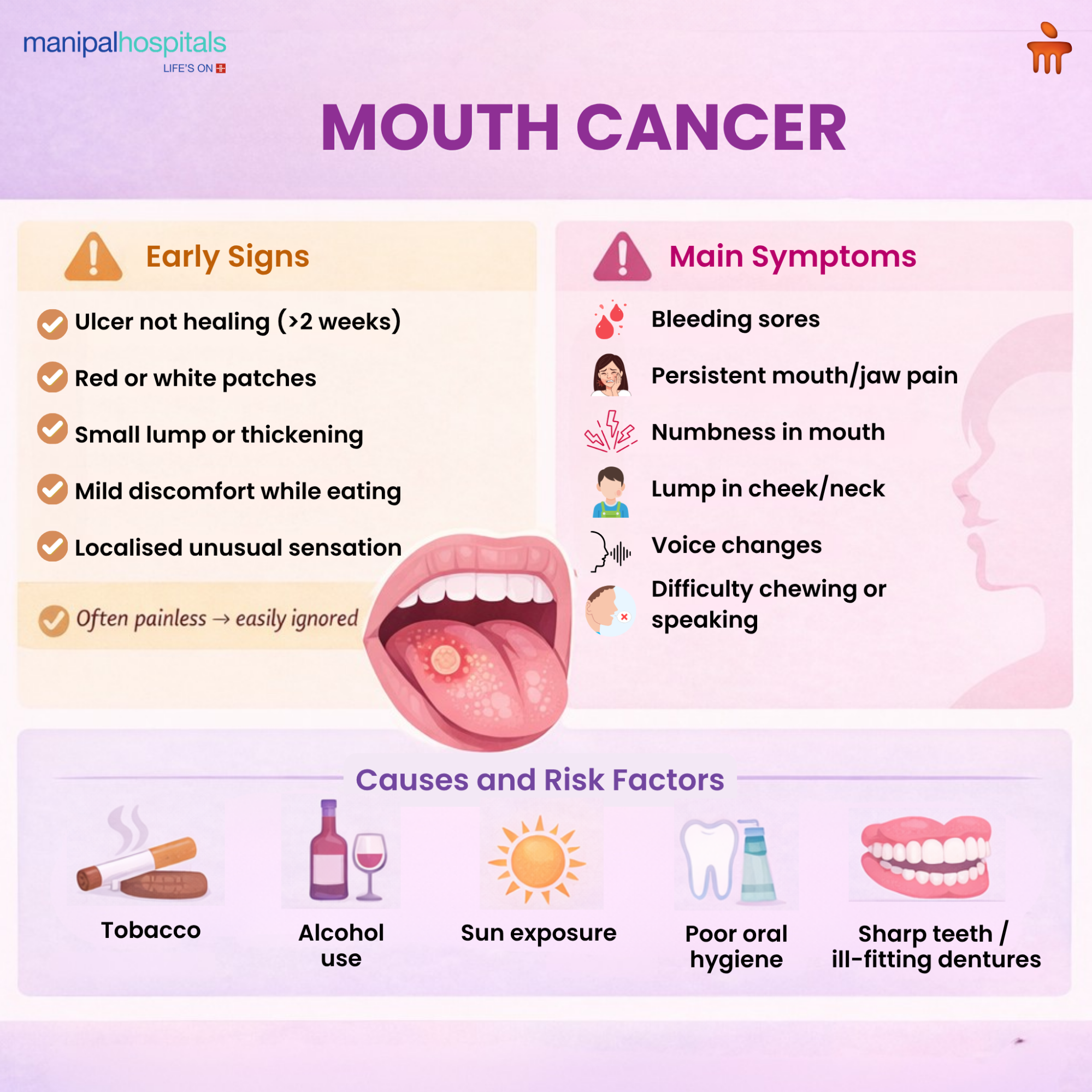
You may experience the following mouth cancer symptoms:
-
A sore or ulcer that easily bleeds
-
Pain in the mouth or jaw that lasts
-
Trouble moving the tongue or opening the mouth widely
-
Numbness in some parts of the mouth
-
A lump in the cheek or neck
-
Change in voice or clarity of speech
The more specific symptoms of mouth cancer include a growth that keeps changing size or texture, or the feeling of a firm lump when touched. If eating, speaking, or even opening your mouth or brushing your teeth has become uncomfortable, then it is time to consult with a specialist. While these symptoms don’t always mean cancer, they do mean your body needs to be checked carefully.
Red Vs White Patches Inside Mouth
Not every patch inside the mouth means the same thing, and the colour can sometimes give an early clue about what is going on.
-
White patches are often called leukoplakia. They may look thick, rough, or slightly raised, and they usually do not wipe off easily.
-
Red patches, known as erythroplakia, are less common, but they tend to draw more attention because they can sometimes be linked to more significant changes in the mouth lining.
If either type of patch stays in place, it should be checked by a doctor or dentist, especially if there is pain, irritation, bleeding, or any change in size or texture.
Why Does Mouth Cancer Develop?
Understanding the underlying causes can help you recognise risk factors in your own lifestyle. Mouth cancer usually develops due to long-term irritation or exposure to harmful substances that damage the cells lining the mouth.
Some of the most common factors include:
-
Consuming tobacco in any form, be it smoking or chewing
-
Excessive consumption of alcohol
-
Excessive exposure to the sun's rays, especially in the case of lip cancer
-
Presence of the Human Papillomavirus infection
-
Poor oral hygiene, or irritation from sharp or broken teeth or ill-fitting dentures
Not all people with these risk factors will develop mouth cancer. On the other hand, a person may get diagnosed with mouth cancer despite not being exposed to such risk factors.
How is Mouth Cancer Diagnosed?
Trying to get a clear picture of what is going on in your mouth often starts with a basic examination. A doctor or qualified medical professional will perform a detailed examination of your mouth, possibly asking you how long you have been experiencing your symptoms. If something is not right, further investigations may be needed, which include:
-
A biopsy, where a small sample is examined under a microscope
-
Imaging tests, such as a CT scan or MRI, to assess how far it has spread
-
Checking your lymph nodes
Diagnosing your cancer is not just about identifying that you have it. It is also about identifying how far it has spread. This will allow your doctor to decide on the best mouth cancer treatment that is right for you.
Mouth Cancer Treatment Options
Mouth cancer treatment is planned meticulously depending on the stage, location, and your general health. It aims not only to remove the cancer but also to preserve functions such as speech and swallowing. Here are the primary approaches used in mouth cancer treatment:
-
Surgery: Removal of the tumour along with a margin of healthy tissue. In some cases, reconstructive procedures may be needed to restore appearance and function.
-
Radiation therapy: High-energy rays are used to target and destroy cancer cells. This is often used after surgery or as the primary approach to treating cancer in some cases.
-
Chemotherapy: Medicines are used to kill cancer cells or slow their growth. This is often done in combination with radiation for more effective results.
-
Targeted Therapy: This targets specific molecules involved in cancer growth, allowing more precise treatment in selected cases.
All these treatment approaches are individualised, meaning they balance how well they work with your quality of life in particular, rather than being a universal approach applicable to all affected individuals.
Recovery and Rehabilitation: What Comes After Treatment
The process of healing does not end with the completion of your treatment. The recovery process is equally significant and may involve a mix of physical and emotional adjustments.
You may require support with:
-
Speech and swallowing therapy
-
Nutritional counselling to build your strength
-
Regular check-ups to monitor your condition for any recurrence of cancer
-
Emotional support to cope with your condition
The process of recovery is gradual, and some days may feel worse than others. However, with proper support and care, it is possible to get your life back to normal.
Treatment Planning Snapshot: What Influences Your Care?
Treatment in Malleshwaram for mouth cancer is never one-size-fits-all. Several medical and personal factors come together to shape a plan that suits your specific condition and overall health. Knowing more about the factors that affect these decisions can make you feel more involved in your care process.
|
Factor Considered |
Why It Matters |
How It Affects Decisions |
|
Tumour Location |
Different areas affect speech, swallowing, and appearance differently |
Determines surgical approach and need for reconstruction |
|
Depth of Invasion |
Indicates how deeply cancer has spread into tissues |
Guides the intensity of treatment required |
|
Lymph Node Involvement |
Suggests whether cancer has started spreading |
May require additional surgery or radiation |
|
Overall Health |
Pre-existing conditions can impact treatment tolerance |
Influences the choice between aggressive and balanced approaches |
|
Nutritional Status |
Affects healing and recovery speed |
May require pre-treatment nutritional support |
Conclusion
Paying attention to early changes in your mouth can make all the difference. What may seem like a minor irritation today could be something that needs timely care. Recognising mouth cancer symptoms and understanding its stages allows you to act early, when treatment is more manageable, and outcomes are often better. If you notice any persistent changes, don’t wait them out. Seeking medical advice early brings clarity and reassurance.
For those looking for mouth cancer treatment, visit our expert cancer specialist at Manipal Hospital Malleshwaram, Bangalore, for guidance throughout your journey to recovery.
FAQ's
Yes, it often does. Early mouth cancer may present as a painless ulcer or patch, which is why many people ignore it. Pain usually appears later as the condition progresses.
No, most mouth ulcers are harmless and usually heal in 1-2 weeks. However, if an ulcer persists longer than 2 weeks or changes in appearance, it should be checked.
While it is more common in older people, mouth cancer can also affect younger people, especially if other risk factors are present, such as tobacco or HPV.
Absolutely! Dentists often notice changes in the mouth during routine check-ups and are often the first to suspect mouth cancer.
Recovery varies from person to person. While some adjustments may be needed initially, many people return to their daily routines with the right rehabilitation and support.
Share this article on:


