7 Min Read
When facing bone cancer or aggressive tumours such as osteosarcoma, many patients fear losing a limb. However, modern oncology has evolved significantly, and limb salvage surgery offers hope by preserving the affected arm or leg while effectively treating the disease. At Manipal Hospital Kharadi, this advanced surgical approach is helping patients regain mobility, confidence, and quality of life.
Let’s break this down in a simple, human, and practical way.
Synopsis
- What is limb salvage surgery?
- Why Is Limb Salvage Surgery Done?
- Limb Salvage Surgery Procedure: Step-by-Step
- Limb Salvage Surgery for Osteosarcoma
- Benefits of Limb Salvage Surgery
- Limb Salvage Surgery Success Rate
- Limb Salvage Surgery Recovery
- Life After Limb Salvage Surgery
- Why Choose Manipal Hospital Kharadi?
What is limb salvage surgery?
Limb salvage surgery is a specialised procedure used to remove cancerous tumors from bones or soft tissues without amputating the limb. Instead of removing the entire arm or leg, surgeons carefully excise the tumor and reconstruct the affected area using implants, bone grafts, or prosthetics.
It is most commonly performed for:
-
Osteosarcoma (bone cancer)
-
Soft tissue sarcomas
-
Certain benign but aggressive bone tumours
Why Is Limb Salvage Surgery Done?
Doctors recommend limb salvage surgery for bone cancer when
-
The tumour is localised and hasn’t spread extensively
-
Major nerves and blood vessels are not heavily involved
-
The limb can still function after tumour removal
In many cases, chemotherapy or radiation therapy is given before surgery to shrink the tumour and improve outcomes.
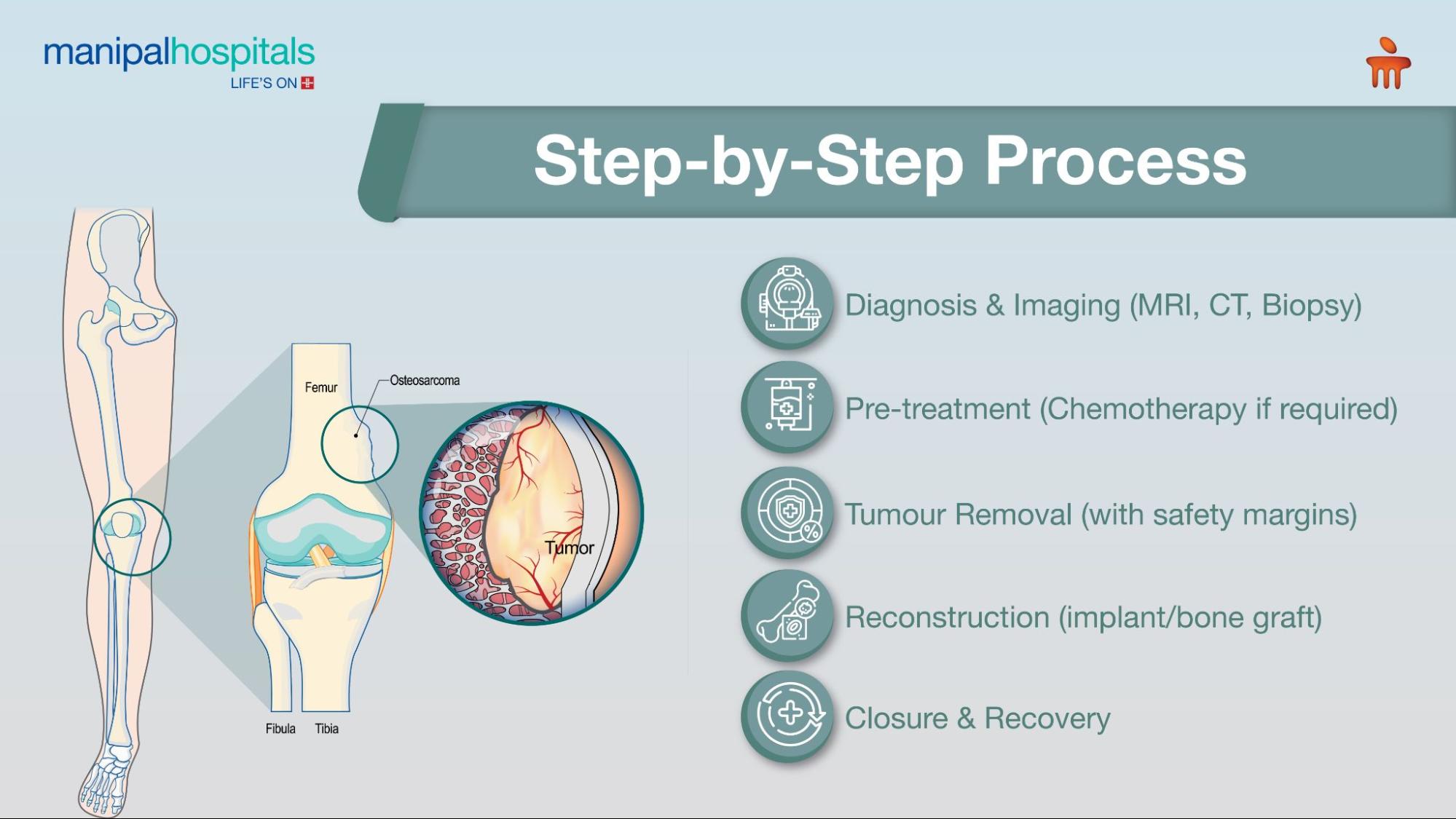
Limb Salvage Surgery Procedure: Step-by-Step
Understanding the limb salvage surgery procedure can ease anxiety.
1. Pre-Surgical Planning
-
Imaging tests like MRI, CT scans, and X-rays
-
Biopsy to confirm cancer type
-
Chemotherapy (in some cases)
2. Tumour Removal
-
The surgeon removes the tumour along with a margin of healthy tissue
-
This ensures no cancer cells are left behind
3. Reconstruction
After removal, the bone or tissue is rebuilt using:
-
Metal implants (prostheses)
-
Bone grafts (from donor or patient)
-
A combination of both
4. Closure and Recovery
-
The surgical site is closed carefully
-
Drainage tubes may be placed temporarily
Limb Salvage Surgery for Osteosarcoma
Limb salvage surgery for osteosarcoma is one of the most common applications of this procedure. Previously, amputation was the standard treatment. Today, over 80–90% of patients with osteosarcoma can undergo limb-preserving surgery.
This approach:
-
Maintains limb appearance
-
Allows better functional recovery
-
Improves psychological well-being
Benefits of Limb Salvage Surgery
Choosing limb salvage surgery offers several advantages:
1. Limb Preservation
The biggest benefit is avoiding amputation and retaining the natural limb.
2. Better Quality of Life
Patients can perform daily activities more independently.
3. Improved Emotional Health
Keeping the limb reduces emotional trauma and boosts confidence.
4. Comparable Survival Rates
In many cases, the limb salvage surgery success rate is similar to amputation when combined with proper cancer treatment.
Risks and Complications
Like any major surgery, limb salvage surgery carries certain risks:
-
Infection at the surgical site
-
Implant failure or loosening
-
Limited mobility or stiffness
-
Nerve damage (rare)
-
Cancer recurrence
However, with experienced cancer care specialists in kharadi, pune at Manipal Hospital these risks are carefully managed.
Limb Salvage Surgery Success Rate
The limb salvage surgery success rate depends on several factors:
-
Type and stage of cancer
-
Patient’s age and overall health
-
Response to chemotherapy
In general:
-
Survival rates are comparable to amputation
-
Functional outcomes are often significantly better
-
Most patients regain good mobility with rehabilitation
Limb Salvage Surgery Recovery
Limb salvage surgery recovery is a gradual process that requires patience and commitment.
Hospital Stay
- Usually 1–2 weeks, depending on the case
Initial Recovery
-
Pain management and wound care
-
Limited movement initially
Physiotherapy
-
Starts early to regain strength and flexibility
-
Critical for long-term success
Full Recovery Timeline
-
3 to 6 months for basic recovery
-
Up to 1 year for optimal function
Life After Limb Salvage Surgery
Patients often ask, "Will I be able to walk or use my limb normally?”
The answer is yes, in many cases.
With proper rehabilitation:
-
Most patients walk independently
-
Children can return to school and sports (with precautions)
-
Adults can resume work and daily activities
However, high-impact activities may be limited depending on the reconstruction type.
Limb salvage surgery may not be suitable if
-
The tumour involves major nerves or blood vessels
-
Infection is severe
-
Cancer has spread extensively
-
Limb function cannot be preserved
In such cases, doctors may recommend alternative treatments like amputation for better survival outcomes.
Why Choose Manipal Hospital Kharadi?
At Manipal Hospital Kharadi, patients benefit from:
-
Advanced imaging and diagnostic tools
-
Experienced orthopaedic oncology surgeons
-
Personalised cancer care plans
-
Dedicated physiotherapy and rehabilitation support
The goal is not just to treat cancer but to help patients live fully after treatment.
Limb salvage surgery has transformed cancer care by offering patients a chance to fight the disease without losing a limb. Whether it’s limb salvage surgery for osteosarcoma or other bone cancers, this procedure combines surgical precision with compassionate care.
If you or a loved one is facing bone cancer, early consultation can open the door to limb-preserving treatment options and better outcomes.
FAQ's
It is a procedure to remove cancerous tumours while preserving the affected limb instead of amputating it.
Yes, when performed by experienced surgeons, it is a safe and effective treatment with success rates.
Basic recovery takes 3–6 months, but full functional recovery may take up to a year.
The limb salvage surgery success rate is high and comparable to amputation in terms of survival, especially for osteosarcoma.
There is a small risk of recurrence, which is why regular follow-ups and monitoring are essential.
Share this article on: